What is SAP Master Data Governance?
SAP Master Data Governance is the discipline of keeping the core records that drive your business accurate, consistent, and trusted across SAP.
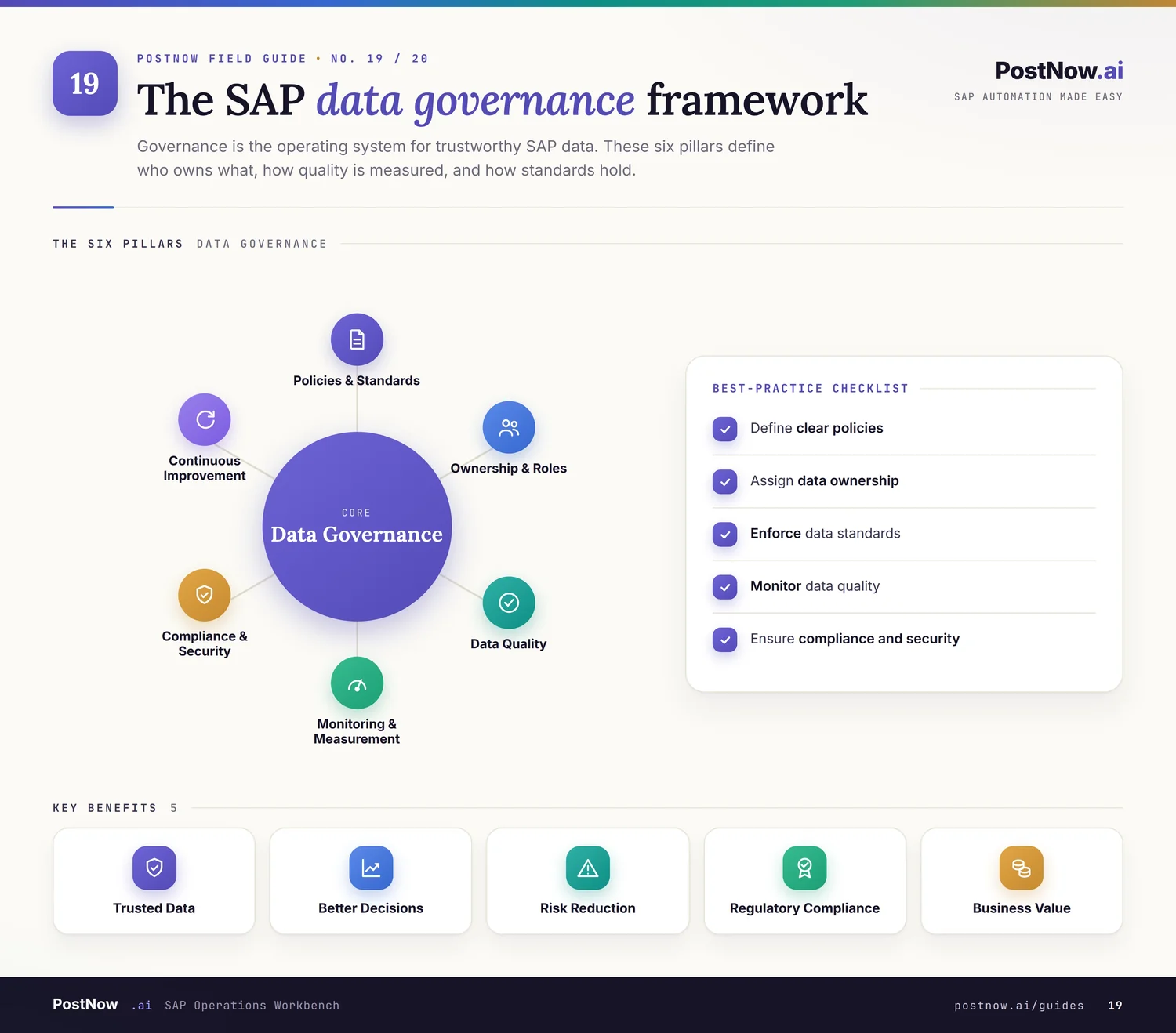
Master data describes the people, places, and things your processes rely on: vendors, customers, materials, business partners, and the finance objects behind them. Unlike transactional data, these records are created once and reused thousands of times, so a single bad field can affect every document that touches it.
Governance is not one transaction or one screen. It is the combination of rules, ownership, and controls, supported by tooling, that decides who can create or change a record, what valid data looks like, and how every change is checked and recorded.
Why SAP Master Data Governance matters
Master data sits upstream of almost every SAP process. When it is wrong, the damage shows up far downstream and is expensive to unwind.
A duplicated vendor can route a payment to the wrong bank account. A material with a missing view can block a sales order. An inconsistent tax field can produce a non compliant invoice. None of these are obvious at the point of data entry, which is exactly why governance matters.
Fewer errors
Standards and validation stop bad records before they reach live SAP tables.
Faster onboarding
Clear ownership and templates cut the time to create and approve new records.
Audit ready
Every change is approved and logged, so audits and reporting are easy to defend.
Strong governance also builds trust in analytics. Leaders only act on reports when they believe the underlying master data is clean, and that belief is earned through consistent controls.
SAP Master Data Governance vs SAP Master Data Management
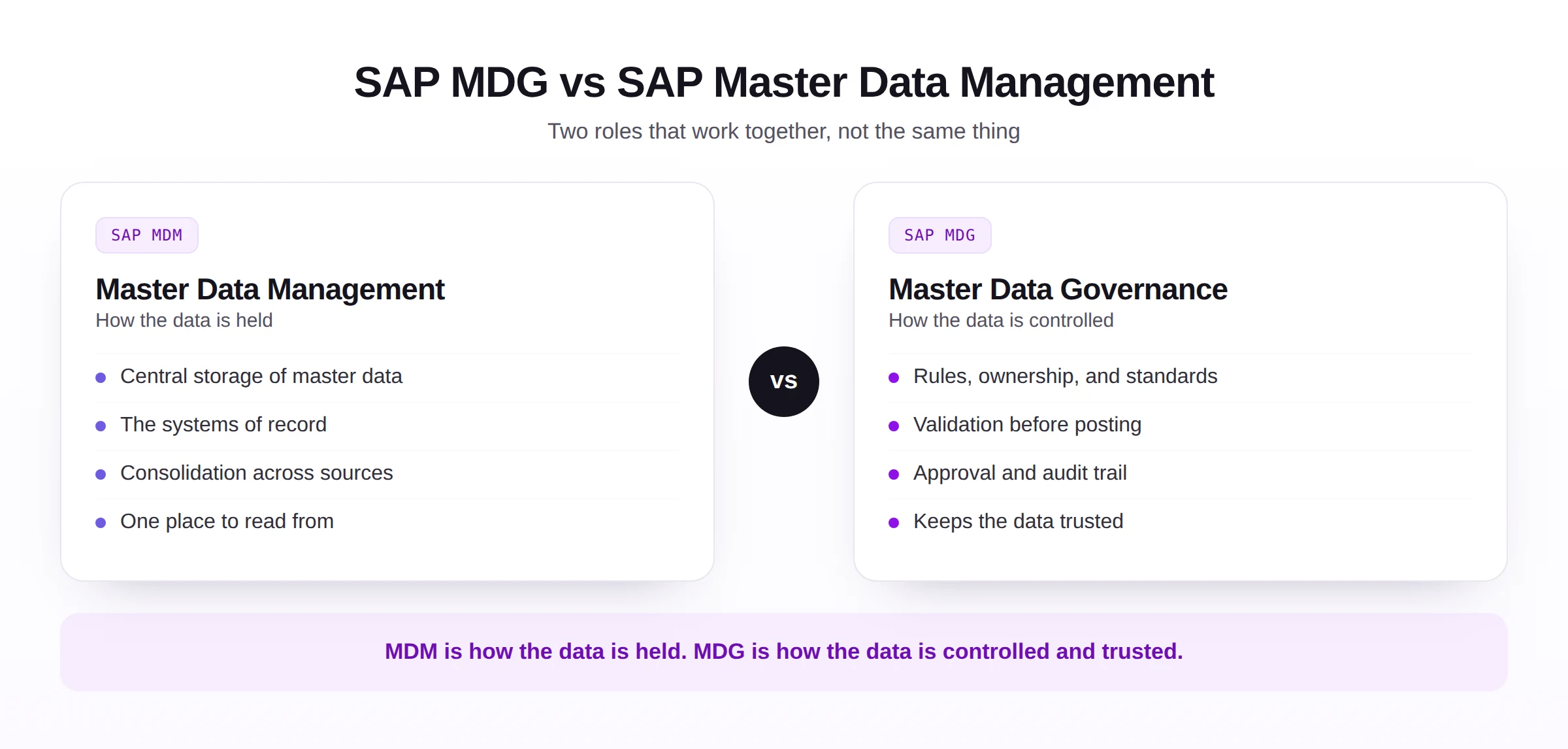
These two terms are often used as if they were the same, but they describe different things that work best together.
Master data management is concerned with where the data lives and how it is maintained. Governance is concerned with the rules, ownership, and approvals that keep that data trustworthy.
| Aspect | Master Data Management (MDM) | Master Data Governance (MDG) |
|---|---|---|
| Core question | Where does the data live and how is it maintained? | Who owns it and how is it kept trustworthy? |
| Focus | Storage, structure, and distribution | Policies, ownership, approval, and audit |
| Typical owner | IT and data platform teams | Business owners and data stewards |
| Outcome | Records exist and are accessible | Records are accurate, compliant, and trusted |
What is SAP MDG (Master Data Governance)?
SAP MDG, short for SAP Master Data Governance, is the SAP application built to create, validate, and govern master data from one central place. The rules live inside your SAP landscape, so they travel with the record instead of sitting in a separate file.
People often use the terms "SAP MDG" and "master data governance" as if they mean the same thing. They do not. One is a discipline. The other is a product that delivers that discipline inside SAP.
As an SAP solution, SAP MDG ships as a licensed module that runs on SAP S/4HANA or as a standalone governance hub. It governs domains such as business partner, material, and finance objects, and it reuses the same data model your transactions already depend on.
The SAP MDG workflow never lets data drop straight into the active tables. Every create or change request moves through defined stages first:
Across those stages, the core SAP MDG capabilities include:
- Central governance of several master data domains from one place.
- Rule based validation that tests values against live SAP before anything posts.
- Approval and change request routing with clear ownership.
- A full audit trail showing who changed what, and when.
- Data quality scoring and dashboards to track the health of each object.
- Controlled replication so governed data stays consistent across systems.
SAP MDG vs general governance practices. General master data governance is a set of practices: the policies, ownership, and review any organization can apply, even with standards documents and manual checks. SAP MDG is the productized version of those practices, with the workflow engine, validations, and audit trail built into SAP.
When organizations implement SAP MDG. Most SAP MDG implementations begin when manual governance stops scaling. Common triggers include:
- High volumes of master data spread across many systems.
- Regulated industries where audit and compliance pressure is constant.
- Several SAP instances that must be kept in sync.
- A merger, carve out, or move to S/4HANA that forces a data cleanup.
- The aftermath of a costly data quality incident.
Benefits of SAP Master Data Governance
Strong governance is not abstract. MIT Sloan Management Review research estimates that bad data costs a typical company 15 to 25 percent of revenue, so the gains below land directly on operations and the bottom line. Source: MIT Sloan Management Review.
Improved data quality
Standards and validation are applied before a record is saved, so fields are complete and consistent from the start instead of being cleaned up later.
Fewer duplicate records
Checks against existing master data catch a vendor or customer that already exists, so spend and history stay under a single record.
Faster onboarding
A governed template and automated validation turn a slow back and forth into one reviewed load, so new vendors and customers go live sooner.
Compliance and audit readiness
Every change is approved and logged, so segregation of duties holds and an auditor can see who changed what and when.
More accurate reporting
When the underlying master data is clean and deduplicated, spend analysis, tax, and management reporting line up instead of needing reconciliation.
Lower operational costs
Catching errors at entry removes the rework, blocked documents, and support tickets that bad records create downstream.
Better decision making
Leaders act on numbers they trust, because the records behind them are governed, current, and consistent across SAP.
Common master data governance challenges
Most data quality problems trace back to a handful of recurring issues. Naming them is the first step to controlling them.
Types of SAP master data that need governance
Different objects carry different risks, so governance focuses on what matters most for each one.
| Object | Key | Governance focus |
|---|---|---|
| Vendor master | LFA1 | Bank details, duplicates, payment terms, and blocking |
| Customer master | KNA1 | Credit, tax, and consistent sales and company code views |
| Material master | MARA | Complete views, units of measure, and classification |
| Business partner | BP | Roles, relationships, and customer or vendor integration |
| Cost center | CSKS | Hierarchy, validity periods, and responsible owners |
| Profit center | CEPC | Assignments and alignment to the controlling area |
| G/L account master | SKA1 | Chart of accounts consistency and field status control |
The master data lifecycle
Governance is not a one time clean up. It applies at every stage of a record's life, from the moment it is requested to the day it is retired.
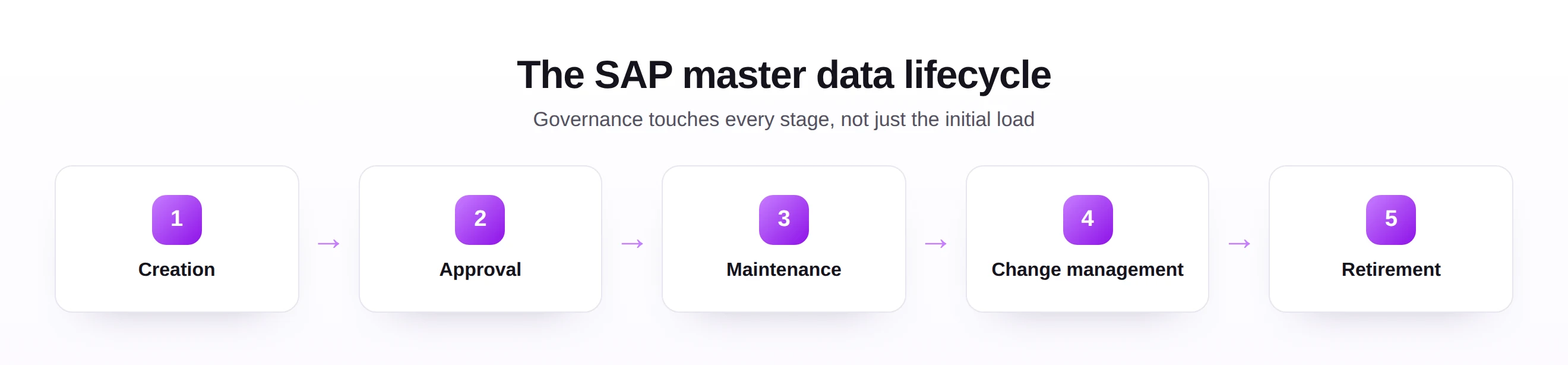
- Creation. A new record is requested with mandatory fields and a clear business reason.
- Approval. A steward or owner reviews the request and signs off before it reaches SAP.
- Maintenance. The record is kept accurate as the business changes around it.
- Change management. Edits are tracked, validated, and approved, never made silently.
- Retirement. Records that are no longer used are blocked or archived in a controlled way.
Governance policies, controls, and compliance
Policies turn good intentions into repeatable controls. The strongest programs keep them simple and enforce them automatically.
- Naming and field standards so records are entered consistently every time.
- Mandatory fields and validation rules that block incomplete or invalid data.
- Segregation of duties so the person who creates a record is not the only one who approves it.
- Approval thresholds that route sensitive changes to the right reviewer.
- A complete audit trail that records who changed what, when, and why.
SAP Master Data Governance in ECC and S/4HANA
Governance principles are the same in both systems, but the landscape differs.
In SAP ECC, many teams govern master data through a mix of process, custom checks, and manual review. Data is often prepared in spreadsheets and keyed in or loaded with older tools, which leaves room for inconsistency.
In SAP S/4HANA, the business partner model unifies customers and vendors, and tighter integration raises the bar for clean, consistent records before and after migration. Governance becomes even more important during an ECC to S/4HANA move, when large volumes of master data are loaded under time pressure.
The role of automation in master data governance
Policies only help if they are applied consistently, and that is hard to do manually at scale. Automation is what makes governance repeatable.
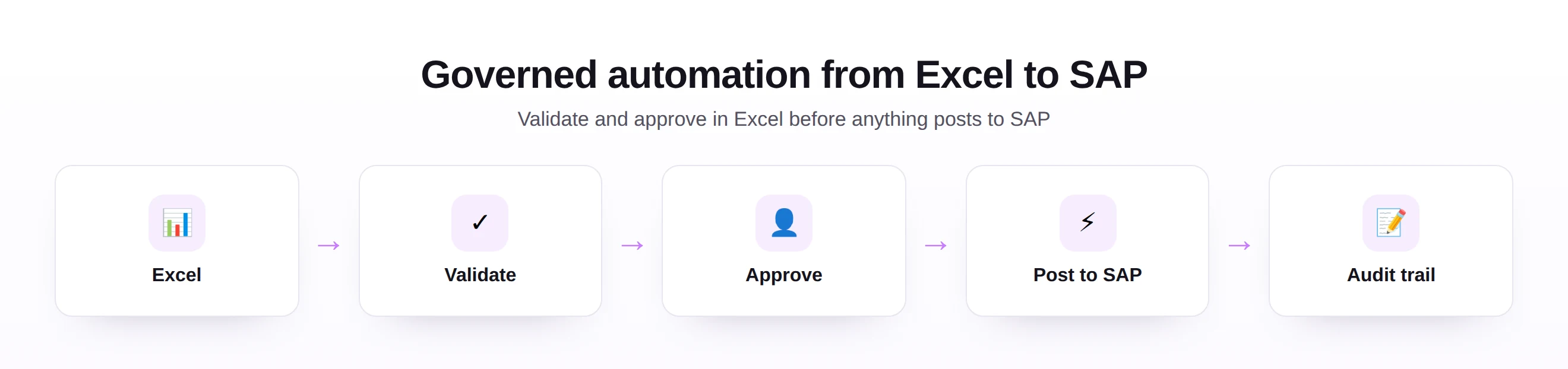
Tools such as PostNow let business and master data teams work where they already are, in Excel, while the governance runs underneath:
- Excel to SAP automation. Load and maintain master data straight from a spreadsheet, with no daily ABAP to run.
- Validation. Records are checked against SAP rules so errors are caught before they post.
- Approval workflows. Changes route for sign off, keeping segregation of duties intact.
- Error reduction. Field mapping and pre flight checks remove the manual rekeying that causes mistakes.
- Auditability. Every run is posted through standard BAPIs and recorded in a complete log.
SAP Master Data Governance best practices
The programs that last share a few habits. None of them require a large new platform to begin.
- Assign a clear owner for every master data object before anything else.
- Define what good looks like with field standards and simple data quality rules.
- Validate before you post, not after, so SAP only ever sees clean records.
- Route changes through approval and keep creators and approvers separate.
- Catch duplicates early with checks at the point of creation.
- Keep a full audit trail so every change can be explained later.
- Automate the repeatable parts so controls do not depend on memory.
SAP Master Data Governance best practices in depth
The checklist above is the short version. The SAP Master Data Governance best practices below are how mature teams make each habit stick across ECC and S/4HANA, without slowing the business down.
Data ownership. Every object needs one accountable owner, named and known. The owner decides what a valid record looks like and signs off on policy, while the work is shared. Splitting ownership by domain, for example one owner for the vendor master and another for the customer master, keeps accountability clear as volumes grow.
Data stewardship. Owners set direction; data stewards do the daily work of validation, deduplication, and remediation. A simple operating model keeps the two roles distinct and gives business users a clear path to request changes.
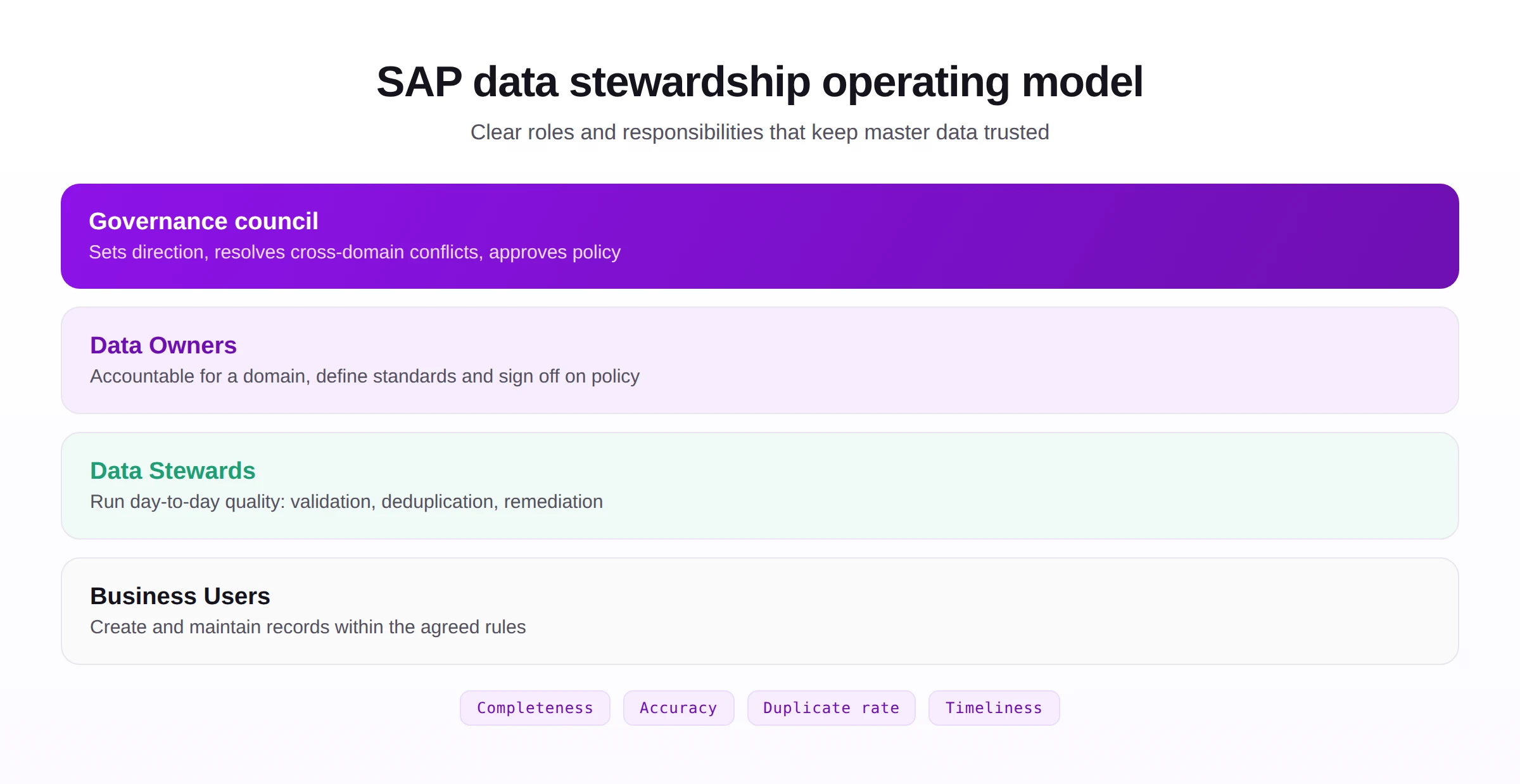
Governance councils. A small cross-functional council, finance, procurement, supply chain, and IT, resolves conflicts that no single owner can settle and approves standards that cross domains. It should meet on a rhythm, not only when something breaks.
Data standards. Write down what a complete record looks like: mandatory fields, formats, naming, and the check tables a value must match. Standards turn governance from opinion into something a tool can enforce, including for finance objects like cost centers and profit centers.
Approval workflows. Separate who creates a record from who approves it. Even one approval step preserves segregation of duties and gives an auditor a clean story for every change.
Data quality monitoring. Track a few metrics rather than many, and review them on a schedule.
| KPI | What it measures | Healthy direction |
|---|---|---|
| Completeness | Share of records with all mandatory fields filled | Up |
| Accuracy | Share of values that match the source of truth | Up |
| Duplicate rate | Duplicate records as a share of the total | Down |
| Timeliness | Time from request to an active, approved record | Down |
Continuous improvement. Treat governance as a program, not a one-off project. Feed audit findings and KPI trends back into the standards, and tighten the rules where errors keep appearing.
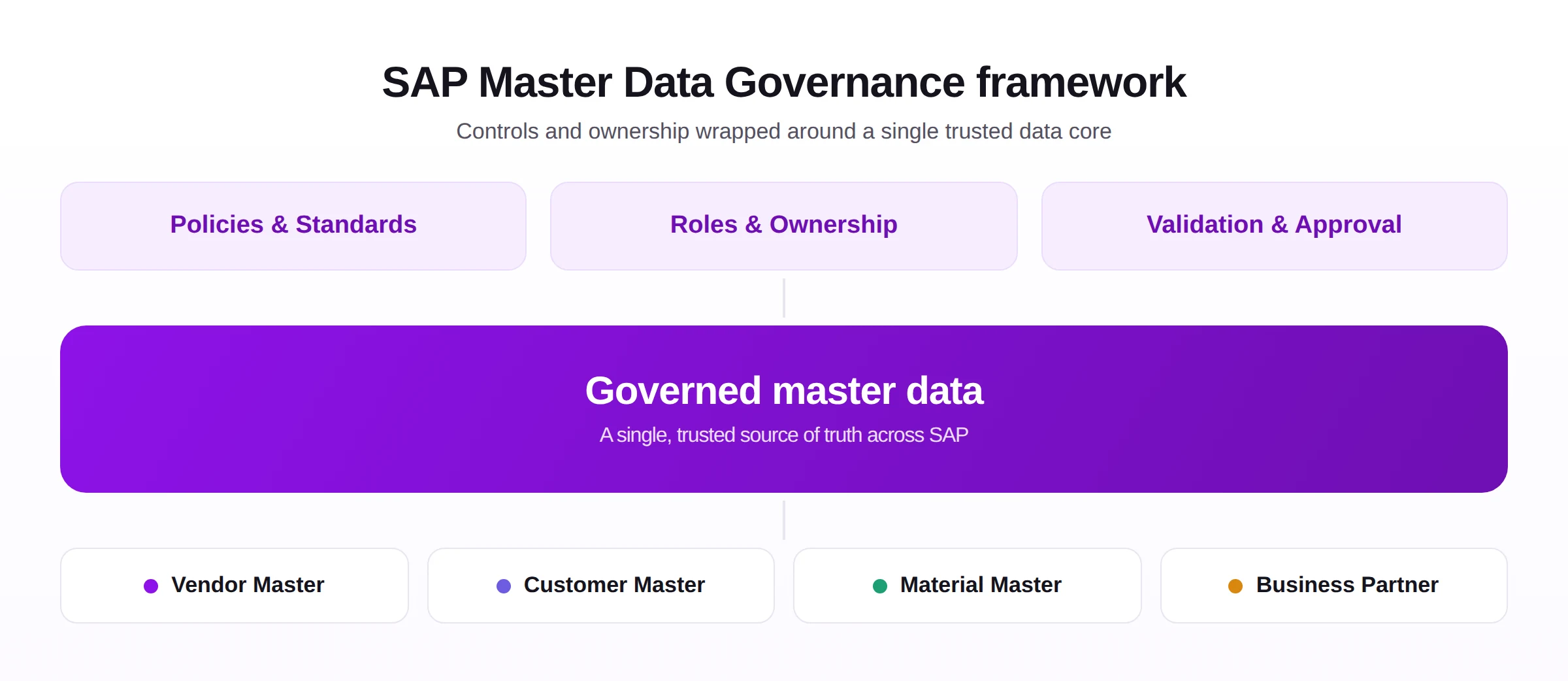
SAP Master Data Governance framework
A clear SAP Master Data Governance framework keeps a program from drifting. The SAP governance framework below organizes the work into five dimensions, people, process, technology, controls, and metrics, that surround one trusted data core.
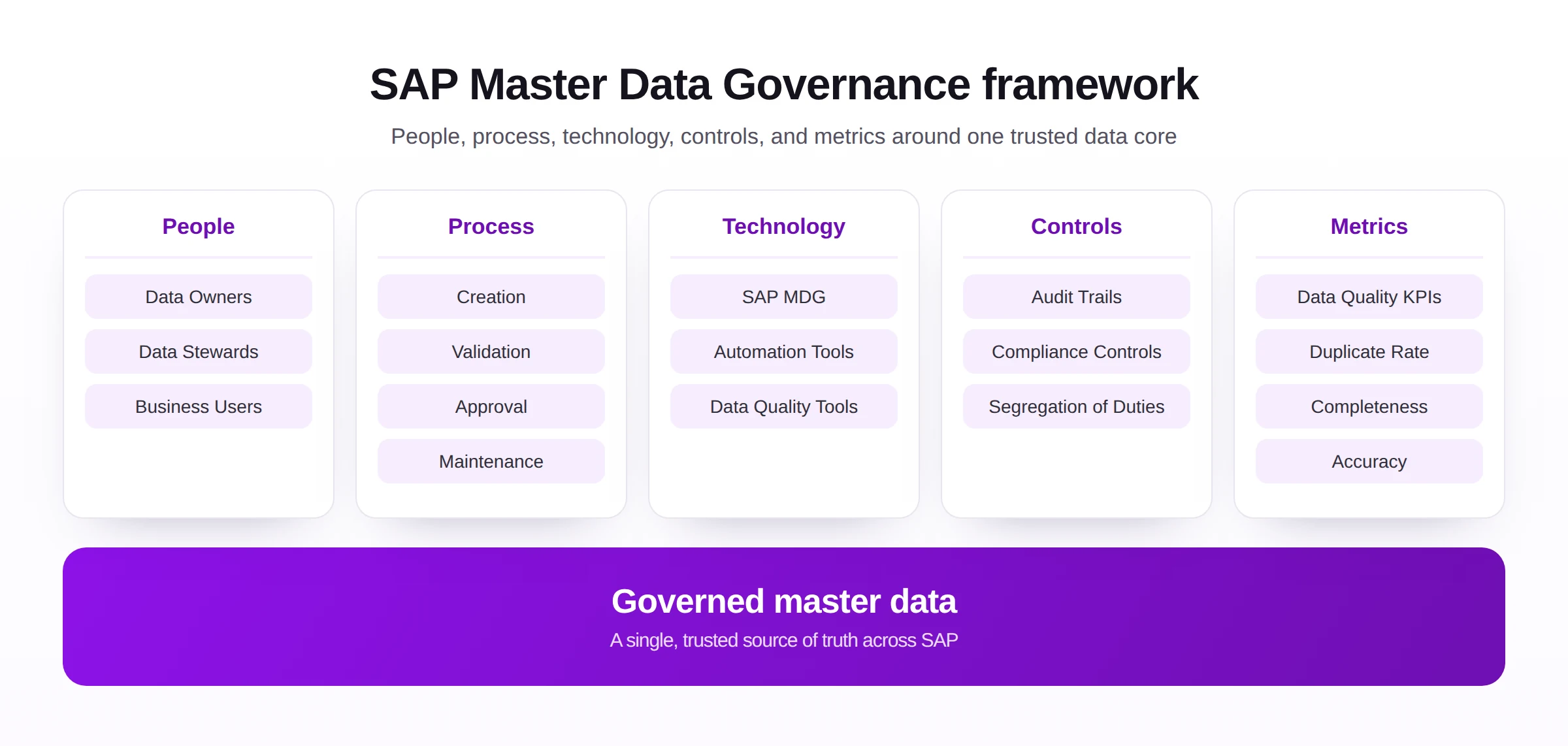
The point of an SAP data governance framework is balance. Strong controls without usable process frustrate the business; smooth process without controls lets quality slip. The five dimensions are designed to hold each other in check, and they apply whether governance runs inside SAP MDG or alongside SAP process automation for teams that are not yet on the full module.
SAP Master Data Governance implementation roadmap
An SAP Master Data Governance implementation works best in stages. This SAP governance roadmap moves from understanding the problem to running a steady program, and most teams can start the early steps before any large platform is in place.
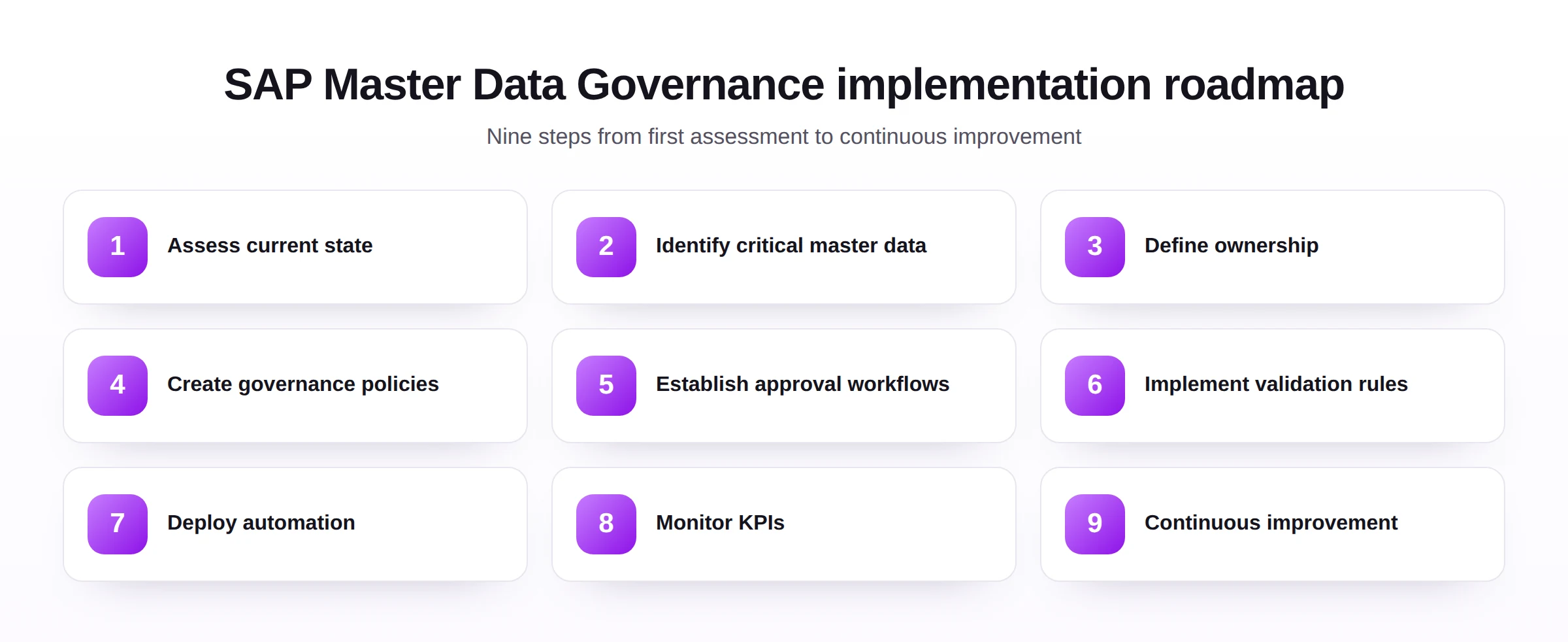
- Assess current state. Measure quality, count duplicates, and map where master data is created and changed. A planned SAP data migration is a natural moment to do this.
- Identify critical master data. Prioritize the objects that drive spend and revenue, typically vendor, customer, and material master data.
- Define ownership. Assign one accountable owner per object before writing any rules.
- Create governance policies. Document standards, mandatory fields, and naming so expectations are explicit.
- Establish approval workflows. Separate creation from approval to protect segregation of duties.
- Implement validation rules. Check values against live SAP and its check tables so errors are caught before posting.
- Deploy automation. Load and validate from Excel with the right SAP automation tools, so controls do not depend on memory.
- Monitor KPIs. Track completeness, accuracy, and duplicate rate on a schedule.
- Continuous improvement. Review findings, tighten standards, and widen coverage to more objects over time.
Common governance mistakes organizations make
Most failed governance efforts share the same avoidable patterns.
- Treating governance as a one time data cleanse instead of an ongoing practice.
- Writing policies that live in a document but are never enforced in the system.
- Leaving objects without an owner, so quality has no one accountable for it.
- Validating data after it posts, when the damage is already done.
- Relying on manual entry at scale, which guarantees rekeying errors.
Future trends in master data governance
Governance is shifting from periodic clean ups to continuous, assisted control.
AI assisted governance
Models suggest field mappings, flag likely duplicates, and explain why a record looks wrong.
Automated validation
Rules run continuously, so issues are caught as data changes rather than at audit time.
Quality monitoring
Live scores track the health of each object so teams can act before quality slips.