What is SAP Master Data Management?
SAP Master Data Management is the practice of creating, maintaining, and consolidating the core records that every SAP process depends on, so they stay accurate and usable wherever they are read.
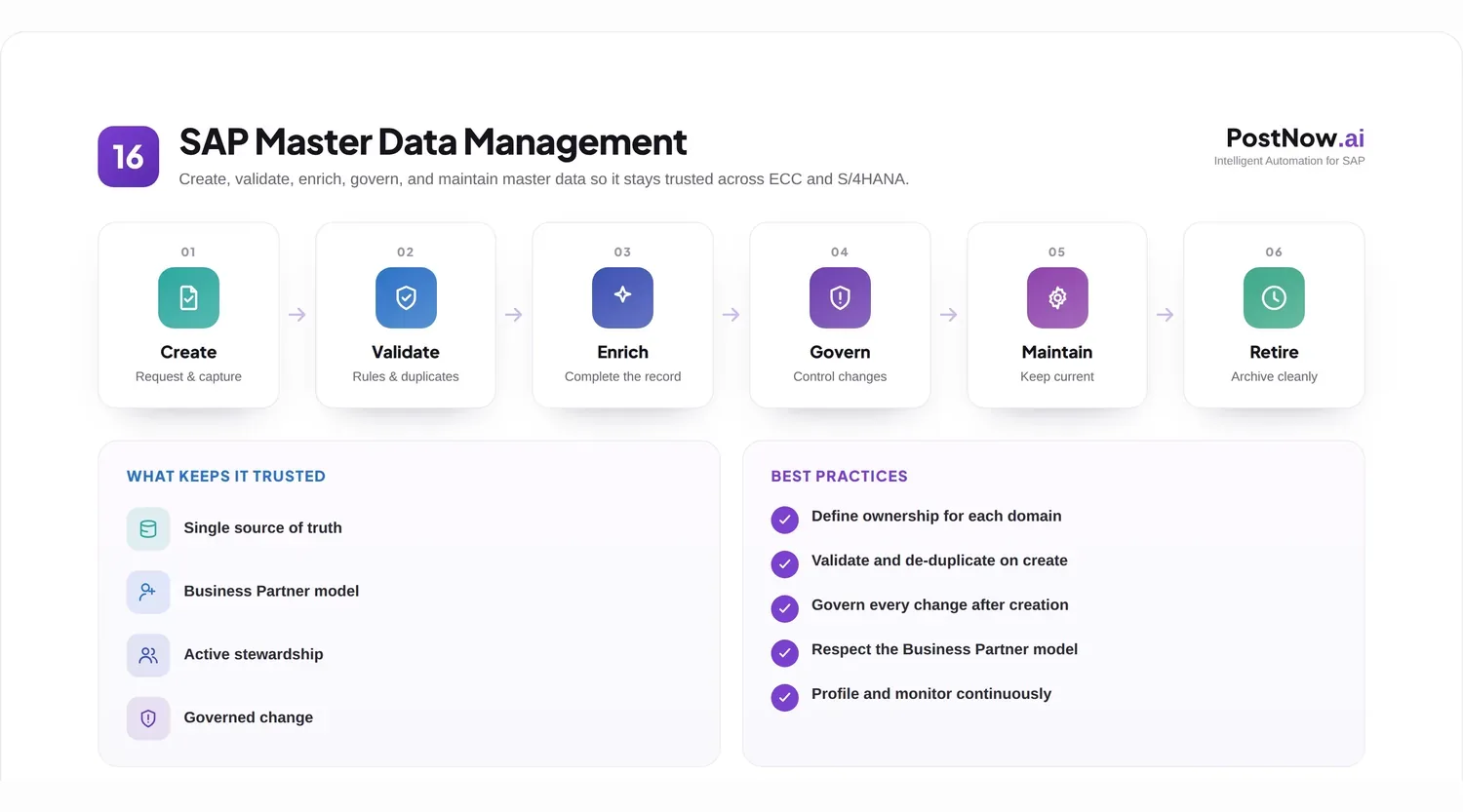
Master data is the stable reference data behind your transactions: the vendors you pay, the customers you bill, the materials you buy and sell, and the finance objects that classify it all. Each record is created once and then reused by countless documents, which is why its quality has such a long reach.
SAP MDM is not a single screen or transaction. It is the mix of structure, routines, and tooling that decides how a record enters the system, how it is kept current, and how it is eventually retired.
Across an SAP landscape, master data is shared between modules and often between connected systems. Procurement, sales, finance, and supply chain all draw on the same records, so managing them well is what lets those processes run without friction.
For the SAP managers, architects, consultants, and master data teams who live with these records, the day to day reality is less about theory and more about keeping thousands of small details correct. Master data management gives that work a structure, so it becomes repeatable rather than heroic.
It also helps to be clear about what master data management is not. It is not a one-time load, and it is not only a job for IT. It is an ongoing, shared responsibility between the business teams who know what a record should say and the people who keep the system tidy, and that shared ownership is what stops quality from eroding over time.
Why master data management matters
Master data sits underneath almost everything SAP does, so the quality of these records quietly shapes outcomes far downstream.
Data quality
Clean master records mean fewer surprises, because the values feeding each document are complete and correct from the start.
Smoother processes
Orders, invoices, and postings flow when the records behind them are trusted, instead of stalling on missing or conflicting data.
Reliable reporting
Spend analysis, tax, and management reporting only add up when the underlying master data is consistent across the business.
Compliance support
Accurate, well-kept records make it easier to satisfy audit, tax, and regulatory requests without a scramble.
Operational efficiency
Time saved on chasing and correcting records is time the team can spend on work that actually moves the business.
Confident decisions
Leaders can act on SAP numbers when they trust the records behind them, rather than second-guessing the source.
Taken together, these reasons explain why master data management is treated as a foundation rather than a side project. The cost of weak data is rarely one dramatic failure; it is the steady drag of small errors, duplicated effort, and decisions made on numbers no one fully trusts.
Types of SAP master data
Most SAP programs manage a handful of core objects. Each has its own structure and transaction, but all benefit from the same disciplined approach.
| Object | Code | What it holds |
|---|---|---|
| Vendor master | XK01 | Suppliers you buy from and pay, across general, accounting, and purchasing data. |
| Customer master | XD01 | The accounts you sell to and bill, across sales, accounting, and general data. |
| Material master | MM01 | The goods and items you buy, make, store, and sell, across many views. |
| Business partner | BP | The unified S/4HANA model that links customer and vendor roles to one entity. |
| Cost center | KS01 | Where costs are collected for controlling and internal reporting. |
| Profit center | KE51 | Where responsibility for profit is tracked within the controlling area. |
| G/L account | FS00 | The accounts that structure the general ledger and financial statements. |
| Asset master | AS01 | Fixed assets with their classes and depreciation areas. |
These objects are different in detail but share a common need: one accurate version, used the same way everywhere. That shared need is what master data management exists to meet.
Getting each object to a single, agreed version is the practical goal. When two teams disagree about a vendor address or a material description, the fix is not another spreadsheet but a clear master record that both sides accept and maintain together.
SAP Master Data Management vs SAP Master Data Governance
The two terms travel together, but they answer different questions. Management is the doing; governance is the deciding.
| Aspect | SAP Master Data Management | SAP Master Data Governance |
|---|---|---|
| Focus | Creating and maintaining the records | The rules and ownership behind them |
| Question it answers | How is the data kept clean and current | Who decides, approves, and is accountable |
| Typical activities | Loading, updating, deduplicating, archiving | Standards, approval, audit, segregation of duties |
| Output | Usable master records | Trusted, defensible master records |
In practice they reinforce each other. Management without governance can move fast but drift in quality; governance without solid management sets rules that nothing reliably carries out. Strong programs pair the two, which is the subject of the companion guide to SAP Master Data Governance.
Common misconceptions worth clearing up:
- They are not rivals. One maintains the records, the other keeps them honest.
- You do not need a large platform to start either; both can begin with clear ownership and validation.
- Governance is not only a control function. It exists to make day-to-day management easier and safer.
The split of responsibilities is worth stating plainly. Management responsibilities sit with the teams who create and maintain records: preparing data, loading it, correcting errors, and keeping fields current. Governance responsibilities sit with owners and approvers who set standards, decide who may change what, sign off on sensitive updates, and answer to audit. In a smaller organization the same people may wear both hats, but the two jobs stay distinct.
Common SAP master data challenges
The same problems show up across industries, and most trace back to how records are created and maintained rather than to SAP itself.
- Duplicate records, where the same vendor or customer exists more than once and splits spend and history.
- Inconsistent data, where the same field is filled differently from one team to the next.
- Data silos, where each department keeps its own version and no one holds the master copy.
- Missing ownership, where no one is clearly accountable for a given object.
- Poor data quality, where incomplete or stale fields quietly break downstream processes.
- Spreadsheet-driven processes, where records are prepared offline with no shared checks.
- Manual maintenance, where updates depend on memory and free time rather than a repeatable routine.
What these challenges share is a single root cause: data created or changed without consistent checks. Fix that one point, the moment a record enters or is updated, and most of the symptoms further downstream begin to fade on their own.
The SAP master data lifecycle
Master data is not loaded once and left alone. It moves through a lifecycle, and management applies at every stage, not just the first.
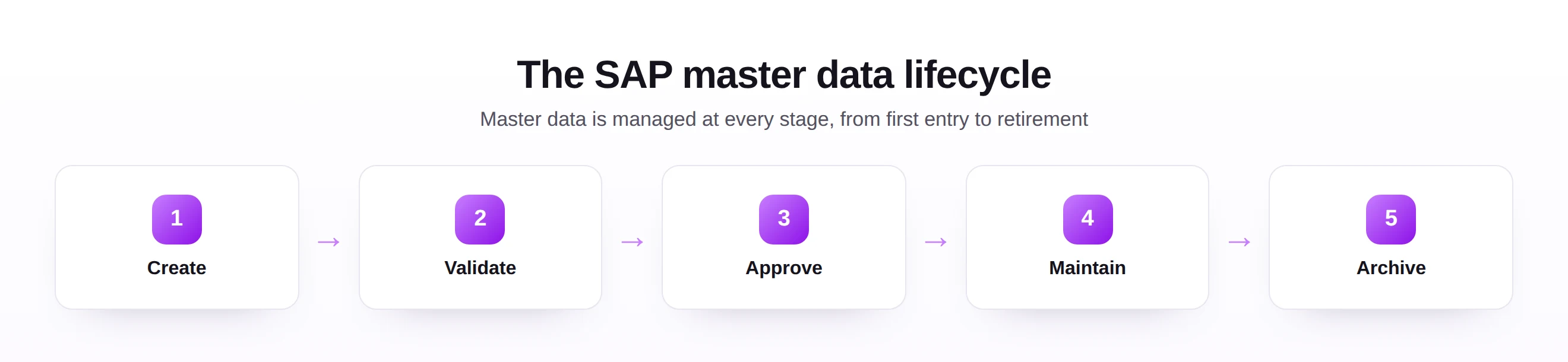
Treating the lifecycle as a whole, rather than fixating on the initial load, is what separates a tidy go-live from data that stays clean for years. Maintenance and archiving are the easy stages to neglect, yet they are where quality is quietly won or lost over the long run.
SAP master data quality management
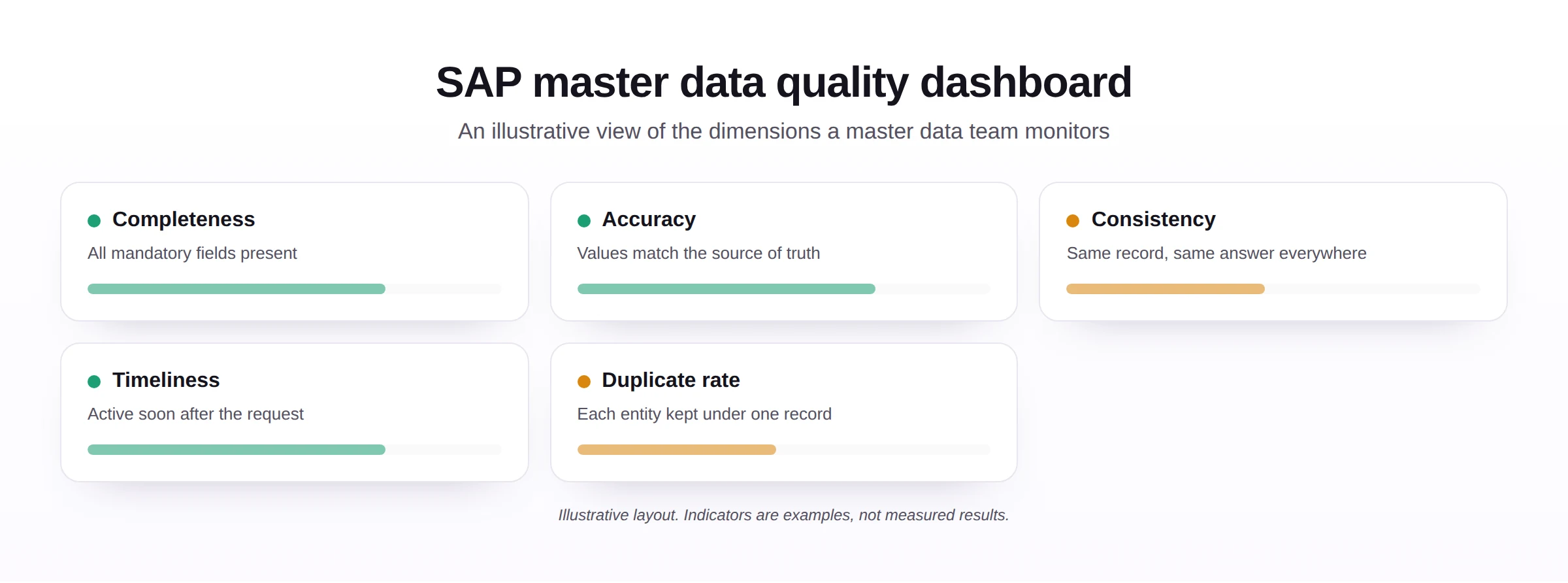
Quality is the heart of master data management. A few clear dimensions make it measurable rather than a matter of opinion.
| Dimension | What it means |
|---|---|
| Accuracy | Values reflect the real world and match the trusted source. |
| Completeness | Every mandatory field for the object is present. |
| Consistency | The same record gives the same answer across systems and views. |
| Timeliness | Records are active soon after they are needed, not weeks later. |
Monitoring these dimensions on a regular rhythm turns quality into something a team can manage. When a score slips, it points to where standards or checks need tightening.
A practical rhythm matters more than a perfect score. Reviewing the dimensions on a set cadence, agreeing on what an acceptable level looks like for each object, and acting on the gaps turns quality from a vague aspiration into a managed part of the program.
SAP ECC vs S/4HANA master data management
How master data is modeled differs between releases, and that shapes how you manage it.
The Business Partner model. In SAP ECC, customers and vendors are usually maintained as separate objects. In S/4HANA, the Business Partner brings them together under one entity with roles, which removes duplication but changes how records are created and kept in step.
Data model changes. S/4HANA simplifies several structures and tightens some rules, so standards written for ECC should be revisited rather than copied across unchanged.
Migration considerations. A move to S/4HANA is the moment master data quality is tested hardest. Cleaning and aligning records before a data migration avoids carrying old problems into the new system.
Modernization opportunities. The shift is also a chance to retire silos, agree on single owners, and put repeatable checks in place, so the new landscape starts cleaner than the old one ended.
There is no single right answer for every landscape. Organizations still running ECC can put strong management in place today, while those moving to S/4HANA can use the transition to reset standards and ownership. What matters is matching the approach to the data model actually in front of you.
SAP master data automation
Automation is what makes good management sustainable. It applies the same checks every time, at a scale manual work cannot match.
- Excel to SAP automation, so records are prepared in a familiar tool and loaded under control through Excel to SAP automation.
- Bulk creation, turning a long list of new records into a single reviewed load.
- Mass updates, applying a change across many records consistently.
- Validation, checking values against live SAP before anything posts.
- Approval workflows, keeping a review step in place even at volume.
- Error reduction, because the rules do not depend on anyone remembering them.
The same approach covers each object, from the vendor master and customer master to the material master, cost centers, and profit centers. Picking the right SAP automation tools and connecting them with broader SAP process automation keeps the whole flow consistent.
Error reduction is the quiet benefit that ties the rest together. Because a tool applies the same validation to every row, the mistakes that creep in during manual entry, a missing company code, a mistyped tax field, a duplicate created by accident, are caught before they ever reach SAP.
Automation does not remove the need for people; it changes what they spend time on. Instead of rekeying records and chasing errors, the team focuses on the judgment calls: agreeing standards, reviewing exceptions, and deciding how each object should be maintained, while the repetitive work runs on rails.
SAP master data management best practices
A few habits separate programs that hold their quality from those that slip back.
- Assign ownership so each object has one accountable owner before anything else.
- Write down data standards that say what a complete, valid record looks like.
- Align with governance, connecting daily management to the rules set out in SAP Master Data Governance.
- Monitor data quality on a schedule, so problems are spotted while they are small.
- Improve continuously, feeding what you learn back into standards and checks.
None of these requires a large new platform to begin. Clear ownership, a written standard, and validation at the point of entry already move a program a long way.
It also helps to start narrow. Picking one or two high-impact objects, getting them genuinely clean, and proving the routine works builds the credibility to extend the same approach across the rest of the landscape.
SAP master data management framework
A simple framework keeps a program balanced. It brings five dimensions together around the goal of trusted master data.
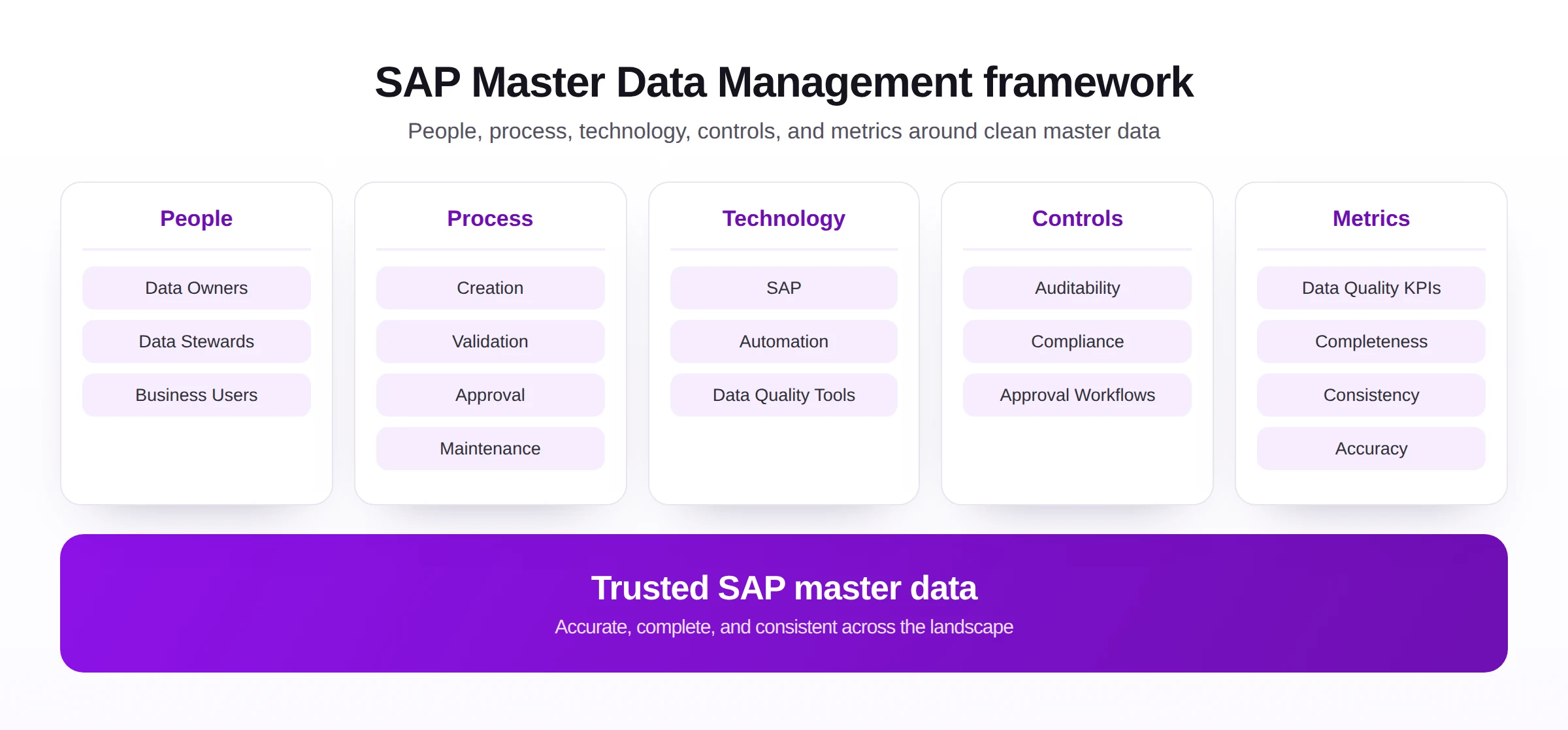
The value of the framework is balance. People without process leads to inconsistency; technology without controls only speeds up mistakes; metrics without ownership produce reports no one acts on. Holding the five dimensions together is what keeps a program healthy as it grows.
SAP master data management implementation roadmap
Managing master data well is a staged effort. This roadmap moves from understanding the current state to running a steady, improving program.
- Assess current state. Measure quality, count duplicates, and map where records are created and changed.
- Define ownership. Name one accountable owner for each object.
- Standardize data. Agree on mandatory fields, formats, and naming.
- Clean existing records. Fix and deduplicate what is already in the system.
- Implement controls. Put validation and an approval step in place for new and changed records.
- Deploy automation. Load and update from Excel with consistent checks rather than manual entry.
- Monitor KPIs. Track completeness, consistency, and accuracy on a regular rhythm.
- Improve continuously. Tighten standards where errors recur and widen coverage to more objects.
Each step builds on the one before, so the order matters. Cleaning records before ownership is agreed, or deploying automation before standards exist, tends to create rework. Moving through the stages in sequence keeps the effort steady and the gains durable.
Common master data management mistakes
Knowing the usual traps makes them easier to avoid.
Most of these are habits rather than technical limits, which is good news: they can be corrected without replacing systems, starting with ownership and a standard for the objects that matter most.
The encouraging part is that none of these mistakes requires a system replacement to fix. They are habits, and habits can change. Naming an owner, writing a one-page standard, and adding a validation step for the objects that matter most will correct the majority of them, often within a single quarter.
The future of SAP master data management
The direction of travel is toward catching problems earlier and leaning less on manual effort.
- AI-assisted data quality, flagging likely duplicates and odd values before they spread.
- Intelligent validation, suggesting the right field mappings and corrections as data is prepared.
- Wider automation, so more of the lifecycle runs through repeatable, checked steps.
- Governance convergence, with management and governance working as one connected practice.
- Continuous monitoring, turning quality from a periodic project into an always-on signal.
The constant through all of it is the same: trusted master data, kept clean from creation onward, remains the foundation that everything else in SAP is built on.
For most teams, the smartest move is not to wait for the future to arrive. The foundations that make advanced tooling useful, namely clean records, clear ownership, and consistent checks, are the same ones worth building today, so the program is ready to use each new capability as it lands.