SAP GL account automation is the practice of opening and maintaining general ledger accounts from a spreadsheet instead of keying each one through FS00. PostNow runs it from Excel by recording the transaction once and replaying it: each account is a row, the recording sets the chart of accounts and company code segments for every row, the values are checked, and the batch posts in one pass, with any SAP error turned into plain language.
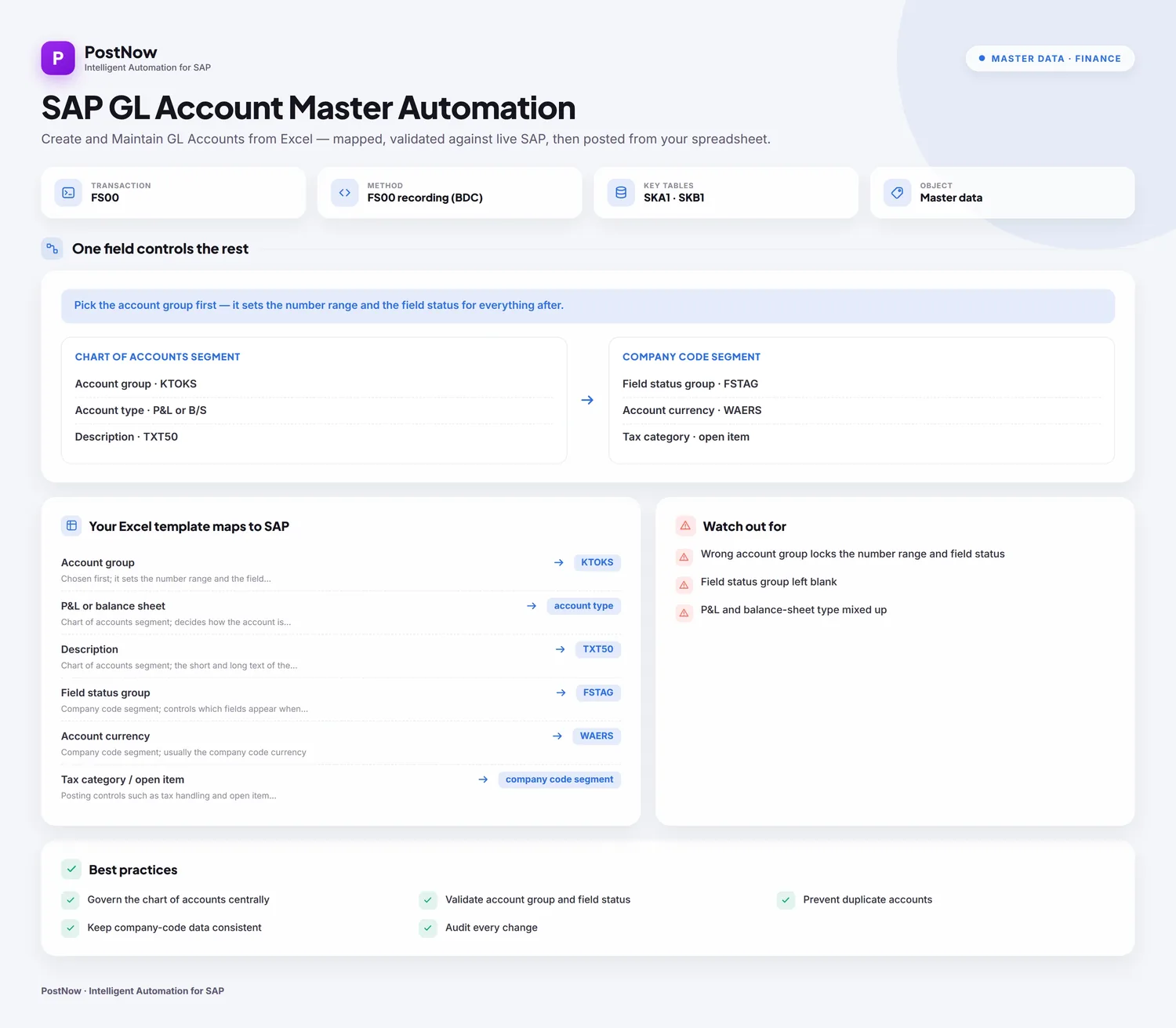
Here is a twelve-step worked example of a GL account upload from Excel to SAP, taking in new accounts and edits to existing ones. Keep the recording and mapping and you have a GL account Excel template ready for the next chart-of-accounts rollout or company-code extension. The method runs the same on classic ECC and on S/4HANA, where the general ledger still maintains accounts behind FS00. After the initial setup, the people loading the data write no ABAP and depend on no developer.
Why automate GL account creation rather than keying FS00
Opening an account manually means working through FS00: pick the account group, set the account type and description on the chart of accounts segment, then complete the company code segment with its field status group, currency, tax category, and posting controls. A few are no trouble. Rolling out a new chart of accounts, extending the ledger to another company code, or migrating a legacy structure becomes hundreds of accounts across two segments, and that is where field status groups and tax categories begin to drift.
A GL account upload takes the keying away. The accounts live in Excel and the recording posts the whole set across both segments in one run. For a bulk GL account creation at go-live or a mass GL account upload during a finance migration, the slow parts, capturing the transaction, matching columns to fields, formatting the data, and reading FI messages, are handled for you. The twelve steps below lay the method out in full.
Before you start: what you need
- Your accounts in Excel, one per row, with a column for every field across the chart of accounts and company code segments you intend to set.
- SAP authorization matching
FS00andFS02for the chart of accounts and company codes you are loading. - PostNow in Excel, tied to your SAP system. Its supporting components are installed in SAP once at setup, and the account loads then run from the task pane.
FS00 recording covers both, so a single load creates the account centrally rather than splitting the work across FSP0 and FSS0.Your GL account Excel template: the fields SAP expects
A GL account is split between a shared segment and a company-code-specific one, so the template groups its columns the same way. These are the fields a GL account upload depends on; carry them, and confirm the account group, field status group, and tax category they reference already exist.
| Excel column | SAP field | Why it matters |
|---|---|---|
| Account group | KTOKS | Chosen first; it sets the number range and the field status |
| P&L or balance sheet | account type | Chart of accounts segment; decides how the account is closed at year-end |
| Description | TXT50 | Chart of accounts segment; the short and long text of the account |
| Field status group | FSTAG | Company code segment; controls which fields appear when posting |
| Account currency | WAERS | Company code segment; usually the company code currency |
| Tax category / open item | company code segment | Posting controls such as tax handling and open item management |
FS00 across its two segments, and PostNow uses a transaction recording to carry the whole thing. You step through one FS00 creation, the type and description on the chart of accounts segment and the control and create/bank/interest tabs on the company code segment, while PostNow captures the screens and the fields entered. That recording is a reusable template the add-in replays for every row, the values pulled from your columns. Step 2 is where you make it.The GL account upload, step by step
Lay out and open your sheet
Put each account on a row under headers such as Account Number, Account Group, Type, Description, Field Status Group, Currency, and Tax Category. Open the workbook and bring up the PostNow task pane beside it.
Record the FS00 transaction
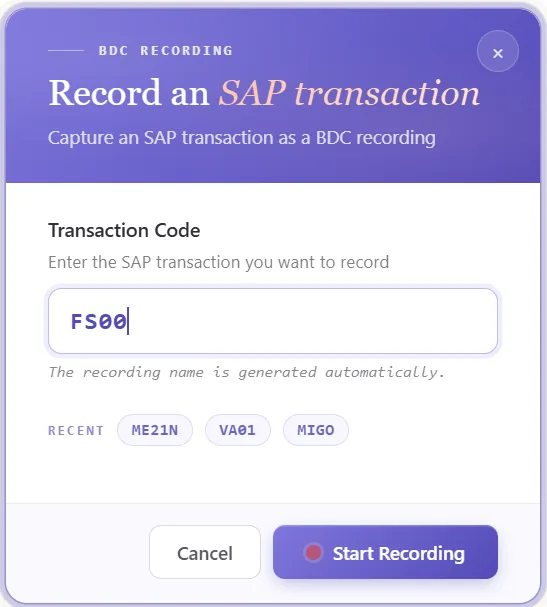
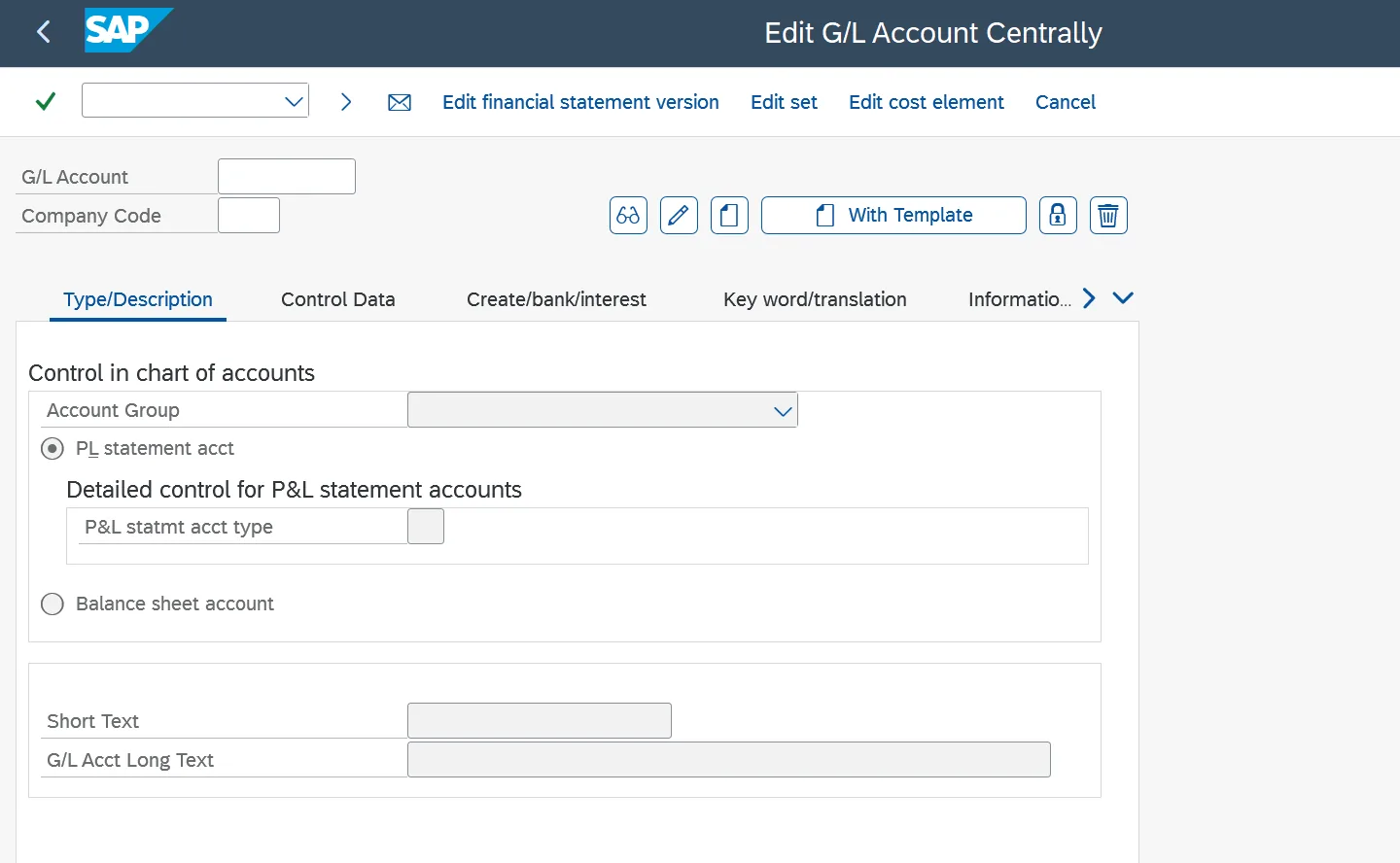
Because the account spans two segments on one screen, you capture the transaction once. Start a recording, run a single FS00 creation, and PostNow follows what you do:
- It captures the type and description on the chart of accounts segment
- It records the control, create, bank, and interest tabs of the company code segment
- One capture is enough; the recording then drives every account in the sheet
Save it and PostNow makes it a reusable template, so opening accounts from Excel to SAP never again means working through FS00 yourself.
Look over the recorded screens and fields
PostNow shows the recording as the segments it stepped through and the fields it will set on each. Because it follows the real FS00 layout, a quick read shows what is captured where:
That overview shows, before any mapping, which column belongs to which segment of the account.
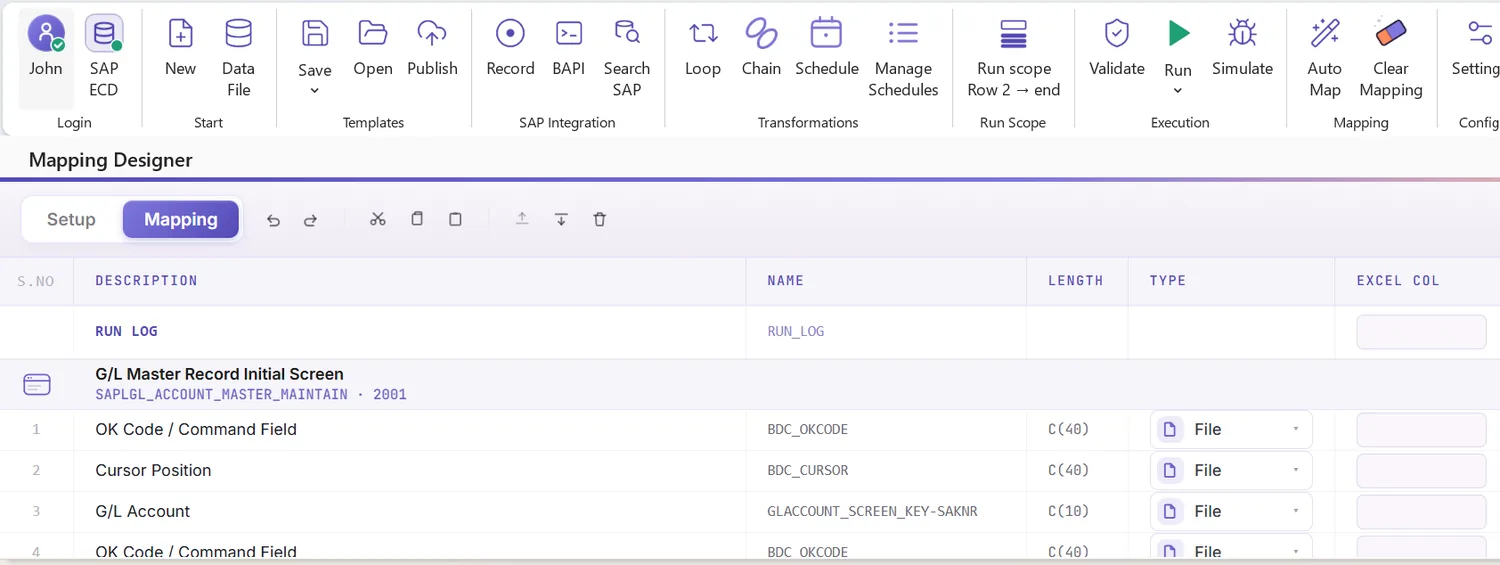
Open the Mapping Designer
Selecting the recording fills the Mapping Designer with one line per captured field. Two points apply to accounts:
- Added fields are detected. Extra fields your account group exposes on the recorded tabs are picked up, ready to map.
- You can add more manually. Any field the recording did not reach you place yourself, keeping the full account in one load.
Match columns with Mapping AI AI
Now connect the recording to your data. Mapping AI reads your headers, or a screenshot you paste, and proposes an Excel column for each recorded field, which you confirm or adjust, a useful saving when an account splits its data between a shared segment and a company-code one.
Auto Map and stamp the headers
Set the mapping with Auto Map. Each recorded field is bound to its column and SAP-tagged headers are written into the sheet, so the workbook becomes the template and stays aligned with the recording across both segments.
Set formatting and update flags
Each field's properties govern how its value is typed into the screen: leading zeros on the account number, upper case on codes, trimmed spaces, defaults, and regex. With these set, the replay enters exactly what each segment expects.
When the recording is a change rather than a creation, you flag only the fields the replay should overwrite, so a mass GL account update touches just the controls you intend and leaves the rest of the account untouched.
Check the data in Excel first
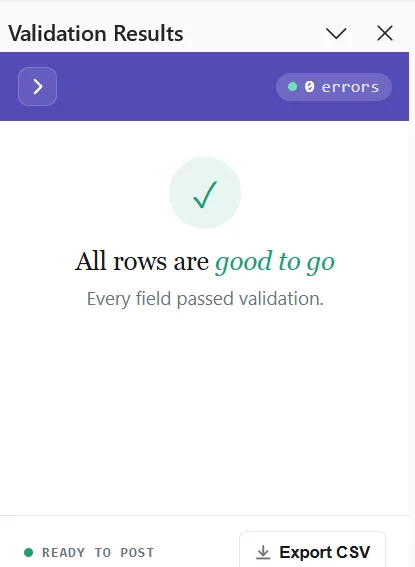
Checking before the replay is time well spent: a field-status or account-group error tends to halt the screen mid-run. Validate brings that check forward, testing each row against SAP's length, format, and required-field rules and marking the problem cells, so the sheet is clean before the recording runs.
Confirm against live SAP
Neat formatting still will not prove a value exists, a field status group or tax category can read fine and be missing. To test it, open the field's properties, switch on field validation, and name the check table and field, a field status group against its definition, a company code against T001, or the account group against its setup. Select the cell, run Validate master data, and PostNow checks live SAP for the value.
Shape the load with loops and conditions
When the file needs more than a straight replay, set it up first:
- Loops: the recording steps down your rows, creating one account after another from the same captured flow.
- IF conditions: run only the rows that qualify, for instance setting the open-item fields only on balance-sheet accounts, or skipping rows still missing an account group.
Set the scope, run, and review AI
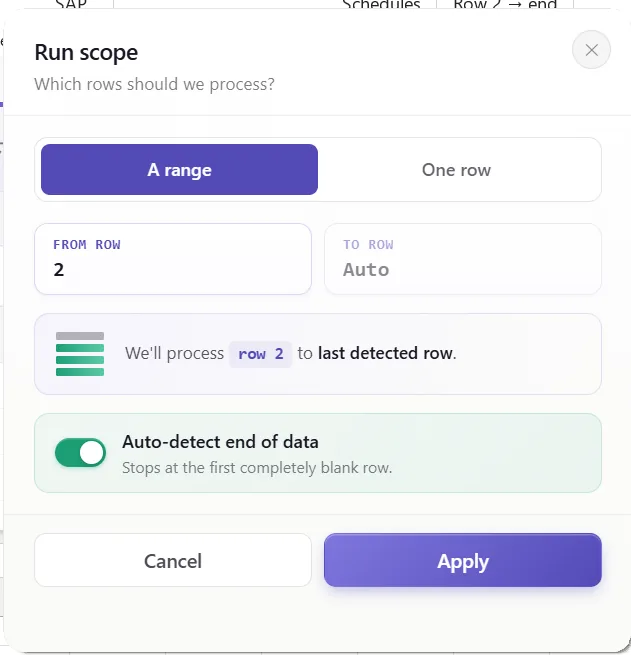
Choose the range with Run Scope, one test account ahead of the rest, and press Run. A few things help:
- Foreground replay: watch the recording type into
FS00for the first account to confirm it behaves. - Run log: each result appears live and writes into a log column beside its row in Excel.
- AI error review: AI Review reads the FI message and says, plainly, which segment and field stopped the account.
- Per-row result: every account carries its own outcome, so a failure points straight at the row and field to fix.
Publish and roll it out to the team
Once the run comes back clean, publish the script. The recording and mapping become something colleagues run unchanged, they open it, paste their accounts, and post, with nothing to rebuild and no need to understand the transaction behind it. One setup becomes the finance team's standard way to load GL accounts.
Let's talk
Bring a real GL account list and a live SAP connection to a working session. We will record the transaction, map the segments, validate, and post it for real, with AI taking the strain. No slide decks.
Frequently asked questions
What is SAP GL account automation?
FS00. PostNow records the FS00 transaction once and replays it for every row in Excel, while AI maps the fields, checks the values, and explains any error, with no ABAP for the people loading the data.How do you upload GL accounts from Excel to SAP?
FS00 creation once, map your columns to the recorded fields, validate, then replay the recording for the whole list. PostNow checks the data against live SAP, so there is no FS00 keying and no ABAP.What is the difference between the chart of accounts and company code segments?
FS00 recording covers both, so one load creates the account centrally rather than in two passes.Is there a template for uploading GL accounts to SAP?
Can you mass-change existing GL accounts from Excel?
FS00 change instead of a creation, list the accounts with their new values, and mark the fields the replay should overwrite. PostNow runs the change for every row, the Excel route to a mass GL account update without touching FS00 manually.