Introduction
Most SAP migrations are judged on a single morning: the cutover. Yet the outcome is decided weeks earlier, in how the data was prepared. Best practices are simply the habits that move that decision in your favor.
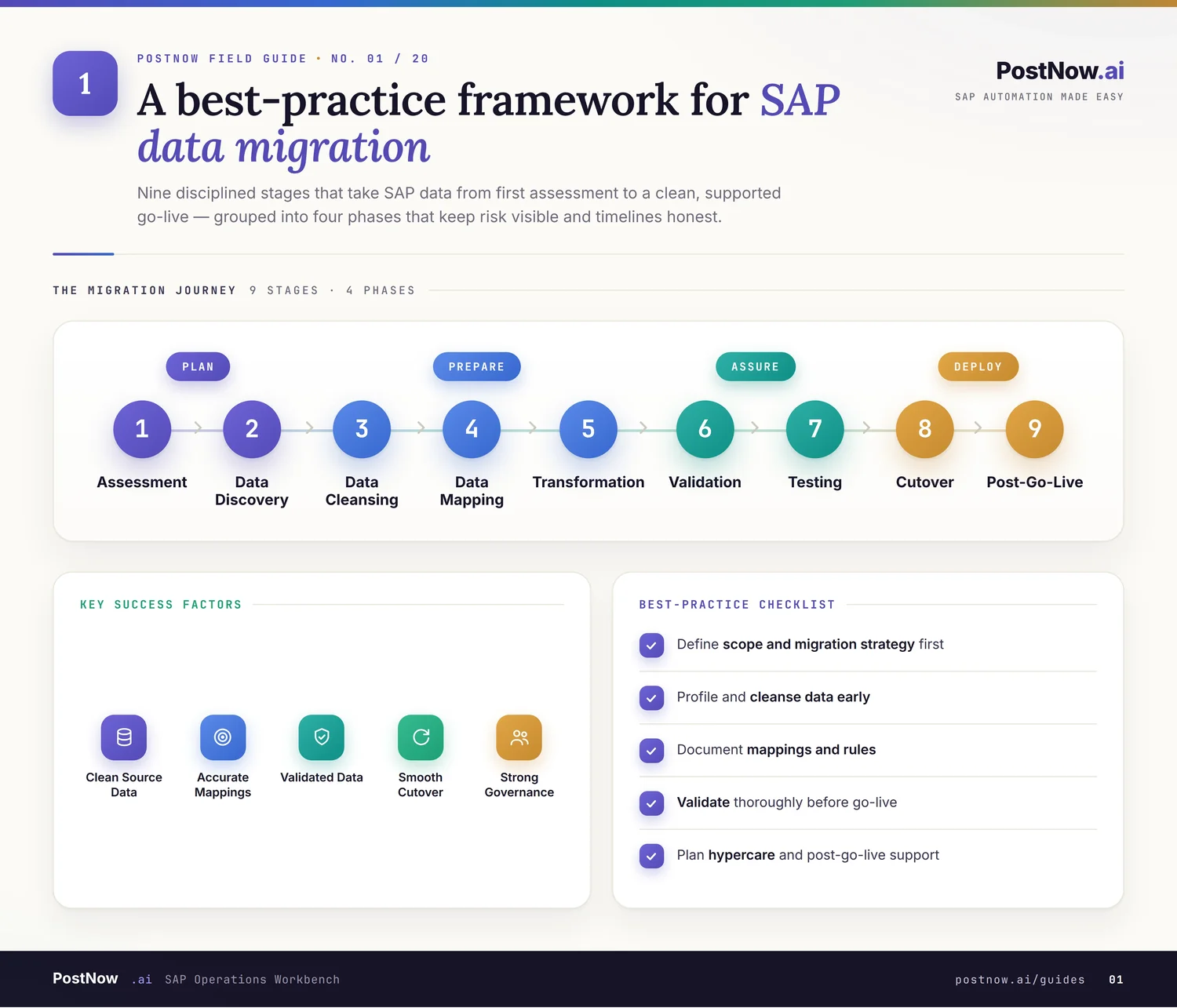
Organizations meet migration at predictable moments: a new SAP implementation, a merger that consolidates systems, or a move to S/4HANA. The trigger differs, but the hard part is always the same, getting trustworthy data into the new system.
This playbook gathers the practices that separate a calm go-live from a chaotic one. For the wider mechanics, the SAP data migration pillar covers the phases and tools; here the focus is on doing each part well.
It is worth being honest about why migrations go wrong. They rarely fail because a tool could not load a record; they fail because the data was not ready, the plan had no slack, or no one could say with confidence that the result was correct. Best practices exist to remove each of those failure modes in turn.
Core concepts: what actually makes a migration succeed
Strip away the tooling and a successful migration rests on four ideas, and every best practice serves one of them.
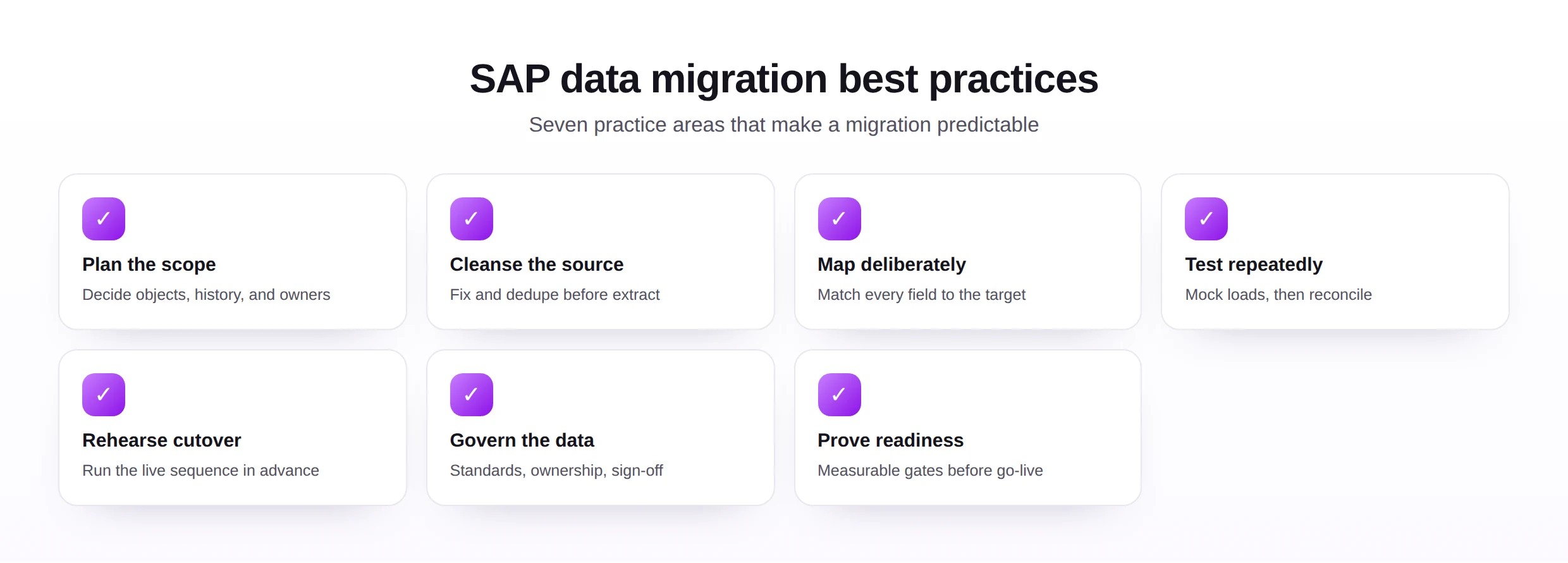
These four ideas are deliberately simple, because a migration is complex enough without a complicated philosophy layered on top. Almost any specific practice you will read about, from naming conventions to reconciliation reports, is really one of these four ideas applied to a particular moment in the project.
Keep these four in mind and the long list of practices below stops feeling like bureaucracy and starts feeling like insurance.
None of these four ideas is glamorous, and that is precisely the point. A migration is not the place for clever improvisation; it rewards teams that do ordinary things reliably, on a schedule, with someone accountable for each piece.
A useful habit is to write these four ideas at the top of the migration plan and return to them whenever a decision feels unclear. More often than not, the right call is whichever option best serves trustworthy data, a repeatable load, provable correctness, or clear ownership.
Common challenges
The obstacles that derail migrations are remarkably consistent, and knowing them in advance is half the battle.
- Underestimated cleansing. The volume of broken, stale, or duplicated source data is almost always larger than the first guess.
- Moving targets. Scope creep, where history or objects are added late, quietly inflates every other task.
- Mapping gaps. Source fields that have no clean home in the target surface late and force rushed decisions.
- Thin testing. A single rehearsal close to go-live leaves no time to fix what it reveals.
- Cutover crunch. Too much work compressed into too small a window, with no room to recover.
It helps to name these challenges out loud at the start of a project, with the whole team in the room. Doing so turns them from nasty surprises into known risks with owners and plans, which is the first and cheapest risk reduction available on any migration.
What unites these challenges is that they are all predictable. Every one of them has been seen on countless projects, which means every one can be planned for. The practices that follow are, in effect, the accumulated answer to that list.
Reading the list, it can feel daunting, but the encouraging truth is that the same handful of practices addresses all of it. You do not need a different defense for each challenge; you need a disciplined approach applied consistently, which is what the rest of this guide lays out.
Best practices, phase by phase
Each phase has a few practices that repay the effort many times over. Treat them as a checklist you revisit, not a one-time read.
Planning
- Fix the scope early: name the objects in, the history to carry, and what is deliberately left behind.
- Set measurable exit criteria for each phase, so progress is a fact rather than a feeling.
- Agree a single owner per object before any data work begins.
Planning earns its keep quietly. A scope that is written down and agreed stops the slow expansion that wrecks timelines, and exit criteria turn vague progress updates into a clear yes or no. The hour spent naming an owner for each object saves days of confusion later, when a question about a record has nowhere to go.
Data cleansing
- Profile the source first, so cleansing targets real problems rather than assumed ones.
- Fix issues at the source where you can, so corrections survive the next extract.
- Resolve duplicates with a clear rule for which record wins, not case by case.
Cleansing is almost always underestimated because the bad data is invisible until you look. Profiling the source brings it into the open, and fixing it where it originates means the improvement is permanent rather than something redone at every extract. A firm rule for resolving duplicates also stops the same debate reopening on every run.
Mapping
- Document every source-to-target decision, including the awkward ones, so nothing is improvised at cutover.
- Decide how retired codes and free-text fields translate, rather than discovering them mid-load.
- Have a business owner approve the mappings, not just the technical team.
Mapping is where business knowledge and system structure meet, so it should not be left to either side alone. Writing down each decision, including how to handle codes and free text with no neat equivalent, turns mapping from a source of cutover surprises into a settled reference the whole team can rely on.
Testing
- Run several mock loads against realistic data, not a token rehearsal.
- Reconcile after every test, comparing counts and key totals to the source.
- Treat each failure as information: fix the cause, then load only the affected records again.
Testing is the practice teams are most tempted to shorten when time is tight, and the one they most regret cutting. Several mock loads, each reconciled against the source, build a body of evidence that the process works. By the final rehearsal, go-live should feel like a repeat of something already done, not a first attempt.
Cutover
Cutover is where planning meets reality. A written runbook, rehearsed in advance, turns a tense morning into a sequence the team has already lived through.
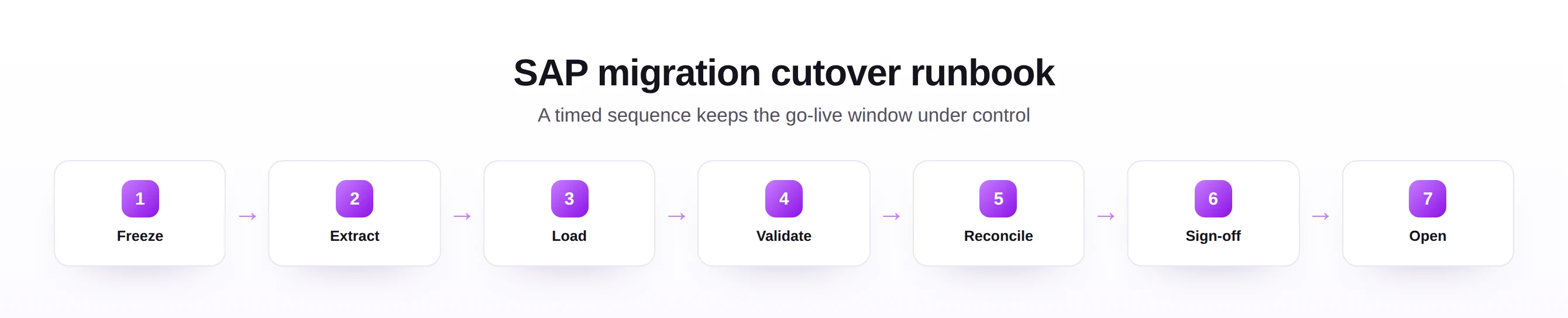
- Sequence the steps with owners and times, and rehearse the whole run end to end.
- Define a clear fallback position before you start, not while something is going wrong.
- Keep the legacy system available for reference until the new one is trusted.
A rehearsed cutover changes the mood of go-live entirely. When the sequence has been run before, the team knows how long each step takes, where the risky moments are, and what to do if one fails. The fallback position matters most precisely because it is rarely needed; deciding it calmly in advance beats improvising it under pressure.
Governance and readiness
- Anchor the migration in strong master data governance, so standards and ownership are clear.
- Make readiness an explicit decision per object, with criteria everyone can see.
- Prepare and load through repeatable routines, often from Excel with Excel to SAP automation, so the rehearsal and the real run use the same path.
Governance ties the phases together. Clear standards and ownership are what let validation stay consistent and readiness be judged the same way for every object. Loading through repeatable routines is the final piece, because a process that runs identically in rehearsal and in production removes the last source of surprise.
A migration readiness model
Readiness is easy to claim and hard to prove. A simple model turns it into a set of gates that each object must pass before it moves.
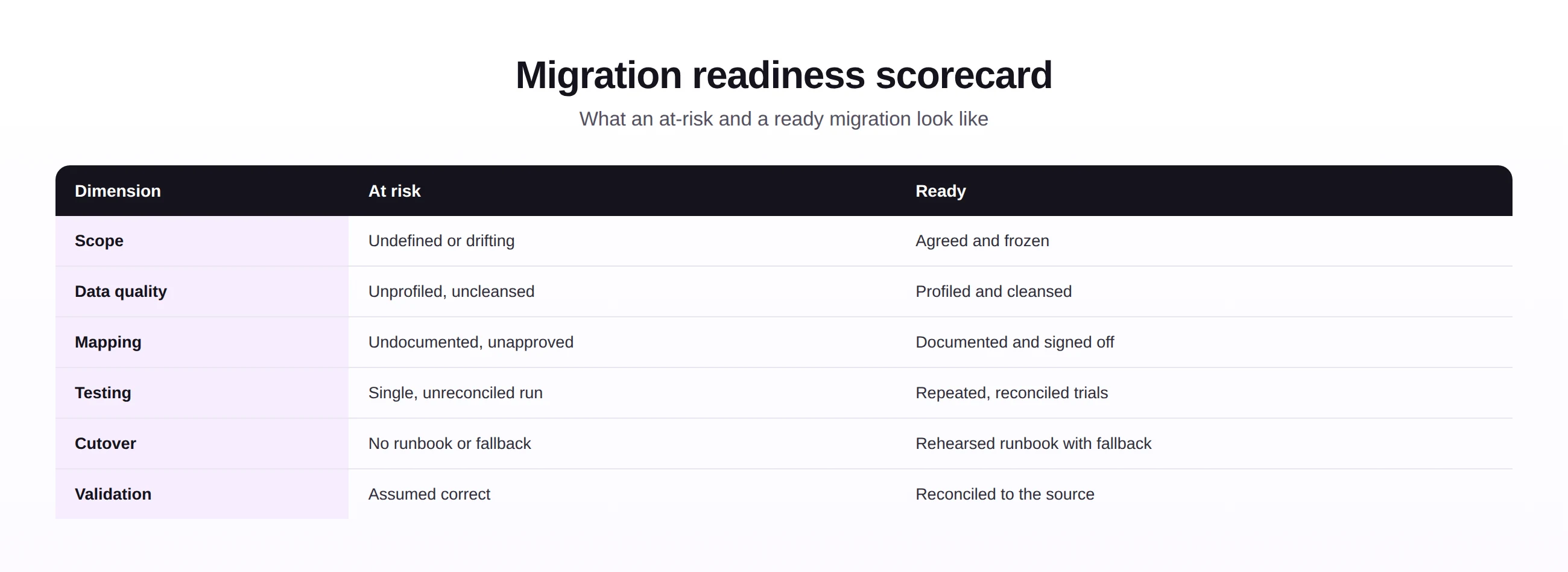
| Gate | What it confirms |
|---|---|
| Scope agreed | The objects and history are fixed and signed off. |
| Quality measured | The source has been profiled and cleansed to an agreed level. |
| Mappings approved | Every source field has a target and an owner has accepted it. |
| Tests passed | Mock loads reconcile against the source within tolerance. |
| Cutover planned | The sequence, owners, and fallback are documented and rehearsed. |
| Owners signed off | Each object has a named owner who accepts it as ready. |
Run the same model for master data such as the vendor, material, and Business Partner objects, and for transactional data such as journal entries and goods movements, so nothing slips through on assumption.
The value of a readiness model is that it replaces argument with evidence. Instead of a meeting where opinions compete over whether to go live, there is a simple question for each object: has it passed its gates. That clarity is worth far more than the small effort it takes to maintain.
A readiness model also helps after go-live. The same gates that proved an object was ready become the baseline you reconcile against, so any drift in the first days of production is caught against a known reference rather than a vague memory of how things looked.
Common mistakes and how to avoid them
The failures below are so common they are almost a checklist of what not to do.
The common thread is timing. Almost every mistake is a task done too late, and almost every fix is the same task done early enough to absorb what it reveals.
It is striking how rarely these mistakes involve technology at all. They are organizational and behavioral, which is encouraging, because a disciplined team can avoid almost all of them without buying anything. The fixes are habits, and habits are within reach of any team.
One more pattern deserves a mention: the quiet erosion of discipline as a deadline nears. Practices followed carefully in early phases get trimmed under pressure, exactly when the stakes are highest. Guarding the routine in the final weeks, rather than relaxing it, is itself a best practice.
Future trends
Migration is getting more assisted, but the disciplines that make it safe are not going away.
- Assisted mapping, where AI proposes source-to-target matches for a person to confirm.
- Continuous validation, checking large volumes against target rules with little manual effort.
- Reusable accelerators, prebuilt objects and templates that shorten the build.
- Cloud and modernization, as more migrations double as a chance to simplify and standardize.
- Stronger governance, with readiness and reconciliation captured as evidence, not just activity.
The tools will keep improving, yet the judgment about what to bring, when it is ready, and whether it reconciled will stay firmly with people.
For teams planning a migration now, the sensible stance is to adopt the assistance where it helps but keep the disciplines intact. A faster mapping suggestion is welcome; skipping reconciliation because a tool seemed confident is not. The technology raises the floor, while the practices still set the ceiling.
The broader lesson is that migration is becoming less of a heroic event and more of a managed, repeatable capability. Teams that treat each move as a chance to refine their playbook find the next migration calmer than the last, because the hard-won lessons are written down rather than relearned.