Introduction
Master data governance and master data management sound alike, and they are often used as if they mean the same thing. They do not. One is about managing the data; the other is about governing the rules that surround it.
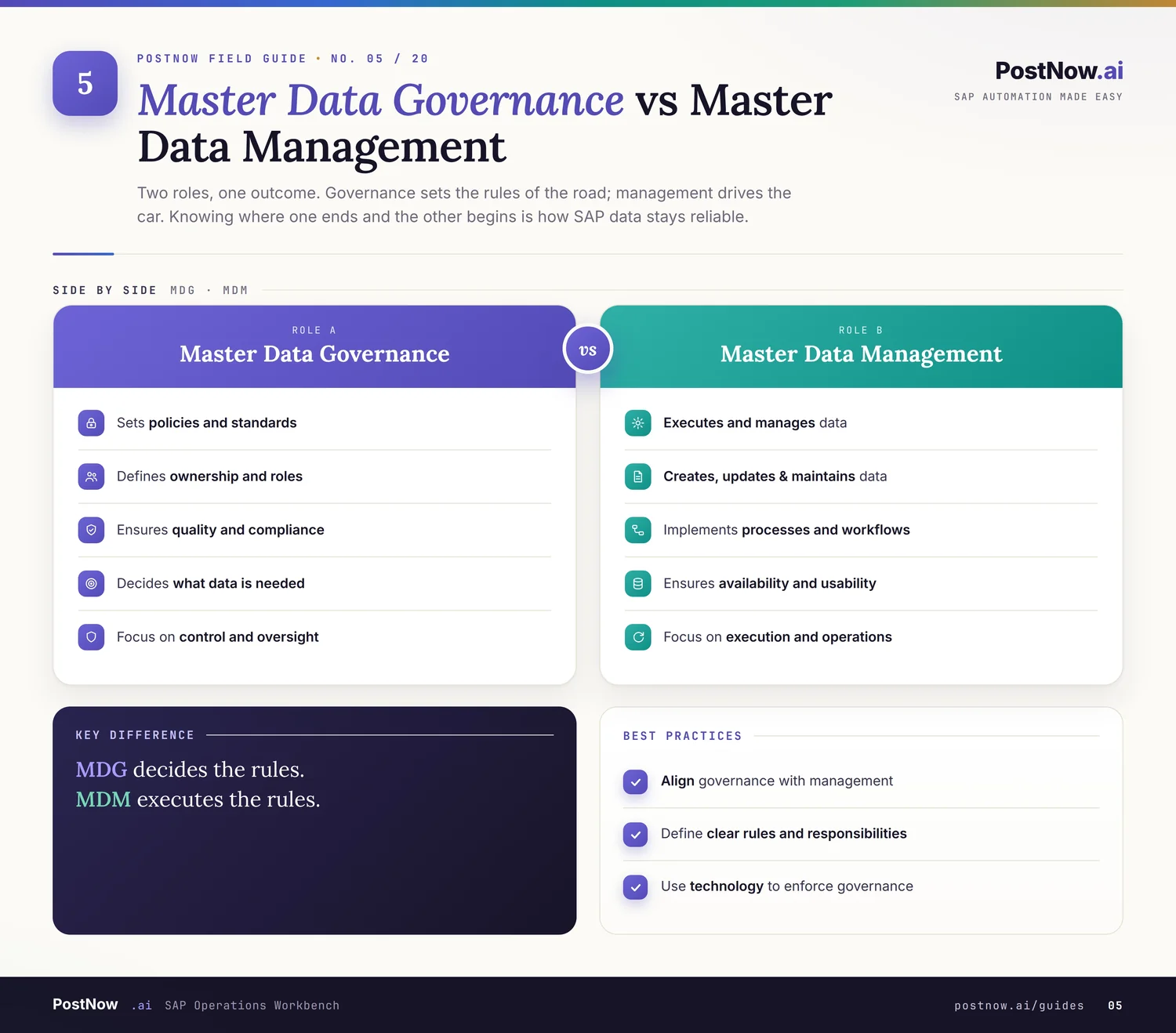
The confusion matters because it leads to real mistakes. Organizations buy a tool expecting it to solve a problem it was never meant to address, or they assign a responsibility to the wrong team. A clear distinction between the two saves a great deal of that wasted effort.
This article draws the line plainly. It defines each discipline, sets out how their responsibilities differ, explains when an organization needs each, and shows how they work best in combination. For the full treatment of either, the master data governance and master data management pillars go deeper.
It is written for the leaders and SAP teams deciding how to structure their data effort, who need clarity rather than jargon.
It is worth saying that the distinction is not academic. The way an organization splits these two responsibilities shapes which team gets which budget, which tool is bought, and who is on the hook when a record is wrong. Getting the concepts right early prevents a tangle of misassigned work later.
Part of why the terms get muddled is that they overlap at the edges. Standards, for instance, are developed within management but ratified within governance, so the same word lives in both worlds. Recognizing these shared touchpoints, rather than pretending the two never meet, is key to using the distinction well.
Notice, too, that the same person can wear both hats in a small team. The distinction is about the type of work, not necessarily about separate departments. What matters is that when someone is cleansing a record they know they are managing, and when they are approving a change they know they are governing.
A final point of clarification before the comparison: this article is about the disciplines, not about any particular product that happens to carry a similar name. The ideas of managing and governing master data apply whatever tools an organization uses, and understanding them clearly makes any tool far easier to evaluate against a real need.
Core concepts: defining both
The simplest way to tell them apart is to ask what each one is responsible for.
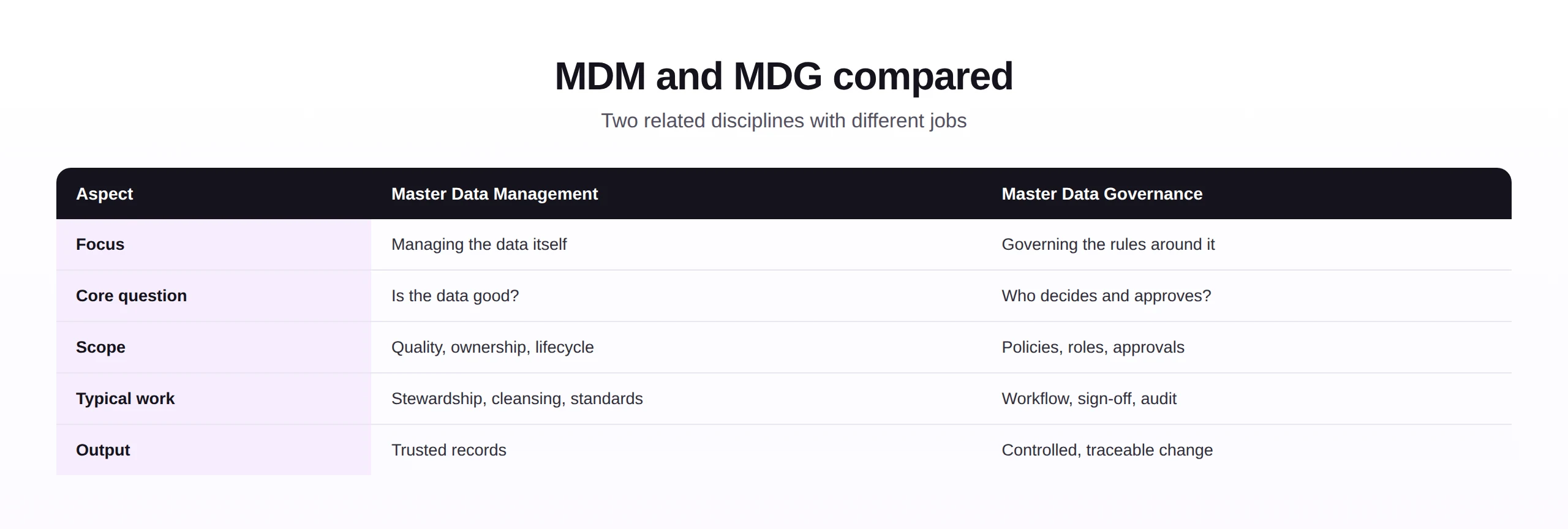
Master data management is the practical work of keeping master data accurate, complete, and current. It covers ownership, standards, stewardship, and the lifecycle of each record. Its central question is whether the data is good.
Master data governance is the framework of rules, roles, and controls that decides how master data may be created and changed. It covers policy, approval workflows, and accountability. Its central question is who is allowed to do what, and how that is proven.
A useful analogy is a library. Management is the work of cataloguing, shelving, and repairing the books so they are usable; governance is the set of rules about who may add, remove, or alter a book, and how those decisions are recorded. You need both for the collection to stay trustworthy.
The library analogy is worth lingering on, because it captures why neither discipline is optional. A beautifully catalogued library with no rules about who can alter the books will not stay accurate for long, and a strict set of rules over a pile of damaged books does not make them readable. Order and rules serve different needs.
Another way to frame it: management is mostly about the present state of the data, while governance is mostly about the process of changing it. One asks whether today's records are right, the other whether tomorrow's changes will be made properly. Both questions need an answer.
With the definitions settled, the differences between the two come into sharper focus, and so do the problems that arise when they are blurred together. The next section looks at exactly those problems before turning to how the two are best combined.
Common challenges
Most of the trouble in this area comes from blurring the two, and it shows up in predictable ways.
- Expecting one to do the other, such as assuming a governance workflow will clean up existing data.
- Governance without management, where rules exist but the underlying data is still poor.
- Management without governance, where data is cleaned but nothing stops it degrading again.
- Unclear ownership, where no one can say which team owns standards versus approvals.
- Tool confusion, where software is bought for one need and expected to meet the other.
Each of these traces back to the same root: treating two distinct disciplines as one. Separating them, then deliberately connecting them, is the way out.
It is encouraging that these challenges are conceptual rather than technical. They are solved by clear thinking and clear assignment, not by a bigger budget. Once a team genuinely internalizes that management and governance are different jobs, most of the confusion simply dissolves.
It helps to picture them as a loop rather than a line. Governance defines how things should be done, management does them and reports what happened, and governance uses that feedback to refine the rules. Neither comes strictly first; they cycle, each making the other better over time.
Recommended approach: using both together
In a mature organization, the two are not rivals but partners. Governance sets the rules, and management carries them out.
How the responsibilities split
The clearest way to combine them is to divide responsibility task by task, so there is no overlap and no gap.
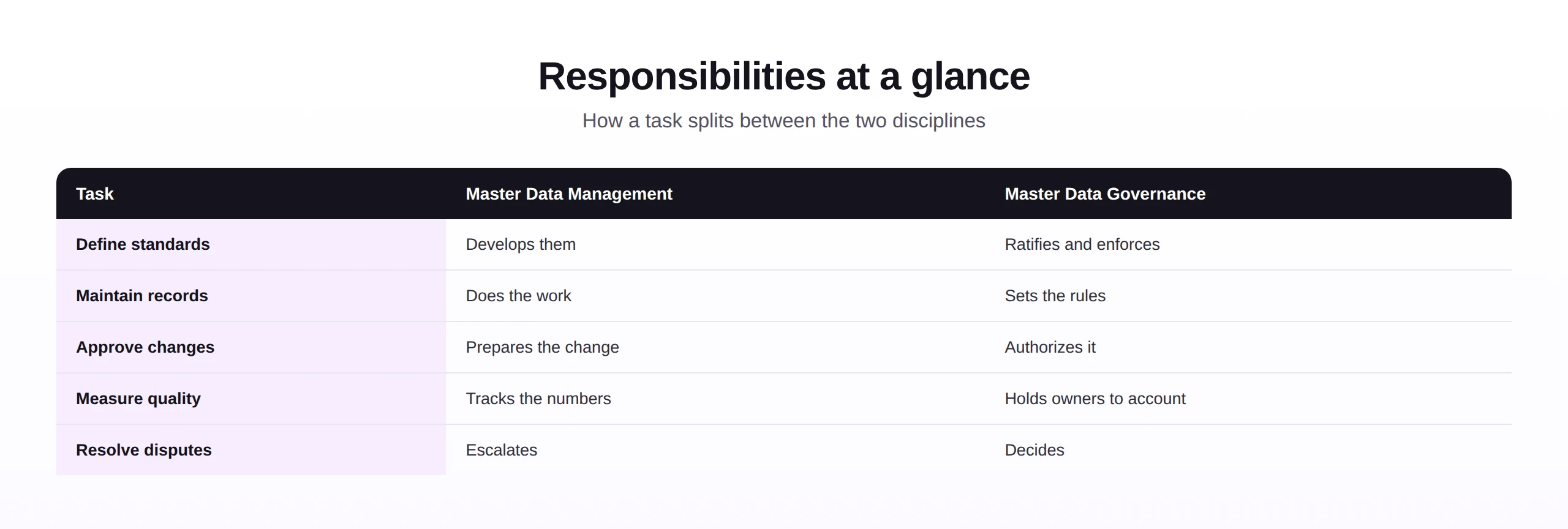
Governance ratifies and enforces standards that management develops; governance authorizes the changes that management prepares; governance holds owners to account for the quality that management tracks. Each discipline does what it is suited to, and the handoffs between them are explicit.
The benefit of splitting responsibilities this precisely is that nothing is anyone's vague duty. Each task has a side that owns it and a side that supports it, and the boundary between preparing a change and approving it is exactly where good control lives. Blurring that boundary is how both quality and accountability slip.
Governance models
Governance can be centralized, with a single team setting rules for the whole organization, or federated, with shared principles applied locally by each domain. Centralized models give strong consistency; federated models give flexibility and local ownership. Many organizations land somewhere between the two.
There is no single correct model, and the right choice often shifts as an organization grows. A young company may govern centrally because it is small enough to do so, while a large, diverse one may have to federate to stay practical. The test is whether the model produces consistent data without becoming a bottleneck.
Making them work as one
- Define standards once and enforce them at the point of entry, often through repeatable loads such as Excel to SAP automation.
- Route changes through approval, then let management execute them cleanly and validate against SAP.
- Apply the same split across domains, from the vendor and customer masters to the material master and Business Partner.
When the two run well together, the experience for an ordinary user is seamless. They request a change, it is approved by the right person, and it is executed and validated cleanly, all without the user needing to know where management ends and governance begins. That invisibility is the sign of a mature setup.
It is also fair to admit that the boundary is sometimes debated, and reasonable people draw it in slightly different places. That is fine. The point of the distinction is not to win a definitional argument but to make sure every important task has a clear home, which any sensible split achieves.
A decision guide: where to start
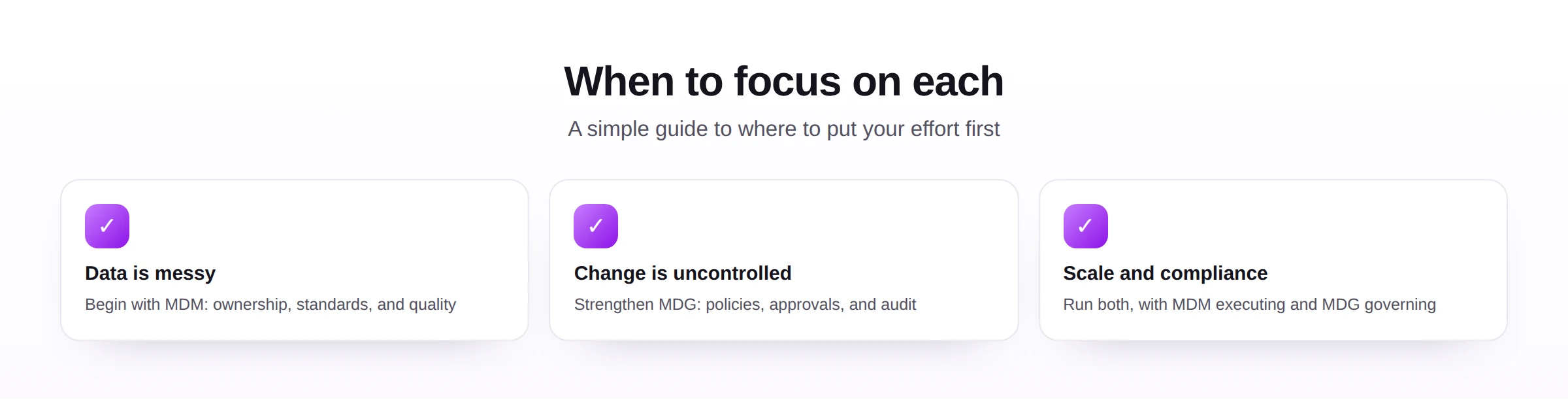
Few organizations build both at once. The right starting point depends on which problem hurts more today.
| If your main problem is... | Start with... |
|---|---|
| Inaccurate or duplicated records | Master data management, to fix quality at its source. |
| Uncontrolled or untraceable changes | Master data governance, to add policy and approval. |
| Audit and compliance pressure | Governance first, with management close behind. |
| A migration or S/4HANA move | Management to clean, with governance to keep it clean. |
| Growth that outpaces manual control | Both, run together as a single capability. |
Whatever the entry point, the destination is the same: management and governance operating as two halves of one trusted data capability. A clean data migration is often where the two first come together in practice.
The decision guide is meant as a starting point, not a permanent assignment. An organization that begins with management to fix a quality crisis will usually find that, once the data is clean, the pressing need becomes keeping it that way, which is a governance problem. The emphasis naturally rotates over time.
It is striking how a single clear sentence can prevent a year of confusion: management looks after the data, governance looks after the rules. Repeating that line whenever a question arises keeps a whole team aligned without needing to relitigate the concepts each time.
Common mistakes and how to avoid them
The mistakes here are mostly about confusing scope, and each has a simple correction.
The remedy in every case is the distinction this article draws. Decide which discipline owns which task, give each the tools it actually needs, and design the handoffs so nothing falls through the gap between them.
Underneath every one of these mistakes is the same misunderstanding, that the two disciplines are interchangeable. Hold the distinction firmly and the errors become almost obvious in advance, because each one is simply an attempt to make one discipline do the other's job.
A simple habit prevents most of this: before assigning any data task or buying any data tool, ask whether the need is about the quality of the data or the control of its change. That one question routes the work to the right discipline more reliably than any org chart.
Future trends
Both disciplines are evolving, and the line between them is becoming more about roles than tools.
- AI in management, suggesting matches and spotting quality issues for stewards to confirm.
- Embedded governance, where approval and policy are built into everyday automation tools rather than bolted on.
- Convergence in platforms, as single tools increasingly support both the management and governance of data.
- Business-led ownership, putting more of both disciplines in the hands of the people who use the data.
- Quality as a shared metric, reported and governed together rather than in separate silos.
Even as tools converge, the conceptual difference will remain useful. Knowing whether a problem is one of data quality or of decision rights will always point to the right fix faster than treating everything as the same.
For organizations planning their data strategy now, the practical message is to name the two functions explicitly, even if the same team does both at first. Naming them keeps the responsibilities visible, makes it clear what each tool is for, and leaves room to grow each function as the need for it matures.
One more trend deserves mention: as platforms merge the two, the risk is that the conceptual line blurs along with the tooling. The teams that benefit most will be those that keep the distinction clear in their roles and processes even when a single tool happens to cover both.
In the end, the relationship between the two is best understood as complementary rather than competitive. Management gives governance something worth governing, and governance gives management the rules that make its work last. An organization that respects both finds its data is not only clean today but dependable for the long run.