Executive summary
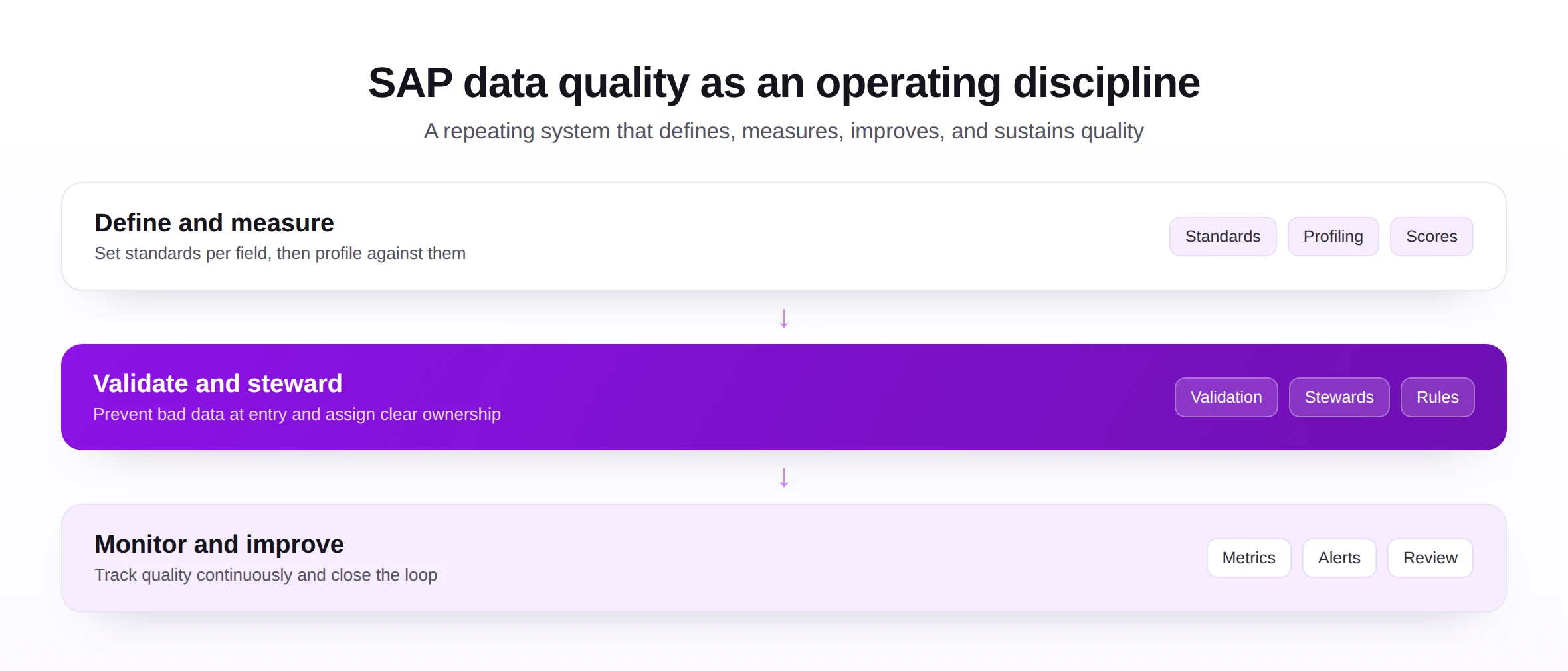
Data quality is not a project an organization completes; it is a discipline an organization operates. The enterprises that trust their SAP data are the ones that have built a system to keep it trustworthy, not the ones that cleaned it once.
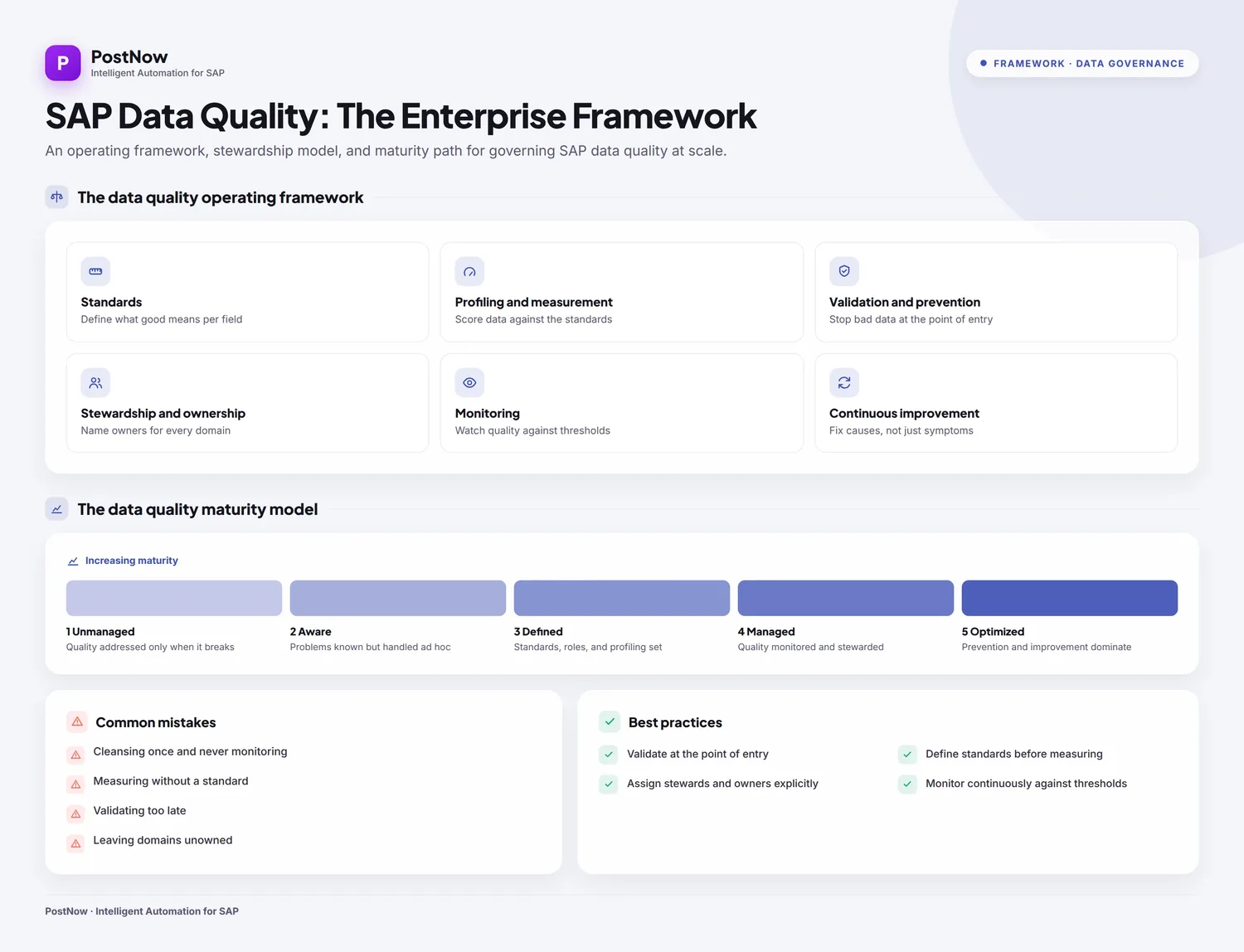
This resource defines that operating discipline in full. It is written for directors, architects, data governance teams, and business process owners who must move data quality from a recurring fire drill to a managed capability. It provides an operating framework, a stewardship and governance model, a monitoring framework, a maturity model, and a continuous improvement loop, assembled into a system that can be run and measured.
Three principles run throughout. Quality is multi-dimensional and must be measured, not felt. Quality is preventable at the point of entry far more cheaply than it is correctable later. And quality decays without ownership, so it requires named stewards and clear governance to sustain.
For leadership, the takeaway is that data quality responds to management. Define standards, measure against them, prevent errors at entry, assign ownership, monitor continuously, and improve in a loop, and quality becomes a property the organization controls rather than a condition it suffers. This guide builds on the master data management and master data governance pillars.
This resource is built to serve several readers. A director can take the executive summary, the maturity model, and the action plan and have what they need to sponsor a quality program. An architect will work through the operating framework and monitoring approach. A data governance team will live in the stewardship and governance sections. The structure supports each without repeating itself.
It is also written to last. The dimensions, the capabilities, and the stewardship roles describe how quality behaves, not how any tool works, so the guidance should remain valid across SAP releases and across whatever profiling or monitoring tooling an enterprise adopts.
One framing is worth fixing at the start. Data quality is an operating discipline, not a project with an end date. A project finishes; a discipline runs continuously. Mistaking the one for the other is the root of most disappointment with data quality, because a cleaned data set with no system to keep it clean begins decaying the day the project closes.
It helps to read this guide alongside the master data pillars, which describe how data is managed and governed; this resource focuses specifically on the quality of that data, the property that determines whether it can be trusted. The three together cover management, governance, and quality as a connected whole.
The guide assumes that quality is worth managing because the data is shared and consequential, which is the normal condition in an SAP landscape. Where data is genuinely trivial and isolated, a lighter touch is appropriate, and part of the discipline is knowing where full rigor is warranted and where it is not.
Why this topic matters
Poor data quality is a tax levied on everything an SAP system does. It is rarely catastrophic in a single instance and almost always corrosive in aggregate.
Business impact
Every report, decision, and automated process draws on the underlying data. When that data is sound, the outputs can be trusted and acted on; when it is not, the errors propagate silently into forecasts, payments, and plans. Because the damage is distributed rather than concentrated, it is easy to under-count, which is precisely why it persists.
Quality also shapes the return on every other investment. Analytics, automation, and reporting initiatives all assume trustworthy inputs, and each is undermined in proportion to the data's flaws. Improving quality therefore raises the value of the entire portfolio of systems that depend on it.
Governance impact
Quality cannot be sustained without ownership, and ownership is a governance question. Who decides what good looks like for a field, who resolves an issue, and who answers for a domain are all governance decisions, and where they are unanswered, quality has no one to defend it. This is why quality and governance are inseparable in practice.
Operational impact
Operationally, poor data stalls processes and generates rework. A blocked posting, a misrouted delivery, or a duplicated payment each traces back to a quality failure, and each consumes time that the organization will never recover. Quality, in this sense, is operational efficiency by another name.
SAP-specific impact
SAP concentrates these effects because its data is shared so widely. A single master record may be referenced by thousands of transactions, so one flaw radiates across the landscape. The interdependence that makes SAP powerful also makes its data quality consequential, which is why a structured discipline, rather than occasional cleanup, is essential.
These impacts compound rather than add. A completeness gap becomes a process delay, which becomes a workaround, which becomes a new source of inconsistency, and the original small flaw has now spawned several. Because quality problems breed one another, addressing them at the source is far more effective than treating each downstream symptom in turn.
Quality is also an enabler in a way that is easy to overlook. It does not merely prevent harm; it unlocks value, because trustworthy data is the precondition for confident automation, reliable analytics, and faster decisions. An investment in quality is therefore an investment in every capability that depends on data, which is to say nearly all of them.
The cost of inaction is the strongest argument of all. Doing nothing is not neutral; it allows decay to continue and errors to accumulate, so the gap between a managed and an unmanaged data estate widens over time. Quality is one of the few areas where standing still actively makes the position worse.
A further reason quality matters is that it is the quiet foundation of trust. Once users encounter a few wrong records, they begin to doubt the system as a whole, and rebuilding that trust is far harder than maintaining it. Quality, in this sense, protects the credibility of the entire SAP landscape, not just individual records.
It is also worth being honest that quality work is rarely glamorous. Its rewards are largely the absence of problems, which is easy to take for granted, so sustaining the discipline requires leadership that values prevented errors as much as solved crises. Naming that value explicitly is part of keeping the discipline funded.
The discipline also pays back unevenly but reliably. Early gains come quickly from defining standards and profiling a neglected domain, while later gains come from the slower work of prevention and monitoring. Knowing this shape helps leaders set expectations: visible improvement first, durable improvement after.
It is also worth naming the audiences this discipline ultimately serves. Finance teams depend on it for accurate balances, procurement for clean vendors, logistics for reliable materials, and analytics for trustworthy inputs. Quality is rarely owned by these consumers, yet every one of them suffers when it lapses, which is the strongest argument for funding it centrally.
The sections that follow apply this conviction in detail, moving from concepts through the operating framework to a concrete action plan any SAP organization can adopt.
Core concepts and the dimensions of quality
A managed discipline needs a precise vocabulary. These concepts and dimensions are the foundation on which the framework, stewardship model, and monitoring approach are built.
A data quality dimension is a measurable aspect of quality. The core dimensions are accuracy, whether a value reflects reality; completeness, whether required fields are present; consistency, whether the same fact agrees everywhere; timeliness, whether data is current when needed; validity, whether values fit their rules; and uniqueness, whether unintended duplicates exist. Each is measured separately because strength in one does not imply strength in another.
A data standard is the agreed definition of acceptable quality for a field or record, expressed as rules and formats. Without a standard, quality cannot be measured, only debated, which is why defining standards is the first capability in the framework.
Profiling is the measurement of data against its standards to produce scores rather than impressions. Validation is the application of rules to prevent non-conforming data from entering in the first place. The two are complementary: profiling reveals the current state, validation protects the future one.
Stewardship is the ongoing responsibility for the quality of a data domain, held by a named steward. Governance is the structure of roles, policies, and decision rights within which stewardship operates. Together they answer the question of who keeps the data good.
These definitions matter because quality conversations otherwise dissolve into generality. When someone says the data is poor, the discipline asks: poor on which dimension, against which standard, measured how, and owned by whom. That precision is what makes quality manageable rather than merely lamented.
Precision in these terms prevents costly confusion. When a team reports that data is clean, the discipline asks against which standard and measured how; when it reports that validation is in place, it asks whether that means prevention at entry or merely a check at reporting. The questions are exacting because the looser answers, discovered later, are expensive.
The dimensions interact, which is why they are assessed together. A record can be complete but inaccurate, or valid in format but stale in content, so improving one dimension while ignoring another produces data that is good on paper and untrustworthy in use. Reading the dimensions as a set guards against this kind of partial, misleading improvement.
It also helps to define quality as fitness for purpose rather than perfection. The goal is data good enough for the decisions and processes that rely on it, not flawless data for its own sake. Anchoring quality to actual use keeps the effort proportionate and prevents the discipline from chasing an unreachable and unnecessary ideal.
It is worth distinguishing data quality from data governance, since the two are often conflated. Governance is the structure of roles and decision rights; quality is the measurable condition of the data itself. Governance enables quality, but the two are assessed and improved through different means, which is why this resource treats them as related yet separate.
These foundational concepts recur throughout the framework, the maturity model, and the monitoring approach, which is why they are defined carefully here. A reader who is clear on the difference between profiling and validation, or between an owner and a steward, will find the rest of the resource straightforward to apply.
Throughout, the resource favors a small number of capabilities applied well over a large number applied thinly. It is better to operate six capabilities consistently than to maintain a dozen on paper, because a discipline simple enough to run is a discipline that gets run.
The capabilities are described in a logical order, but in practice they operate together rather than in strict sequence. An organization improving a domain will define standards, profile, validate, and steward more or less concurrently, with monitoring and improvement following once a baseline exists. The framework names the parts; the discipline runs them as a whole.
The data quality operating framework
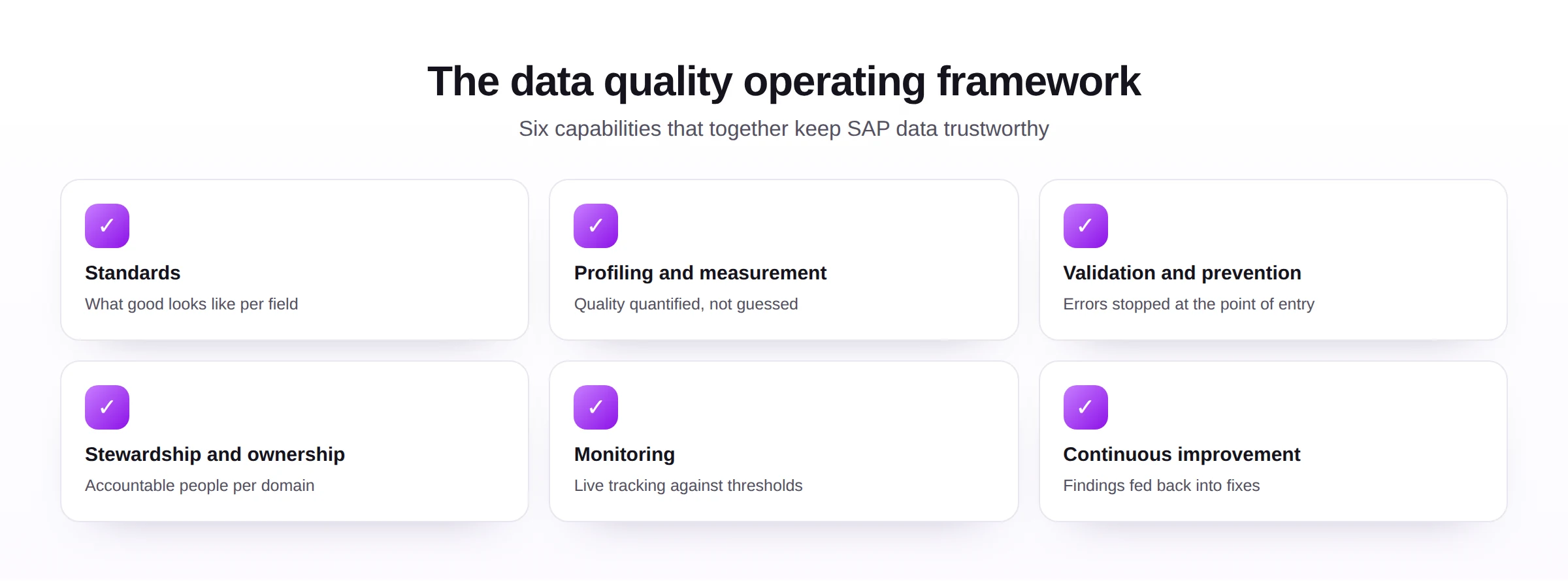
The operating framework comprises six capabilities. Together they form a system that produces and protects quality rather than a one-time cleanup.
Standards
The framework begins by defining, for each important field, what good means in terms of rules and formats. This is the most foundational and most frequently skipped capability, because it requires the organization to decide explicitly what it has often only assumed. Everything downstream depends on an agreed answer.
Profiling and measurement
With standards defined, the data is profiled against them to produce dimension-level scores. Measurement converts a vague sense of quality into specific, trackable numbers, which is what allows improvement to be targeted and progress to be demonstrated.
Validation and prevention
This capability stops non-conforming data from entering, by validating records at the point of entry against the standards. It is the most economical capability, because every error prevented is an error that never has to be found, diagnosed, and corrected. It connects directly to disciplined data entry such as Excel to SAP automation.
Stewardship and ownership
This capability assigns accountable people to data domains, so that quality has owners rather than orphans. Without stewardship, the other capabilities decay, because no one is responsible for acting on what measurement and monitoring reveal.
Monitoring
Monitoring tracks quality continuously against thresholds, so that decay is detected early rather than at the next crisis. It turns quality from a periodic audit into a live, observed property of the data.
Continuous improvement
Finally, continuous improvement feeds findings back into standards, validation, and stewardship, so the system gets better over time. This is the capability that distinguishes a static cleanup from a discipline that compounds.
The six capabilities interlock into a single system. Standards make measurement possible; measurement directs validation; validation reduces the load on stewardship; stewardship acts on monitoring; monitoring feeds improvement; and improvement refines the standards. Adopting them in isolation yields a fraction of the value, because much of their power comes from how each supports the next.
The framework is deliberately lightweight, because a heavy process is abandoned. Six capabilities are enough to be complete without being burdensome, and an organization can deepen any one of them as its needs grow rather than beginning with more ceremony than it can sustain. Adoption that survives contact with daily work matters more than theoretical completeness.
It is worth noting that the framework applies equally to master data and to transactional data. A vendor record and a financial posting both benefit from standards, validation, and monitoring, so the same operating model serves the whole SAP estate rather than any single object, which is part of what makes it efficient to adopt.
The order of the capabilities is not arbitrary. Standards must come before measurement, measurement before targeted validation, and stewardship before monitoring can be acted upon. An organization that tries to monitor before it has standards, or to validate before it knows its baseline, tends to produce activity without improvement.
The data quality maturity model and stewardship
To manage quality, an organization must know how managed it currently is. The maturity model provides that read, and the stewardship model defines who carries the discipline forward.
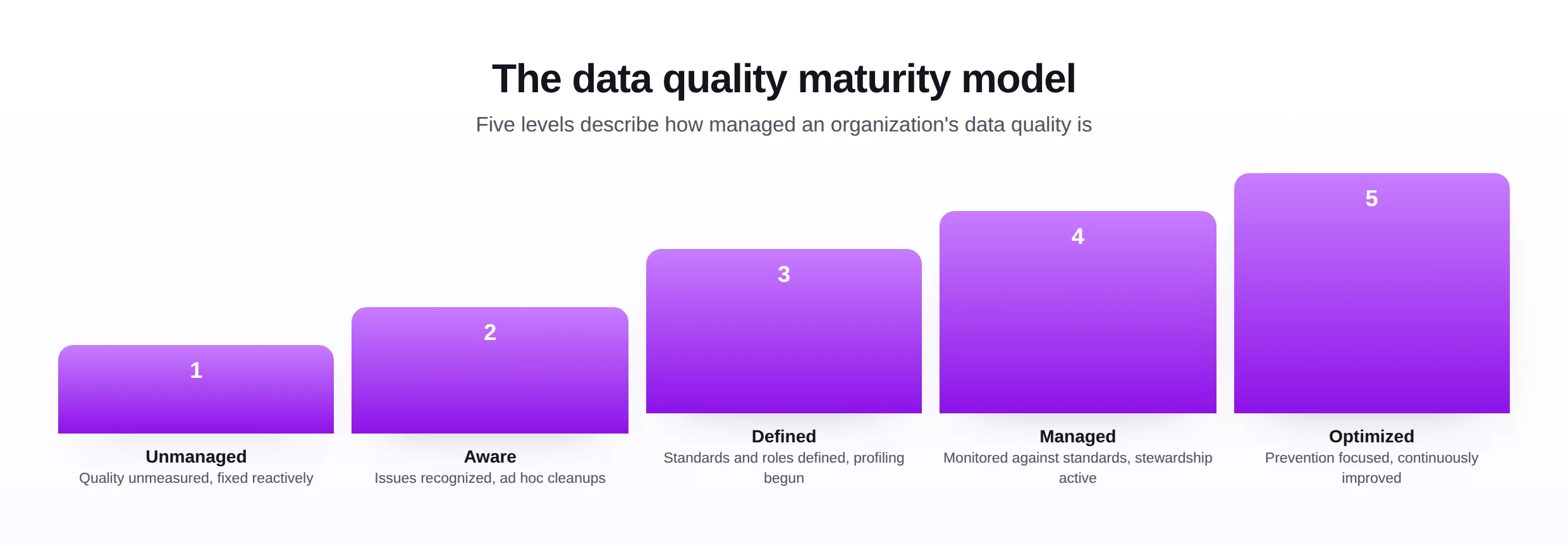
At the unmanaged level, quality is unmeasured and fixed reactively; at the optimized level, it is prevention-focused and continuously improved. The intermediate levels, aware, defined, and managed, describe the path most organizations travel. Knowing your level sets realistic expectations and identifies the next capability to build.
Maturity is carried by people, which is where the stewardship model comes in. Three roles share responsibility: the data owner, accountable for standards and quality in a domain; the data steward, who monitors, resolves, and maintains day to day; and the data custodian, who manages the systems, access, and storage. Clear separation of these roles is what keeps quality from becoming everyone's concern and no one's job.
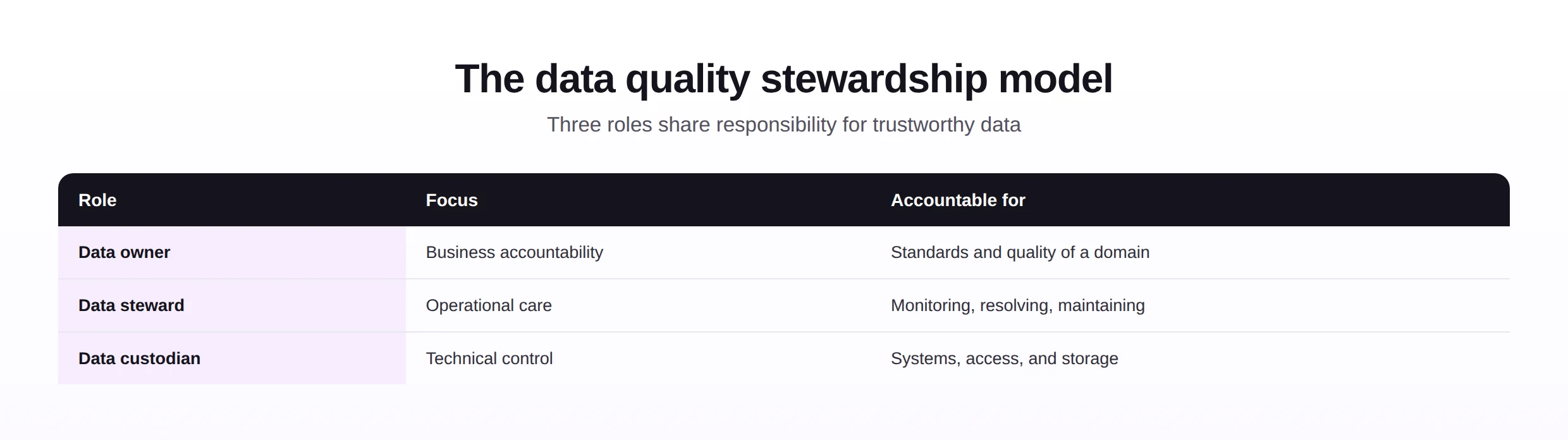
Above these roles, a governance structure sets policy and resolves cross-domain questions, often through a council that includes business and technical representation. The structure need not be elaborate, but it must make decision rights clear, so that disagreements about standards or priorities have a defined way to be settled.
| Maturity level | What it means for data quality |
|---|---|
| 1 Unmanaged | Quality is unknown and addressed only when it breaks. |
| 2 Aware | Problems are recognized but handled ad hoc. |
| 3 Defined | Standards, roles, and profiling are established. |
| 4 Managed | Quality is monitored and actively stewarded. |
| 5 Optimized | Prevention and continuous improvement dominate. |
The maturity model is best used as a planning input, not a grade. An organization at the aware level should expect to invest in standards and profiling before it can monitor meaningfully, while one at the managed level can focus on prevention and improvement. Reading the model this way turns an honest view of weakness into a sensible plan rather than a source of discouragement.
Stewardship succeeds or fails on credibility. A steward with responsibility but no authority, or with a title but no time, cannot sustain quality, so the roles must come with the standing and the capacity to act. Naming a steward is the easy part; empowering one is what actually keeps a domain healthy.
The governance structure around stewardship can be summarized as a small set of bodies and decision rights. The model below shows a typical arrangement, kept deliberately light so that it clarifies accountability rather than adding bureaucracy.
| Body or role | Decision right |
|---|---|
| Data governance council | Sets policy and resolves cross-domain disputes. |
| Data owner | Approves the standards for a domain. |
| Data steward | Resolves quality issues within a domain. |
| Data custodian | Maintains the systems, access, and storage. |
The purpose of the structure is not to add layers but to make decision rights explicit, so that a disagreement about a standard or a priority has a defined place to be settled rather than stalling indefinitely between teams.
The stewardship roles can be held by different people or, in smaller organizations, combined, as long as the responsibilities are explicit. What matters is not the number of individuals but the clarity of accountability, so that for every domain it is unambiguous who sets the standard, who maintains the data, and who manages the systems beneath it.
A maturity level should be read as a description of the current system, not a judgement of the people in it. Most organizations sit at the lower levels not through negligence but because no one ever built the discipline, and the model's value is to show the next step rather than to assign blame for the present state.
Implementation roadmap and monitoring framework
The roadmap turns the framework into an operating rhythm, with monitoring and continuous improvement as its engine.
Planning and execution
Begin by selecting a priority data domain, defining its standards, and profiling it to establish a baseline. Then cleanse the issues found, ideally at the source, and put validation in place at the point of entry so the same problems do not recur. The output of this stage is a domain that is measured, cleaned, and protected.
Governance and stewardship
Assign the owner, steward, and custodian for the domain, and connect them to the governance structure. This is where the discipline becomes durable, because it gives the monitoring that follows someone to act on its findings.
The monitoring framework
Monitoring tracks each dimension against agreed thresholds and raises attention when quality drifts. The framework below summarizes what effective monitoring includes, turning quality into a continuously observed measure rather than a periodic surprise.
| Monitoring element | Purpose |
|---|---|
| Dimension metrics | Track accuracy, completeness, and the other dimensions over time. |
| Thresholds | Define the level at which a dimension needs attention. |
| Dashboards | Make quality visible to owners and stewards. |
| Alerts | Flag drift early, before it spreads. |
| Review cadence | Bring stewards together to act on findings. |
Continuous improvement
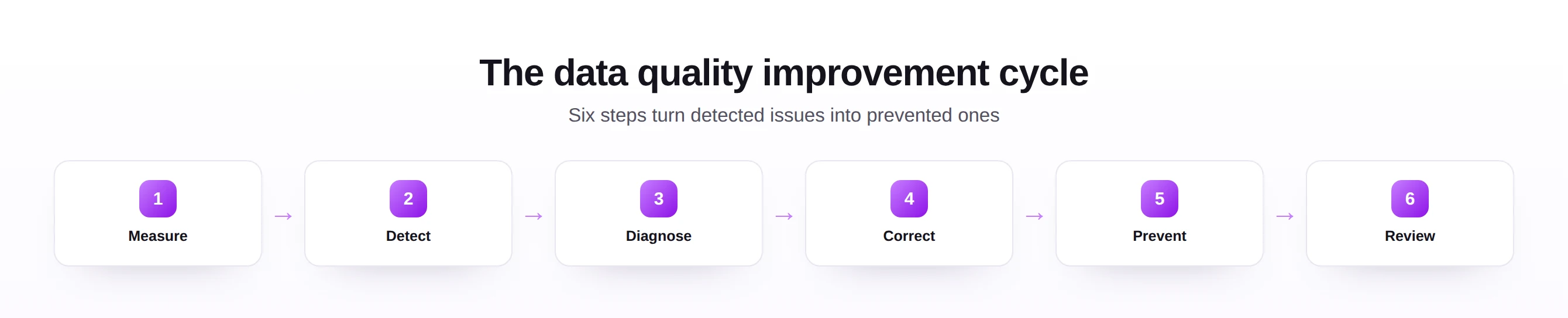
The improvement cycle closes the loop: measure quality, detect issues, diagnose their cause, correct them, prevent recurrence by strengthening validation, and review the result. Repeated, this cycle moves the organization steadily up the maturity model, shifting effort from correction toward prevention.
The improvement cycle is what makes the whole discipline compound. Each turn of measure, detect, diagnose, correct, prevent, and review not only fixes today's issues but strengthens the validation that prevents tomorrow's, so the volume of correction needed should fall over time. A discipline that is working becomes quieter, not louder, as prevention takes over from cleanup.
The economics strongly favor prevention. An error caught at the point of entry costs a moment to reject; the same error found in a report costs an investigation, a correction, and the unwinding of every decision it touched. This asymmetry is why the framework places validation early and treats prevention as the most valuable capability of all.
Monitoring deserves the discipline of agreed thresholds rather than raw vigilance. Without a defined level at which a dimension warrants action, monitoring produces either constant noise or complacency. Thresholds turn a stream of numbers into clear signals, telling stewards not just how quality is trending but when to intervene.
The improvement cycle benefits from being scheduled rather than reactive. A regular review, on a cadence the stewards can sustain, ensures that detected issues are actually diagnosed and prevented rather than merely logged. Without a rhythm, even a well-designed cycle tends to stall at detection, accumulating known problems that no one finds time to address.
Best practices
A set of disciplines, applied together, turns the framework into a quality capability that lasts.
- Validate at the point of entry, so prevention does the heavy lifting and correction handles only the residue.
- Define standards before measuring, so quality has a target rather than an opinion.
- Assign stewards and owners explicitly, grounded in master data governance, so quality is never an orphan.
- Monitor continuously against thresholds, so decay is caught early and acted on.
- Keep an audit trail of changes, so issues can be traced to their source and prevented there.
- Improve in a loop, feeding findings back into standards and validation so the system compounds.
These practices place governance, validation, auditability, scalability, and maintainability at the center of the discipline. Adopted together, they produce data that stays trustworthy because the system around it is arranged to keep it so, rather than depending on periodic rescue.
These practices reinforce one another into a durable whole. Standards enable measurement, measurement enables monitoring, monitoring enables stewardship to act, and improvement refines the standards again. An organization that adopts them as a connected system gains far more than one that picks a few, because the value lies as much in their connections as in each practice alone.
They should also be applied in proportion to the stakes. A rarely used reference table does not warrant the same rigor as a master data domain that thousands of transactions depend on, and imposing heavy process on trivial data breeds the cynicism that later undermines the discipline where it matters. Matching effort to consequence keeps the practice credible.
Finally, each cycle should leave the organization more capable. The standards written, the validations built, and the stewardship established all raise the maturity level for next time, so quality work is cumulative rather than repetitive. Treating each domain brought under control as a permanent gain, not a temporary fix, is what moves an enterprise steadily up the maturity model.
One practice underpins all the others: making quality visible. A dimension score on a dashboard, a trend line, or a simple report changes behavior in a way that exhortation never does, because it turns an abstract aspiration into a number people can see moving. Visibility is often the single most effective lever a quality program has.
Common challenges
A familiar set of challenges undermines data quality. Each has a root cause and a practical response.
No agreed standard
The root cause is that quality was never defined, so it cannot be measured. The risk is endless debate about whether data is good enough. The mitigation is to define explicit standards per field, turning a subjective argument into an objective measurement.
Quality treated as a project
The root cause is the belief that data can be cleaned once and left. The risk is steady decay as new records arrive and circumstances change. The mitigation is to operate quality as a continuous cycle with monitoring, so it is maintained rather than restored.
Ownership vacuum
The root cause is that responsibility for quality is diffuse. The risk is that issues are everyone's concern and no one's task. The mitigation is the stewardship model, which assigns named owners, stewards, and custodians to each domain.
Late validation
The root cause is checking quality only at reporting, long after bad data entered. The risk is errors that have already spread by the time they are noticed. The mitigation is to validate at the point of entry, preventing rather than chasing.
Treating symptoms, not sources
The root cause is repeatedly cleaning the same data without fixing what produces the errors. The risk is permanent, unrewarding rework. The mitigation is to diagnose and address the source, which the improvement cycle is designed to do.
These challenges share a shape: each begins as a reasonable economy and ends as a recurring cost. Skipping standards saves an awkward meeting and guarantees endless debate; deferring validation saves setup and guarantees cleanup; leaving a domain unowned saves a decision and guarantees neglect. The discipline exists precisely to resist these false economies at the moment they are most tempting.
Most of the challenges announce themselves early to anyone watching. An unmeasured domain shows its gaps the moment it is first profiled; an unowned one shows its neglect in unresolved issues; a symptom-treating habit shows itself in repeated cleanups of the same data. A discipline that looks for these early signals can act while each is still small.
A practical countermeasure is a simple issue register per domain, recording each quality problem, its cause, its owner, and its resolution. Over time the register reveals patterns, the same root cause behind many symptoms, and those patterns are where prevention pays off most. The register turns scattered firefighting into targeted, lasting improvement.
It is reassuring that none of these challenges is peculiar to any one organization. They are the predictable consequences of data estates that grew without a quality discipline, which means the responses are well understood and broadly applicable. The work is less about inventing solutions than about applying known ones consistently.
The register, kept simply, becomes a quiet record of the organization learning about its own data. Patterns that were invisible in the moment become obvious across dozens of entries, and those patterns are precisely where a single prevention can retire many recurring problems at once.
Common mistakes
The mistakes below are the failure patterns the operating framework is built to prevent.
Each maps to a capability in the framework: standards, profiling, validation, stewardship, monitoring, and improvement. The discipline is, in effect, a structured way of not making these mistakes, which is why operating it as a system matters more than any single cleanup.
Preventing these mistakes depends on structure far more than on individual vigilance. When the operating framework is the standard way the organization handles data, each mistake corresponds to a capability the framework already requires, so the mistakes become difficult to make. Institutionalizing the discipline is therefore more reliable than depending on individuals to remember its lessons.
The deepest shift the framework asks for is from cleanup to prevention. Cleaning data is visible and satisfying but treats symptoms; preventing bad data at entry is quieter but treats causes. A mature organization spends most of its energy on prevention and reserves correction for the residue, which is the opposite of where an immature one spends its time.
It also helps to treat measurement itself as valuable, even before improvement. Simply knowing the quality of a domain, expressed as scores per dimension, changes how an organization talks about its data, replacing assertion with evidence. That shift toward evidence is often the first and most important sign that a quality discipline is taking hold.
A useful habit is to celebrate prevention as visibly as cleanup. Organizations naturally reward the dramatic rescue of a data crisis while overlooking the quiet validation rule that stopped a thousand crises from forming. Recognizing prevention is how a culture shifts from valuing heroics to valuing the steady discipline that makes heroics unnecessary.
Future trends
Tooling is making quality cheaper to measure and maintain, while the dimensions and disciplines stay constant.
- AI-assisted profiling, surfacing anomalies and likely errors across large data sets at speed.
- Automated validation, applying rules consistently and tirelessly at the point of entry.
- Continuous monitoring, tracking quality as a live signal rather than a periodic audit.
- Suggested remediation, proposing corrections for a steward to approve, explored in AI in SAP automation.
- Governance as evidence, recording standards, owners, and changes as an auditable trail.
However capable the tools become, the dimensions of quality will not change, and neither will the need for ownership. Technology makes the discipline cheaper to operate; it does not replace the decisions about what good means and who is accountable for it. The framework therefore remains relevant as the tooling advances.
None of these trends removes the human core of the discipline. As profiling, validation, and monitoring become more automated, the scarce skill shifts from performing checks to deciding what good means, interpreting what the metrics show, and owning the outcome. Tools make the discipline cheaper to operate; they do not supply the judgement or the accountability it still requires.
Enterprises should therefore adopt these capabilities as accelerators of the framework rather than substitutes for it. A tool that profiles faster makes measurement cheaper, but it does not decide the standard or own the domain. Seen this way, advancing tooling extends the framework's usefulness rather than dating it.
For data governance teams specifically, these trends sharpen the role rather than diminishing it. As tools handle more of the mechanics, the team's value concentrates in defining standards, setting thresholds, and adjudicating the cross-domain questions that no tool can decide. The framework gives that role a clear and durable structure.
The trends also lower the barrier to entry. Capabilities that once required specialist tooling and large teams are increasingly accessible, which means even smaller SAP organizations can now operate a credible quality discipline. The framework scales down to meet them without losing its essential shape.
Action plan
This step-by-step plan lets an organization stand up the quality discipline on a first domain and extend it from there.
- Choose a priority domain, such as vendor or material master, where quality clearly matters.
- Define standards for its key fields, agreeing explicitly what good looks like.
- Profile against the standards to establish a measured baseline per dimension.
- Cleanse at the source to an agreed level, with the fixes made permanent.
- Validate at the point of entry, so the cleaned state is protected going forward.
- Assign owner, steward, and custodian, connecting them to the governance structure.
- Stand up monitoring, with metrics, thresholds, and a review cadence for the domain.
- Run the improvement cycle and extend the pattern to the next domain.
Completed on one domain, this plan produces both trustworthy data and a repeatable template that makes every subsequent domain faster to bring under control.
A word on cadence and scope. It is far better to bring one domain fully under the discipline than to apply a thin version everywhere. A single domain taken from unmanaged to managed proves the value, builds the muscle, and produces the template that makes the next domain quicker. Quality matures domain by domain, not all at once.
Followed over time, the discipline also produces a valuable record: the standards agreed, the issues found and fixed, the trends observed, and the improvements made. That history is both an audit asset and the raw material for continuous improvement, and it lets an enterprise demonstrate, with evidence, that its data is well governed and steadily improving.
The overarching message is encouraging. Data quality responds to management, which means it is within an organization's control. Define, measure, prevent, own, monitor, and improve, and trustworthy data becomes a property the enterprise produces deliberately rather than a condition it hopes for.
For leaders deciding where to begin, the most reliable first move is to make one domain's quality visible and owned. Measurement plus ownership, applied to a single important domain, sets in motion the cycle that the rest of the framework sustains, and it produces the early, demonstrable result that earns support for going further.