Executive summary
SAP automation initiatives rarely fail for technical reasons. They fail because the organization was not ready, and no one measured that readiness before committing budget and reputation.
This resource provides an enterprise-grade framework for assessing automation readiness across SAP landscapes. It is designed for leadership teams who must decide where to invest, in what order, and how to defend those decisions to sponsors and auditors. Rather than offering a checklist of good intentions, it sets out a structured assessment that produces a score, a maturity level, and a prioritized plan.
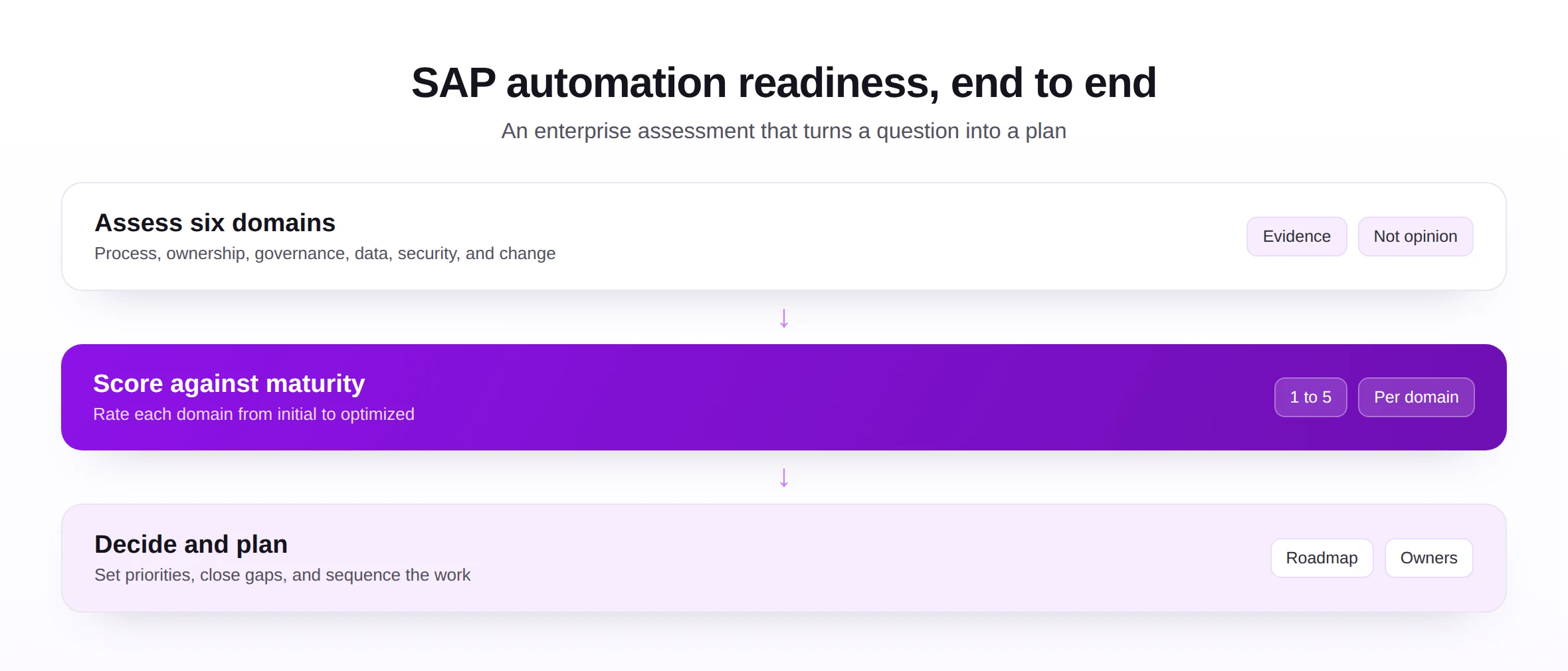
The framework rests on three movements. First, assess six readiness domains using evidence rather than opinion. Second, score each domain against a five-level maturity model. Third, translate the scores into a sequenced roadmap that closes the weakest gaps before automation depends on them.
For leaders, the central message is simple. Readiness is measurable, it is largely within your control, and assessing it deliberately is the cheapest insurance an automation program can buy. The sections that follow give directors, architects, and process owners a shared language and a repeatable method for making that assessment rigorous.
A note on how to use this resource. It is written to be read in full by an assessment owner and consulted in parts by everyone else. A director may need only the executive summary and the scorecard; an architect will work through the framework and assessment model; a process owner will care most about the domains that touch their area. The structure supports all three readers without repeating itself.
It is also written to outlast any single tool or release. The domains, the maturity levels, and the scoring logic describe enduring properties of an organization, not features of a product, which is why the framework should remain useful across SAP versions and across whatever automation tooling an enterprise adopts.
Why this topic matters
A readiness assessment is not a procedural hurdle. It is the mechanism that prevents an automation program from amplifying problems faster than it solves them.
Business impact
Automation concentrates risk and reward. When a process is ready, automating it compounds value across every future execution. When it is not, the same automation compounds error, rework, and lost confidence at the same speed. The financial difference between those two outcomes is large, and it is decided before the first line of configuration is written.
Leaders also face an allocation problem. There are always more automation candidates than capacity to deliver them, and choosing poorly wastes scarce specialist time. A readiness assessment turns that allocation from a contest of opinions into a defensible, evidence-based decision.
Governance impact
Every automated SAP action still requires ownership, defined roles, and an audit trail. If those are absent before automation, they remain absent afterward, only now they execute automatically and at volume. Assessing governance readiness forces these questions into the open while they are still inexpensive to answer, and it connects naturally to master data governance.
Operational impact
Operationally, readiness determines whether an automation can be trusted to run unattended. A process that varies between teams, or that depends on tacit knowledge held by one person, will not behave predictably once automated. The assessment surfaces these fragilities as findings rather than as production incidents.
SAP-specific impact
SAP landscapes add their own complications. Processes that span ECC and S/4HANA, inconsistent master data across clients, and authorization models that have accreted over years all shape whether automation will hold. A structured assessment makes these realities explicit before they become the reason an initiative stalls, and it draws on disciplines covered in SAP process automation.
It is worth being explicit about who carries each kind of impact, because readiness is a shared responsibility. Business owners carry the operational and financial consequences, governance and data teams carry the control and quality consequences, and architects carry the technical and security consequences. An assessment that engages all of them produces a fuller and more honest picture than one run from a single vantage point.
These impacts also compound. A weak data domain does not merely raise the risk of errors; it undermines the trust that adoption depends on, which in turn weakens the business case. Because the domains interact, the assessment treats them as a system rather than a set of independent checkboxes, and it reads the pattern across them rather than any one in isolation.
Finally, the impacts argue for assessing early. Each consequence described here is far cheaper to address before automation than after, when the process is live and carrying real work. The assessment is, in essence, a way of moving these decisions to the point in time where they are least expensive to get right.
Throughout, the framework favors clarity over completeness. It is better to assess six domains well than twelve superficially, and better to score honestly on a five-level scale than to invent false precision. This restraint is deliberate, because an assessment simple enough to run consistently will be run, while an elaborate one tends to be abandoned after a single use.
Core concepts and terminology
A shared vocabulary is the foundation of a credible assessment. These terms recur throughout the framework and deserve precise definitions.
Readiness is the degree to which a process and its surroundings can be automated successfully and sustainably. It is distinct from desirability: a process can be highly desirable to automate and poorly ready at the same time, which is one of the most common and costly confusions in practice.
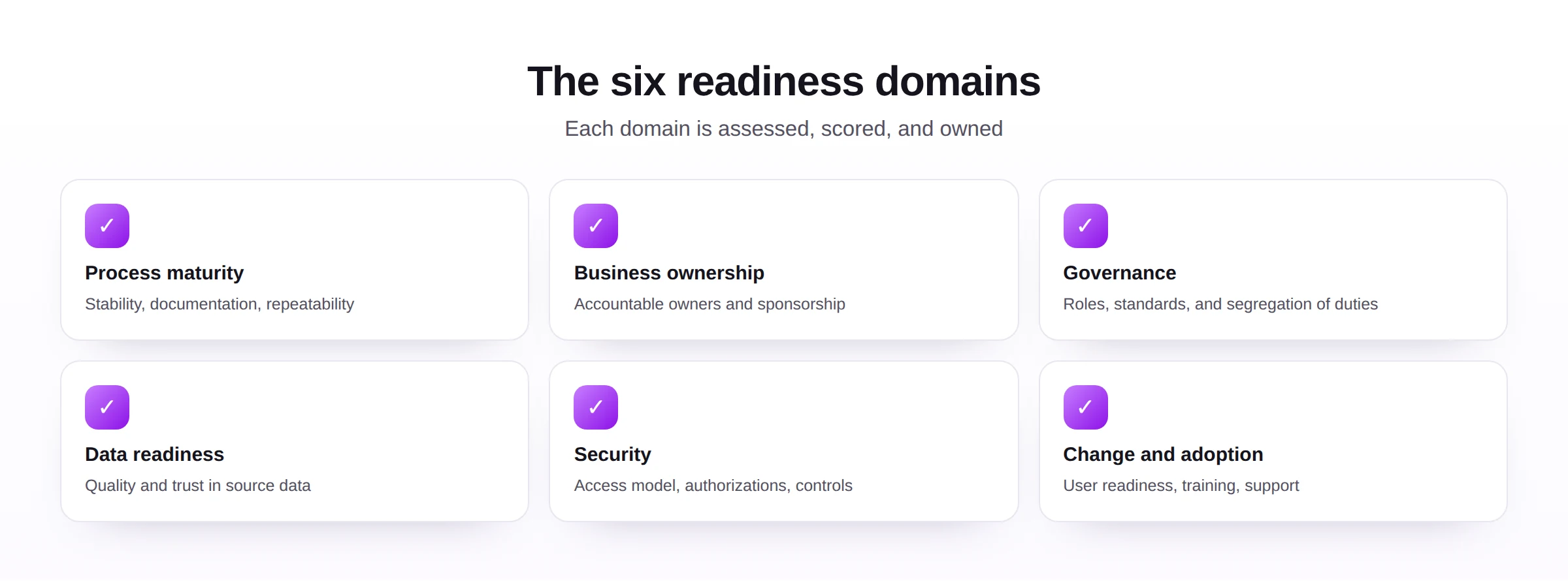
A readiness domain is one of the six areas assessed: process maturity, business ownership, governance, data readiness, security, and change and adoption. Each is evaluated independently because strength in one does not compensate for weakness in another.
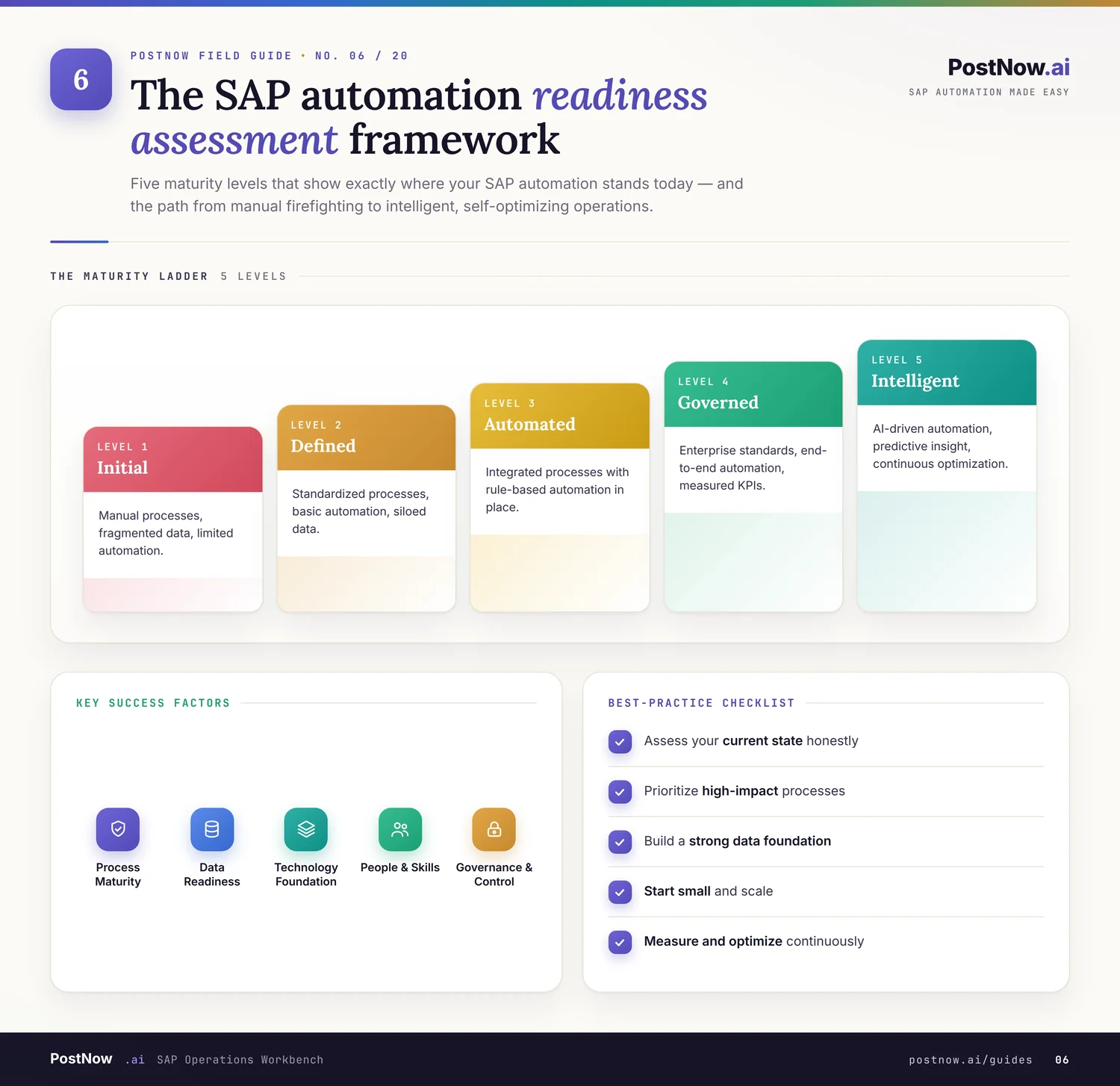
A maturity level is a description of how developed a domain or an organization is, expressed on a five-level scale from initial to optimized. Maturity is the lens through which raw findings become a comparable score.
A readiness score is the rating, from one to five, assigned to a domain after assessment. The pattern of scores across domains, not any single number, is what guides the decision.
An automation candidate is a specific process proposed for automation. Candidates are assessed against the framework so that the strongest proceed first, a sequencing approach that pairs naturally with the catalog of SAP automation use cases.
Holding these definitions steady matters because readiness conversations otherwise drift into generalities. When a team says a process is nearly ready, the framework asks: ready in which domain, at which maturity level, with what evidence. That precision is the difference between a hopeful program and a governed one.
One distinction deserves emphasis because it causes so much confusion in practice. Readiness is about the present state of a process and its surroundings, not about the difficulty of automating it. A technically simple automation can sit on an unready foundation, and a technically complex one can sit on a thoroughly ready foundation. The framework assesses the foundation, leaving the technical effort to be estimated separately.
It also helps to separate assessment from judgement. The framework gathers and scores evidence; it does not make the final decision. Leadership still decides whether to automate now, prepare first, or decline a candidate, weighing the scores against strategy, capacity, and appetite for risk. The framework makes that decision better informed, not automatic.
Used consistently, this vocabulary becomes a shared asset across the SAP organization. When architects, process owners, and governance teams all describe readiness in the same terms, debates that once turned on personal conviction become conversations about evidence and scores, which are far easier to resolve and to defend to a sponsor or an auditor.
Readers familiar with capability models elsewhere will recognize the shape of this approach. What is specific here is the application to SAP automation, where the interplay of process, data, governance, security, and people has its own character, and where the consequences of misjudging readiness are magnified by the speed and reach of the systems involved.
The enterprise readiness framework
The framework assesses six domains. Together they describe everything that must be sound for an automation to succeed and endure.
Process maturity
This domain asks whether the process is stable, documented, and repeatable. A process that changes frequently, or whose real steps differ from its documented ones, is a weak foundation regardless of how attractive automating it appears. Strong process maturity means the steps are understood, consistent, and unlikely to shift under the automation.
Business ownership
Here the question is whether a named business owner is accountable for the process and its outcomes, with visible sponsorship above them. Ownership is what sustains an automation after launch, ensuring it is maintained, defended, and improved rather than quietly abandoned when its author moves on.
Governance
This domain evaluates whether roles, standards, policies, and segregation of duties are defined and enforced. Automation inherits the governance around it, so weak governance produces fast, unaccountable change. Strong governance gives the automation a clear framework of control to operate within.
Data readiness
Data readiness measures whether the source data is clean, complete, and trustworthy enough to automate on. Because automation acts at speed, poor data is amplified rather than absorbed, which makes this domain decisive for any data-centric process. It connects directly to master data management and to the discipline of data quality.
Security
This domain assesses whether the access model, authorizations, and controls are clear and appropriate. An automation runs under some identity with some authorizations, and if that model is tangled or over-permissioned, the automation inherits the risk. Confirming security explicitly is far cheaper before automation than after.
Change and adoption
Finally, this domain asks whether the people affected are ready to adopt the change, with the training and support they need. The best-engineered automation fails if its intended users distrust it or route around it, so adoption readiness is as real a factor as any technical one.
Each domain should have a clear owner for its findings, so that a low score becomes someone's responsibility to address rather than a shared lament. The table below shows the kind of ownership that keeps an assessment actionable, mapping each domain to the role typically best placed to close its gaps.
| Domain | Typical owner of the findings |
|---|---|
| Process maturity | Business process owner |
| Business ownership | Sponsoring executive |
| Governance | Data governance lead |
| Data readiness | Data steward for the domain |
| Security | SAP security or authorizations lead |
| Change and adoption | Functional lead or change manager |
Assigning ownership this way also prevents the assessment from becoming an exercise that one team performs on another. When each domain is owned by the people closest to it, the scores carry more credibility and the resulting actions are more likely to be carried through.
It is worth noting that the six domains are intended to be exhaustive at the level of foundations while remaining few enough to hold in mind. Most additional concerns an assessor might raise, from documentation quality to monitoring capability, can be located within one of the six rather than added as a seventh, which keeps the model both complete and usable.
The enterprise assessment model
The assessment model converts findings into scores and a maturity level, giving leaders a comparable, defensible result.
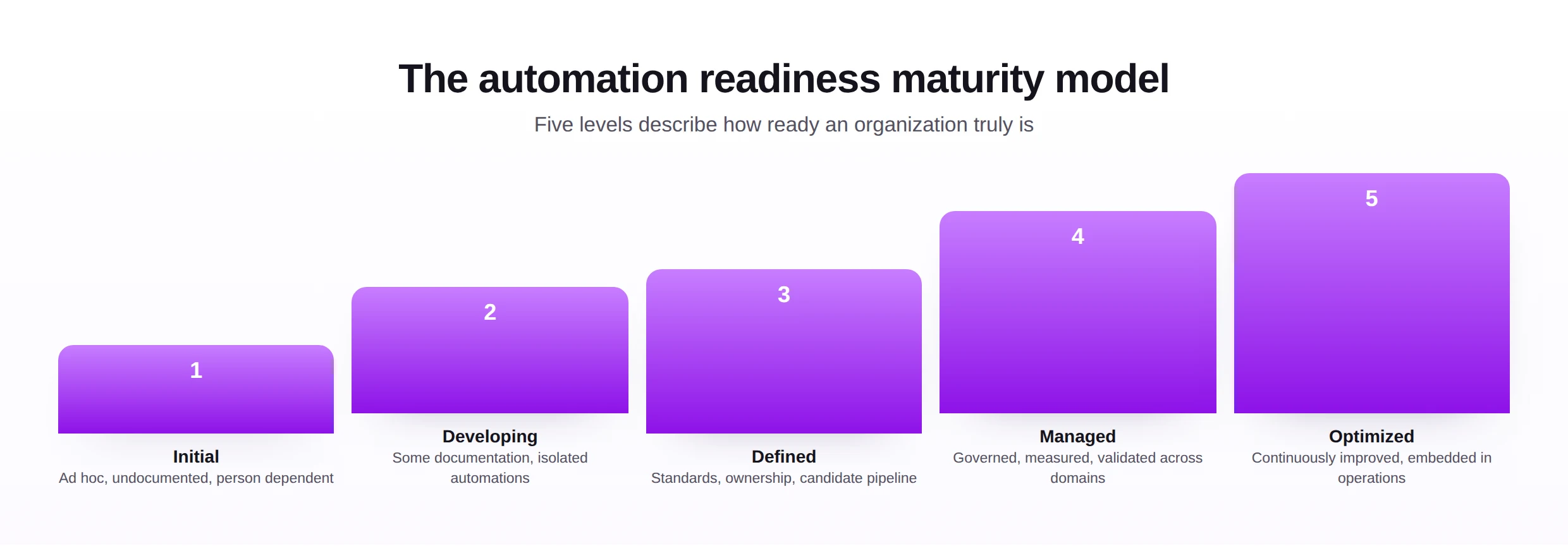
Each domain is scored from one to five against the maturity model above. A score of one describes an initial state that is ad hoc and person-dependent; a score of five describes an optimized state that is governed, measured, and continuously improved. The intermediate levels, developing, defined, and managed, mark the path between them.
The scoring is deliberately evidence-based. Rather than asking whether a domain feels ready, the assessor gathers proof: process documentation, a data profile, role assignments, a training plan. The score reflects what the evidence supports, which keeps the assessment honest and repeatable across different assessors.
The executive scorecard below shows what low and high scores look like in each domain, giving leadership a fast read on where an organization stands and where its effort is most needed.
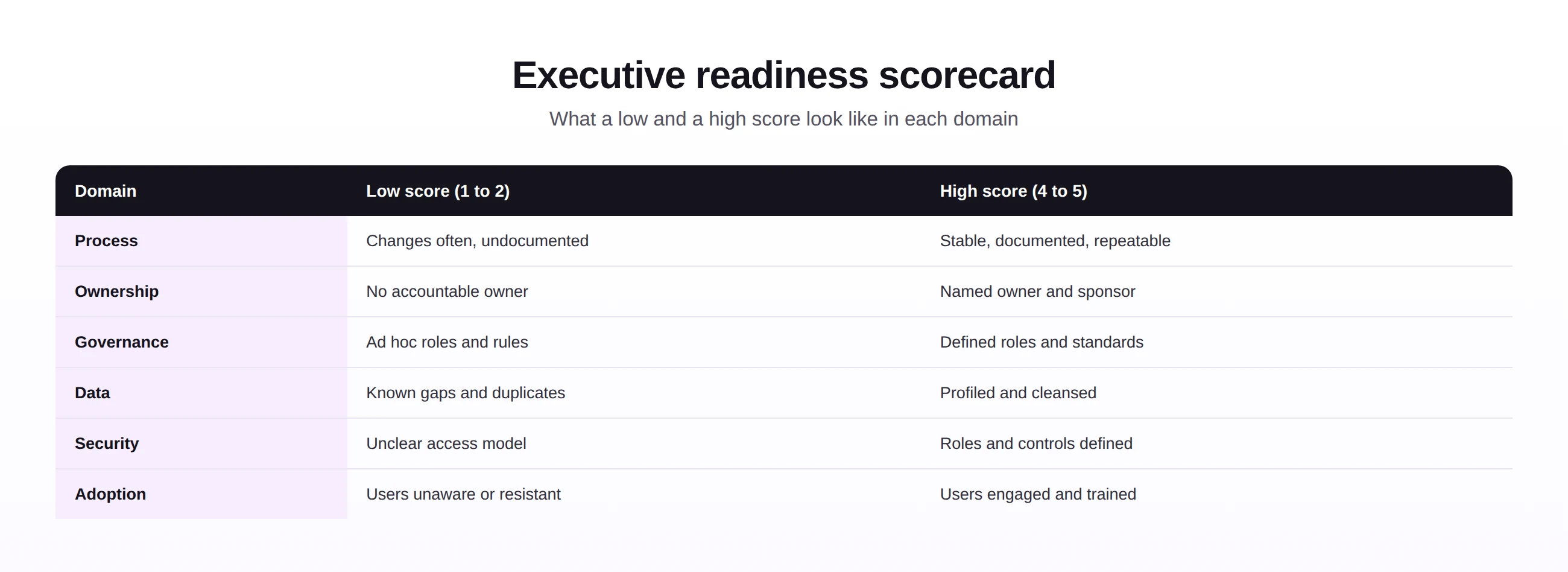
One principle governs interpretation: the lowest-scoring domains set the ceiling. An organization with excellent process maturity but poor data readiness is not ready to automate a data-centric process, because the weak domain will determine the outcome. The assessment therefore directs attention to the weakest links rather than celebrating the strongest.
| Maturity level | What it means for automation |
|---|---|
| 1 Initial | Automation would be fragile and dependent on individuals. |
| 2 Developing | Isolated automation is possible but hard to sustain. |
| 3 Defined | Standards and ownership make reliable automation feasible. |
| 4 Managed | Automation can be governed, measured, and scaled with confidence. |
| 5 Optimized | Automation is embedded and continuously improved. |
The scoring is intentionally comparable across candidates, which is what makes prioritization possible. Because every candidate is scored on the same six domains against the same maturity levels, leadership can lay them side by side and see not only which are most ready, but which share a common gap that a single piece of preparation, such as a data-cleansing effort, would close for several at once.
It is worth guarding against two scoring distortions. The first is generosity, where assessors round up to avoid uncomfortable conversations; the second is perfectionism, where nothing scores well because no state is ever ideal. The remedy for both is the evidence standard: a score must be justified by what the documentation, profiles, and role maps actually show, which anchors the rating to reality.
A practical refinement for large landscapes is to weight the domains by the nature of the candidate. A data-heavy automation might weight data readiness most heavily, while a sensitive financial posting might weight governance and security. The maturity model stays constant; only the emphasis shifts, which keeps the model simple while adapting it to context.
A maturity level is best understood as a description, not a grade. The point of placing a domain at level two rather than level four is not to pass judgement on a team, but to locate the work that would move it upward. Framed constructively, the model becomes a tool people are willing to use honestly rather than one they feel compelled to game.
Implementation roadmap
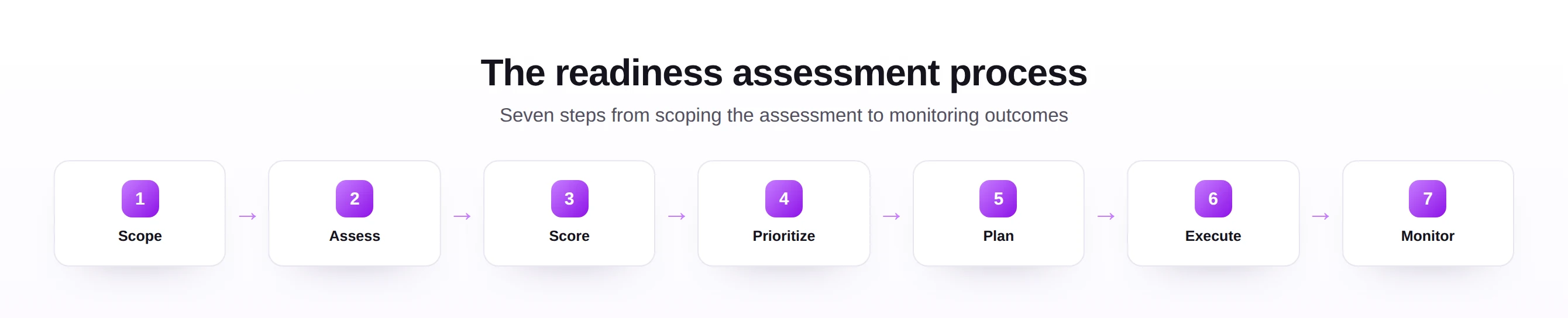
An assessment is only useful if it leads to action. This roadmap turns scores into a sequenced program of planning, execution, governance, monitoring, and improvement.
Planning
Begin by scoping the assessment: which processes, which domains, and which evidence will be gathered. Then assess and score each candidate, and prioritize using the principle that the weakest domains set the ceiling. The output of planning is a ranked list of candidates with their gaps named.
Execution
Execution proceeds in two streams. For candidates that score well, proceed to automate, drawing on the right approach from the comparison of upload tools and the wider automation tools landscape. For candidates with a weak domain, run the targeted preparation, such as cleansing data or documenting a process, that raises the score before automating.
Governance
Governance runs throughout, not at the end. Each automated process needs an owner, defined roles, and an audit trail from day one, so that control is designed in rather than retrofitted. This is where readiness assessment and ongoing governance meet.
Monitoring and continuous improvement
After launch, monitor each automation against the outcomes it was meant to deliver, and re-assess readiness periodically as processes and data evolve. Readiness is not a permanent state, and a domain that was strong can weaken, so the assessment becomes a recurring instrument rather than a one-time gate.
Sequencing deserves particular care because it shapes the program's reputation. Delivering an early, visible success on a thoroughly ready candidate builds the credibility and sponsorship needed to fund the harder, less ready ones. A roadmap that front-loads difficulty, by contrast, risks an early stumble that colors perception of the entire initiative.
Governance and monitoring should be designed together, not bolted on in sequence. The same audit trail that satisfies a governance requirement also provides the data that monitoring needs, so building one mechanism serves both purposes. Treating them as a single design concern avoids duplicated effort and produces automations that are both controlled and observable from the first day they run.
The roadmap is iterative by design. Each pass through it, from scoping to monitoring, produces both delivered automations and a clearer picture of where the organization stands, which informs the next pass. Over several cycles the roadmap becomes less about individual candidates and more about steadily raising the maturity of the whole landscape.
Best practices
A handful of disciplines separate a readiness assessment that guides decisions from one that merely documents them.
- Assess on evidence, not impressions, gathering documentation, data profiles, and role maps so scores are defensible.
- Treat governance as a domain, not an afterthought, confirming roles and standards before automation inherits them.
- Make data readiness a gate for data-centric processes, since automation amplifies whatever quality it is given.
- Confirm security explicitly, so the access model an automation runs under is intentional and least-privilege.
- Design for auditability and scale, so each automation can be reviewed and can grow without redesign.
- Re-assess periodically, treating readiness as a living measure that changes with the landscape.
These practices place governance, validation, security, auditability, scalability, and maintainability at the center of the assessment rather than at its margins. An organization that adopts them builds not just a single successful automation but a durable capability for choosing and delivering them.
These practices are mutually reinforcing rather than independent. Evidence-based scoring strengthens governance, governance enables auditability, auditability supports monitoring, and monitoring feeds the re-assessment that keeps scores honest. An organization that adopts them piecemeal gains less than one that adopts them as a connected discipline, because much of their value comes from how they support one another.
It is also worth recognizing that maturity is built incrementally. No organization moves from an initial to an optimized state in a single program, and expecting it to invites disappointment. The realistic goal of a first assessment cycle is to move the weakest domains up one level, prove the value, and establish the cadence that carries the organization steadily upward over time.
Above all, these practices should feel proportionate. A small, low-risk automation does not warrant the same depth of assessment as a financial posting that runs unattended at scale, and applying heavy process to trivial cases is its own kind of waste. Matching the rigor to the stakes is itself a best practice, and it keeps the framework welcome rather than resented.
Common challenges
Several challenges recur when organizations attempt a readiness assessment. Each has a root cause and a practical mitigation.
Confusing desirability with readiness
The root cause is emotional: the most painful process feels like the obvious first target. The risk is that pain often signals instability or poor data, the very things that make a process unready. The mitigation is to score readiness separately from desirability and to let the evidence, not the frustration, choose the sequence.
Invisible process variation
The root cause is that the same nominal process is performed differently across teams or sites. The risk is an automation built for one variant that fails on the others. The mitigation is to map the process as actually performed, not as documented, before scoring its maturity.
Unexamined data quality
The root cause is that data problems are invisible until profiled. The risk is automating on data whose flaws then propagate at scale. The mitigation is to profile the source data as part of the assessment, turning an assumption into a measured score.
Tangled authorizations
The root cause is access models grown organically over years. The risk is an automation that inherits excessive or unclear permissions. The mitigation is a focused security review of the specific process before it is automated, grounded in least privilege.
Assessment without follow-through
The root cause is treating the assessment as a document to file rather than a plan to execute. The risk is that gaps are named but never closed. The mitigation is to attach an owner and a date to every gap the assessment identifies, so findings become work.
The challenges above share a common shape: each begins as a small omission that feels reasonable under time pressure and ends as a disproportionate problem once automation is live. This is the central argument for a disciplined assessment. It is not that the risks are exotic, but that they are easy to overlook precisely when overlooking them is most tempting, which is why making the assessment a required step matters more than making it elaborate.
A useful organizational habit is to keep a register of the gaps each assessment uncovers, with their owners and target dates, and to review it on the same cadence as the re-assessment. Over a few cycles this register becomes a record of the organization's maturing capability, and it provides the evidence a sponsor needs to see that the investment in readiness is producing steady, demonstrable progress.
Common mistakes
The mistakes below are the failure modes the framework is designed to prevent.
Each maps to a discipline already described: separate readiness from desirability, score on evidence, respect that the weakest domain sets the ceiling, design control in from the start, and re-assess over time. The framework is, in effect, a structured way of not making these mistakes.
Avoiding these mistakes is less about vigilance than about structure. When the assessment framework is embedded as a standard step before any automation is funded, the mistakes become difficult to make, because each one corresponds to a step the framework requires. The most reliable way to prevent them is therefore to institutionalize the framework rather than to rely on individuals remembering its lessons.
It also helps to treat a declined or deferred candidate as a success of the process, not a failure of it. A framework that only ever says yes is not assessing anything; its value lies precisely in its willingness to identify candidates that are not yet ready, and to redirect effort toward preparing them rather than automating them prematurely.
It is reassuring that none of these mistakes requires special expertise to avoid. Each is prevented by a step any disciplined team can take, which means a successful readiness practice depends far more on consistency than on sophistication. The organizations that do this well are simply the ones that do it every time.
Future trends
Readiness assessment is becoming more data-driven and continuous, while the questions it asks remain stable.
- AI-assisted process discovery, helping reveal how a process actually runs across teams and systems.
- Automated data profiling, measuring data readiness faster and more thoroughly than manual review.
- Continuous readiness scoring, tracked as a live indicator rather than a periodic project.
- Governance captured as evidence, with roles, sign-offs, and runs recorded as an auditable trail.
- Guided candidate selection, where tooling suggests which processes are ready to automate next, a theme explored in AI in SAP automation.
The tooling will improve, but the underlying judgment will not change. A process worth automating remains one that is stable, owned, governed, clean, secure, and welcomed, and a framework that measures those qualities will stay relevant as the technology around it advances.
None of these trends removes the need for human judgement; they change where that judgement is applied. As discovery, profiling, and scoring become more automated, the scarce skill shifts from gathering evidence to interpreting it and deciding what to do, which is exactly where experienced architects and process owners add the most value. The framework is designed to keep people in that interpretive role.
Enterprises should therefore adopt these capabilities as accelerators of the framework rather than replacements for it. A tool that profiles data faster makes the data-readiness domain cheaper to assess, but it does not change what a good score means or who is accountable for reaching it. Read this way, future tooling strengthens the framework rather than dating it.
Action plan
This step-by-step plan lets a leadership team move from intention to a defensible first decision within a few weeks.
- Name an assessment owner and agree the six domains as your scoring framework.
- List your automation candidates, drawing on known pain points and the standard use cases.
- Gather evidence per domain for the top candidates: documentation, data profiles, role maps, and adoption signals.
- Score each domain from one to five against the maturity model, recording the evidence behind each score.
- Identify the weakest domains, remembering they set the ceiling, and decide whether to automate now or prepare first.
- Sequence the work, automating ready candidates and scheduling preparation for the rest.
- Attach owners and dates to every gap, so the assessment converts directly into a plan.
- Re-assess on a regular cadence, treating readiness as a measure you maintain, not a box you tick once.
Completed honestly, this plan yields a ranked, evidence-backed automation program that leadership can defend and that delivers early wins while harder candidates are made ready.
A final word on cadence. The first pass of this action plan establishes a baseline; the value compounds when it becomes routine. Many organizations align the re-assessment with an existing planning cycle, so that readiness is reviewed alongside other investment decisions rather than as a separate exercise. Embedded this way, the framework stops being a project and becomes simply how the organization decides what to automate.
Used over time, the plan also produces a valuable artifact: a documented history of which candidates were assessed, how they scored, what was done about the gaps, and how the automations performed afterward. That record is the raw material for continuous improvement, and it is what allows an enterprise to demonstrate, with evidence, that its automation program is both well governed and steadily maturing.