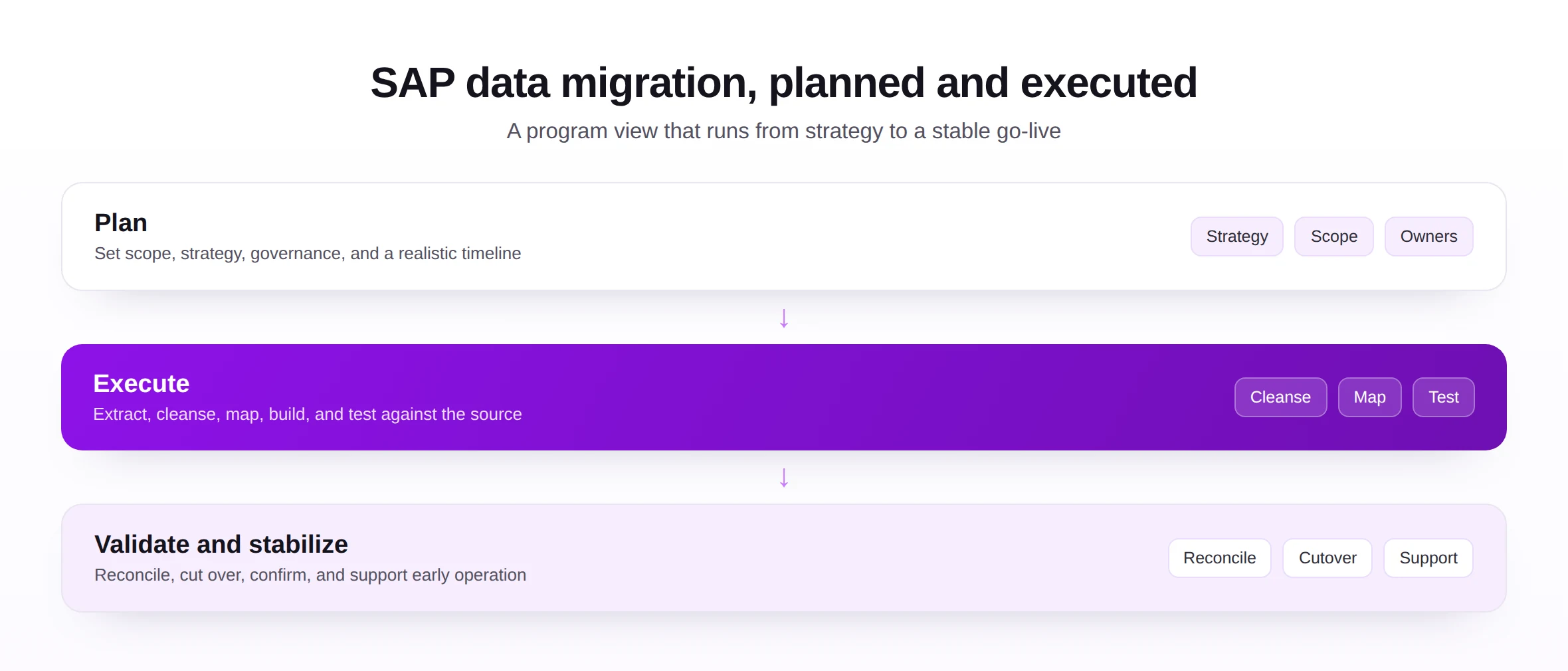
Executive summary
A data migration is one of the highest-stakes events in an SAP program. It is also one of the most predictable, because successful migrations follow a recognizable discipline that unsuccessful ones abandon under pressure.
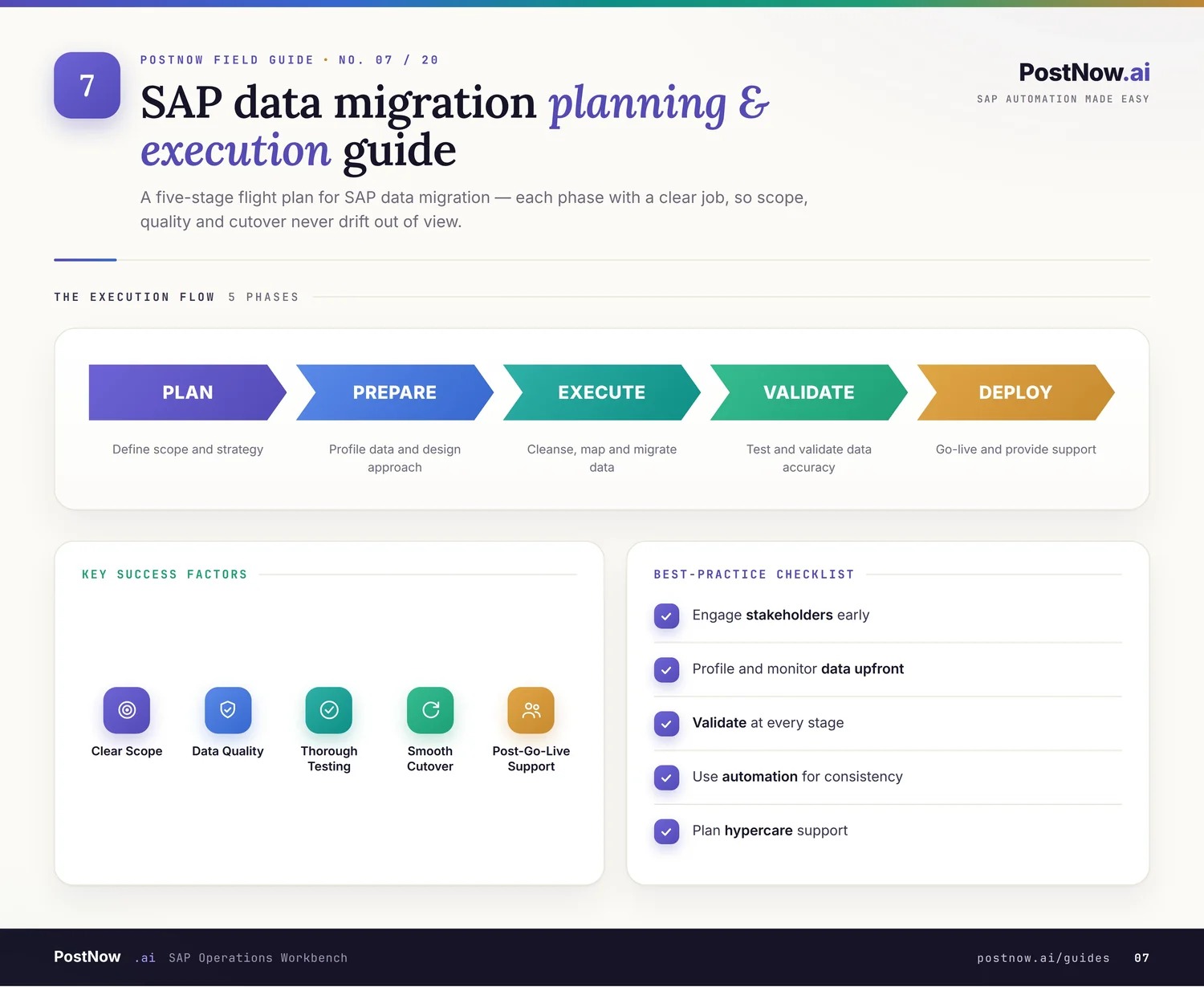
This guide sets out that discipline in full. It is written for the directors, architects, and program managers who must plan a migration, govern its execution, and stand behind its go-live. Rather than a list of tips, it provides a framework of parallel workstreams, a defined lifecycle, a governance and cutover model, and a validation approach, all assembled into a program a leadership team can run and defend.
Three ideas anchor the guide. A migration is a program of coordinated workstreams, not a single load. Its success is decided in preparation, particularly in data quality and mapping, long before cutover. And its credibility rests on validation: a migration is not complete until the data in the new system has been reconciled to its source.
Read in full, the guide equips a team to plan realistically, execute in a controlled sequence, and arrive at a stable go-live with the evidence to prove it. It builds directly on the SAP data migration pillar and complements the migration checklist for day-to-day execution.
This guide is built to serve different readers at different depths. A sponsor can take the executive summary, the readiness scorecard, and the action plan and have enough to govern the program. An architect will work through the framework, lifecycle, and cutover model in detail. A workstream lead will live in the section that touches their area. The structure supports all of them without repeating itself, which is what an enterprise reference should do.
It is also written to remain valid across releases and tools. The workstreams, the lifecycle, and the validation logic describe how a migration behaves, not how any particular product works, so the guidance should hold whether an organization migrates to S/4HANA today or to whatever follows it, and whatever loading mechanism it chooses along the way.
One framing is worth fixing at the outset. A migration is a program, not a task. It has parallel workstreams, dependencies, governance, and a critical event at its heart, and treating it as a single technical load is the first and most consequential planning error an organization can make.
Throughout, the guide assumes a likely target of S/4HANA but applies equally to other consolidations and upgrades. The specifics of objects and tools vary, but the program structure, freeze scope, cleanse data, approve mappings, reconcile testing, rehearse cutover, validate the result, stays constant across them.
The guide also assumes that migration sits within a wider data strategy. A migration is the moment data moves, but the quality, governance, and ownership it depends on are ongoing concerns that outlast any single cutover. Treating the migration as part of that continuum, rather than an isolated project, produces better and more durable results.
Read end to end, the result is a complete operating manual for SAP data migration that a leadership team can adopt as its standard and refine with every program it runs.
Why this topic matters
Migration is where the condition of an organization's data, the clarity of its processes, and the strength of its governance are all tested at once.
Business impact
A migration carries the data that the business will run on for years. Get it right and the new system starts clean and trusted; get it wrong and every downstream process inherits the flaws, often invisibly, until they surface as wrong balances or failed transactions. The business case for a careful migration is simply the cost of the alternative.
Migrations are also unusually time-bound. They culminate in a cutover window where the old system stops and the new one starts, and a slip in that window has visible operational consequences. This concentration of risk is why preparation, rehearsal, and a fallback matter so much more here than in everyday change.
Governance impact
A migration makes hundreds of decisions about ownership, standards, and transformation rules, and each needs to be made by someone accountable and recorded for later review. Without governance, those decisions are made implicitly and inconsistently, which is how migrations accumulate the silent errors that emerge after go-live. Strong governance, grounded in master data governance, gives every decision an owner and a trail.
Operational impact
Operationally, a migration must coexist with a running business. Source systems are still in use, people still need to work, and the cutover has to fit into a window the organization can tolerate. Planning the migration as a program that respects these constraints, rather than as a technical task in isolation, is what keeps it from disrupting the very operations it serves.
SAP-specific impact
SAP adds specific demands. Object dependencies mean master data must precede transactions; conversions such as the move to the Business Partner model reshape long-standing structures; and the choice between approaches and tools affects how validation works. These realities, explored further in the ECC to S/4HANA migration guide, make a structured, SAP-aware approach essential.
These impacts rarely arrive in isolation. A data problem becomes a reconciliation problem, which becomes a go-live delay, which becomes a business and reputational problem. Because the consequences chain together, a weakness in one workstream tends to surface as a crisis in another, which is why the framework manages the workstreams as an interconnected whole rather than as separate tracks.
The impacts also explain the program's shape. Because the business keeps running during a migration, because the cutover is time-bound, and because SAP enforces strict object dependencies, the work cannot simply be done in any convenient order. The lifecycle that follows is a direct response to these constraints, sequencing the workstreams so that each is ready when the next depends on it.
Above all, the impacts argue for front-loading effort. Almost every consequence described here is far cheaper to prevent in planning than to remedy after cutover, when the data is live and the business is depending on it. The discipline of a migration program is, in large part, the discipline of doing the unglamorous preparation before the visible execution.
It is worth stating plainly that no tool removes the need for this discipline. Modern migration tooling is genuinely helpful, but it executes the load; it does not decide scope, judge data quality, or own a mapping. Those remain human, accountable acts, and a program that expects a tool to supply them will be disappointed.
Readers using this alongside the migration checklist will find the two complementary: this guide supplies the program structure and rationale, while the checklist supplies the day-to-day confirmations. Used together, they cover both the why and the what of a migration.
Core concepts and terminology
A precise vocabulary keeps a migration program aligned. These terms recur throughout and underpin the framework, lifecycle, and validation model.
Scope is the agreed set of objects, systems, and the cutoff that define what the migration covers. Scope that drifts is among the most common causes of overrun, which is why freezing it early is a recurring theme.
Profiling is the measurement of source data against expectations to quantify gaps, duplicates, and rule violations. It converts a vague sense that the data is imperfect into specific, addressable findings.
Cleansing is the correction of those findings, ideally at the source so the fixes are permanent. Cleansing is consistently the most under-estimated workstream in a migration.
Mapping is the documented, approved definition of how each source field becomes a target field, including any transformation. Mapping decisions are where much of a migration's silent risk lives.
Reconciliation is the comparison of loaded data against the source to confirm completeness and correctness. It is the evidence that a migration succeeded, and its absence is why some migrations are declared complete while quietly being wrong.
Cutover is the controlled execution of the live migration within a defined window, governed by a runbook with a fallback. It is the moment the program has been preparing for, and the moment a fallback most needs to exist.
These terms are not interchangeable, and treating them precisely is part of what separates a governed migration from an improvised one. When a team speaks of validation, the framework asks whether they mean reconciliation to the source or merely a check that records loaded, because the difference is the difference between proof and assumption.
Precision in these terms is not pedantry; it prevents expensive misunderstandings. When a team reports that the data is clean, the framework asks against which standard and measured how. When it reports that testing passed, the framework asks whether the trial load was reconciled to the source or merely completed. The questions sound exacting because the cost of the looser answer, discovered after go-live, is so high.
The terms also map directly onto accountability. Scope belongs to the strategy workstream, profiling and cleansing to the data workstream, mapping to the mapping workstream, and reconciliation to testing and validation. Naming the concepts precisely is therefore also a way of naming who owns each, which is the foundation of a governed migration.
A final conceptual point: a migration is judged by the state of the target, not the effort of the load. A heroic loading exercise that leaves the new system subtly wrong is a failure, while an unremarkable load that reconciles perfectly is a success. Keeping that outcome-focused definition in view prevents teams from mistaking activity for achievement.
One more definition matters: a successful go-live is not the absence of issues but the presence of control. Even a well-run migration surfaces minor issues in stabilization; what distinguishes it is that those issues are visible, owned, and resolved, rather than discovered late by users. Control, not perfection, is the realistic standard.
It helps to picture the workstreams as lanes in a relay rather than steps in a line. They run concurrently, but the baton, a profile here, an approved mapping there, must pass cleanly between them. Most migration delays happen not within a lane but at the hand-off, which is why managing the interfaces is as important as managing the work.
The enterprise migration framework
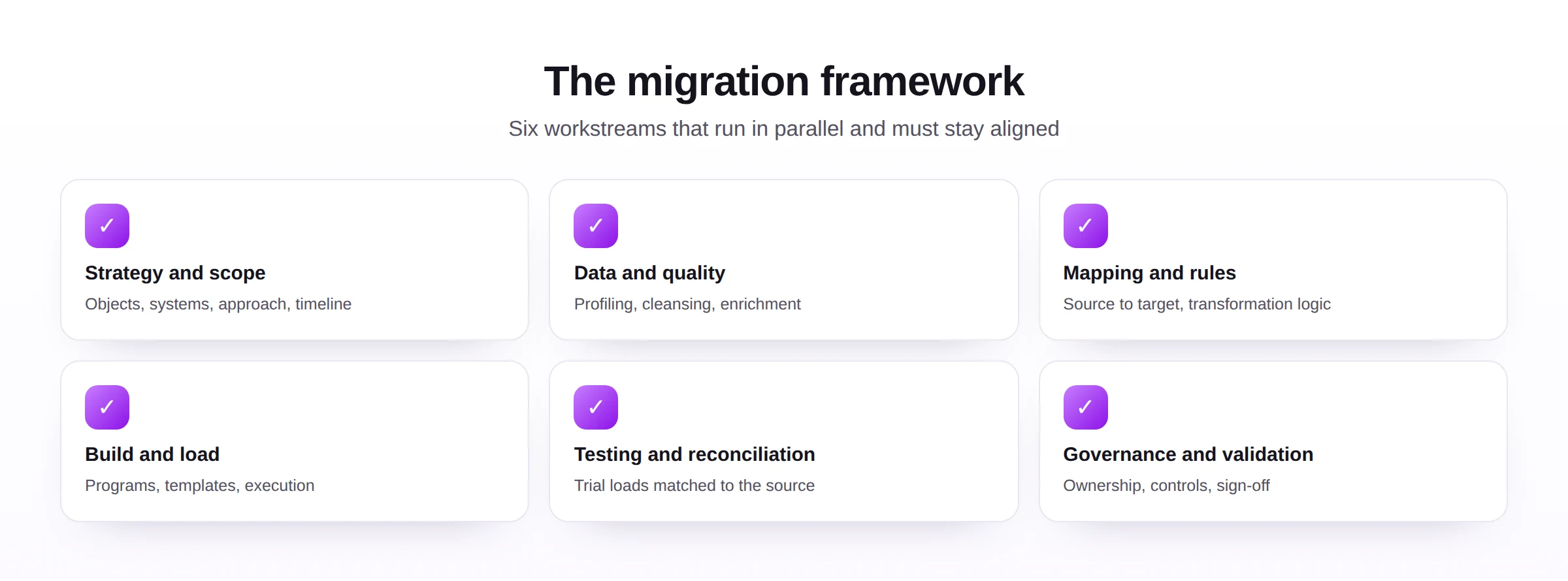
A migration is best understood as six workstreams that run in parallel and must stay aligned. The framework names them so that none is forgotten and their dependencies are managed.
Strategy and scope
This workstream defines what is being migrated, from which systems, by when, and using which broad approach. It sets the cutoff, agrees the objects in and out of scope, and establishes the timeline against which everything else is planned. Its discipline is to freeze scope early and to change it only through a visible decision.
Data and quality
This workstream profiles the source data, cleanses what profiling reveals, and enriches where the target needs more than the source provides. It is the workstream most likely to be under-estimated and most likely to determine the migration's outcome, which is why it is treated as central rather than preparatory. It draws directly on data quality best practices.
Mapping and rules
Here every source field is mapped to its target, with transformation rules documented and approved by an owner. This workstream turns the migration's logic into a record that can be reviewed, tested, and audited, rather than into knowledge held in one person's head.
Build and load
This workstream builds the programs, templates, and routines that perform the load, and executes them. The choice of mechanism, explored in the upload tools comparison, shapes how validation and error handling work, so it is made deliberately rather than by default.
Testing and reconciliation
This workstream runs trial loads and reconciles them against the source, repeatedly, until the results are trusted. It is where confidence is earned, and its discipline is to reconcile rather than merely to load, because a load that runs is not the same as a load that is correct.
Governance and validation
Running across all the others, this workstream assigns ownership, applies controls, and provides the sign-offs and final validation that authorize go-live. It is what makes the migration accountable and auditable rather than simply done.
The workstreams are parallel, but they are not independent. Mapping cannot be finalized until profiling has revealed the true shape of the source; build cannot be trusted until mapping is approved; reconciliation cannot be meaningful until both are in place. Managing these dependencies, so that each workstream has what it needs when it needs it, is the core coordination challenge of a migration program.
For this reason each workstream needs a named lead who is accountable for its outputs and for the hand-offs to the others. A migration without clear workstream ownership tends to fail at the seams, where each lead assumes another is handling a dependency. Explicit ownership of both the workstreams and the interfaces between them is what keeps the program coherent.
The framework also scales down as well as up. A small, single-object migration still has all six workstreams, even if some are brief; a full landscape migration expands each into a substantial body of work. Recognizing that the same structure applies at any size lets an organization reuse one mental model across very different migrations.
The six workstreams also give leadership a clean way to report status. Rather than a single, opaque percentage complete, a program can report the state of each workstream against its exit conditions, giving sponsors an honest, actionable view of where the migration genuinely stands.
Migration readiness and the maturity model
Before committing to a migration, an organization should know how dependable its migration capability is. The maturity model provides that read.
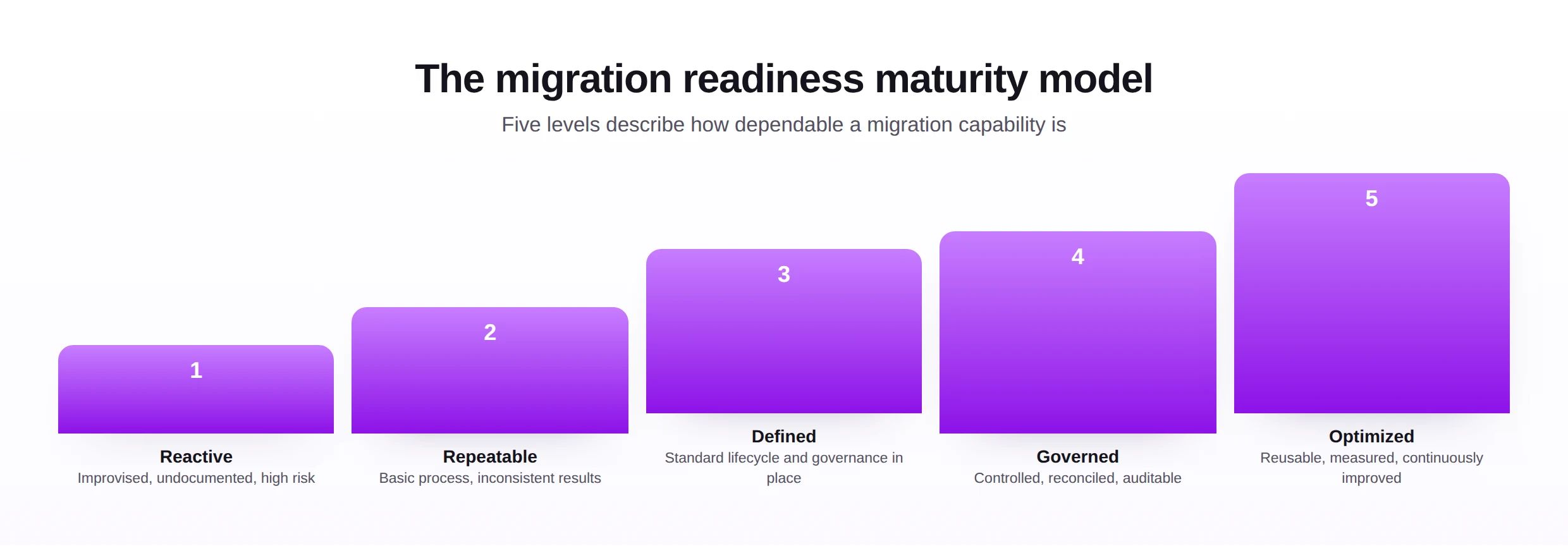
At the reactive level, migrations are improvised and high-risk; at the optimized level, they are reusable, measured, and continuously improved. The intermediate levels, repeatable, defined, and governed, describe the path most organizations travel as they mature. Knowing your level sets realistic expectations for a given migration.
Alongside the maturity model, a readiness scorecard assesses a specific migration across the dimensions that most affect its outcome. The scorecard below contrasts an at-risk state with a ready one, giving leadership a fast diagnostic before cutover is approved.
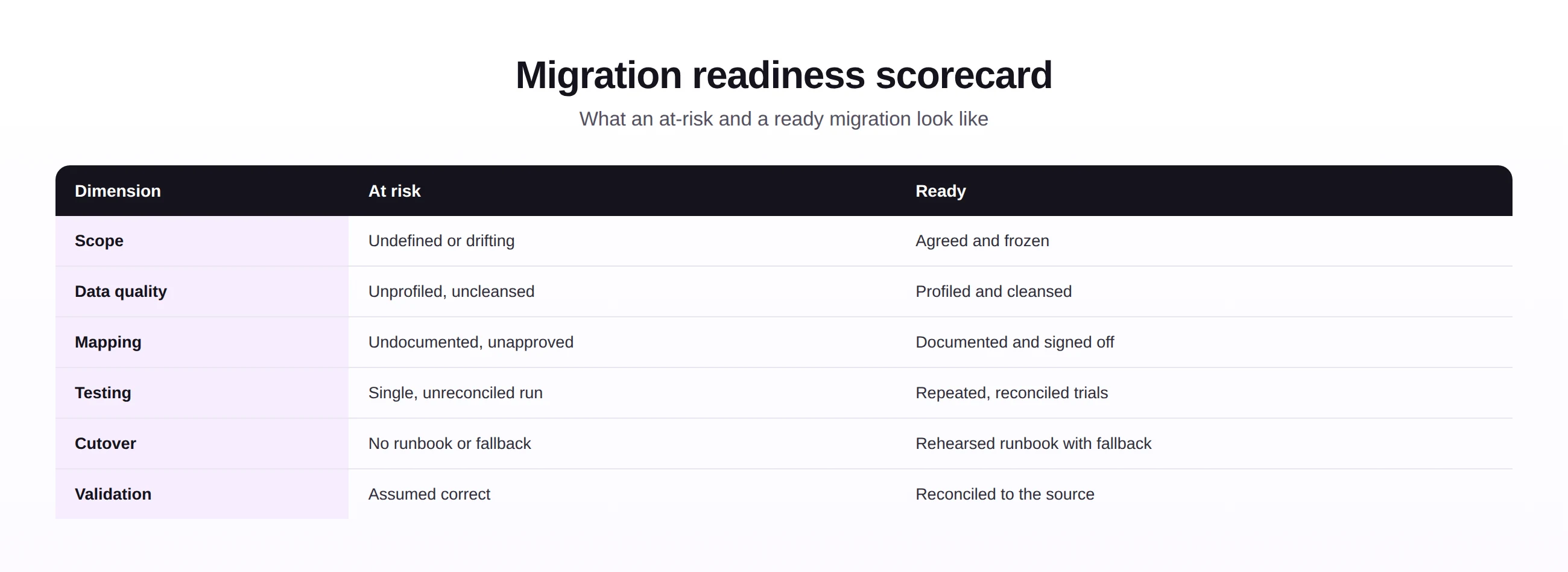
As with any readiness assessment, the weakest dimension governs the result. A migration with excellent mapping but unreconciled testing is not ready, because the untested area is where surprises will appear. The scorecard therefore directs attention to the dimension most likely to fail, not the one already strong.
| Maturity level | What it means for a migration |
|---|---|
| 1 Reactive | Outcomes depend on individual heroics and luck. |
| 2 Repeatable | A basic process exists but results vary. |
| 3 Defined | A standard lifecycle and governance are in place. |
| 4 Governed | Migrations are controlled, reconciled, and auditable. |
| 5 Optimized | Migration is a reusable, measured capability. |
The maturity model is most useful as a planning input rather than a verdict. An organization at the repeatable level should plan a migration with more external support, more rehearsal, and more contingency than one at the governed level, because its capability is less proven. Reading the model this way turns an honest assessment of weakness into sensible risk management rather than discouragement.
Scoring the readiness dimensions demands the same honesty described for any assessment. Generous scoring that avoids difficult conversations simply moves those conversations to cutover, where they are far more painful. The discipline is to score each dimension against evidence, the profile, the approved mappings, the reconciled test results, so the scorecard reflects reality rather than hope.
Different migrations weight the dimensions differently. A migration dominated by complex master data will weight data quality and mapping most heavily; one dominated by a tight cutover window will weight rehearsal and fallback. The dimensions stay constant, but the emphasis follows the specific risk profile of the migration in front of you.
The scorecard is most powerful when revisited at each major checkpoint rather than scored once. A dimension that was at risk early may become ready as the program progresses, and tracking that movement gives the steering group a clear sense of whether the migration is converging on readiness or drifting away from it.
Entry and exit conditions give each lifecycle stage its rigor. A stage should not begin until its inputs exist and should not be declared done until its outputs are proven, which prevents the quiet overlap where a later stage starts on the unfinished work of an earlier one. These conditions are the joints that hold the lifecycle together.
The migration lifecycle and roadmap
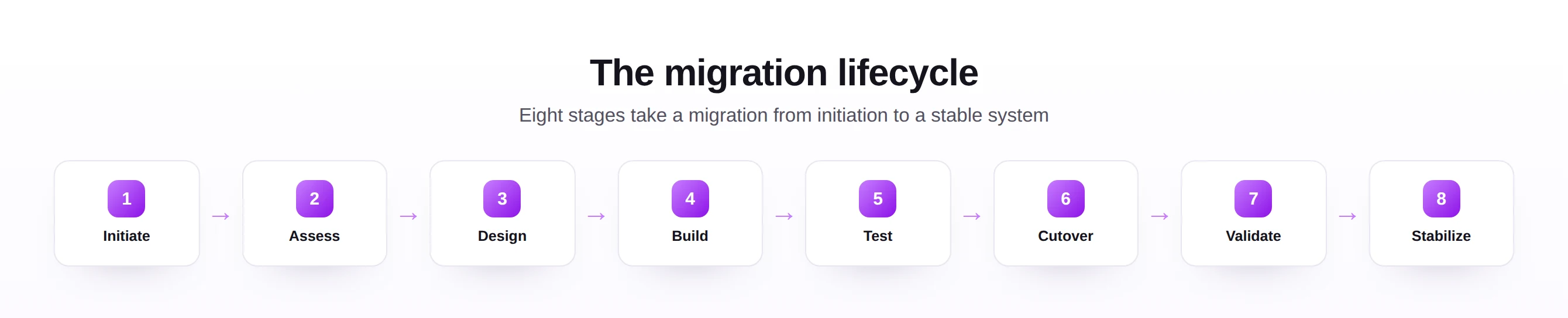
The lifecycle sequences the workstreams into eight stages, each with entry and exit conditions, from initiation to a stabilized system.
Planning: initiate, assess, design
Planning sets the migration up to succeed. Initiation agrees scope, approach, and governance; assessment profiles the source and quantifies the data challenge; design defines the mappings, rules, and the cutover approach. The output of planning is a migration that is fully specified before any production load is attempted.
Execution: build, test
Execution builds the load routines and proves them. Build creates the programs and templates; test runs trial loads that are reconciled against the source and repeated until trusted. The discipline of this phase is repetition, because a single successful test proves far less than several that reconcile cleanly.
Cutover and the cutover framework
Cutover executes the live migration within its window. It is governed by a runbook that lists every step, its owner, and its expected duration, rehearsed beforehand, and backed by a defined fallback. The cutover framework below summarizes what separates a controlled cutover from a risky one.
| Cutover element | Controlled cutover has... |
|---|---|
| Runbook | Every step listed with owner and timing. |
| Rehearsal | The runbook tested on a copy beforehand. |
| Fallback | A defined, decided way back if a step fails. |
| Checkpoints | Go or no-go decisions at agreed points. |
| Communication | Clear roles and a single source of status. |
Validation deserves its own explicit framework, because it is the workstream that proves the migration succeeded. The table below sets out what a rigorous validation approach confirms, moving beyond a simple check that records loaded to genuine evidence that the target matches the source and obeys SAP rules.
| Validation check | Confirms that... |
|---|---|
| Record counts | The expected number of records loaded per object. |
| Reconciliation | Loaded values match the source, not just exist. |
| Control totals | Key sums, such as balances, agree with the source. |
| SAP rule checks | Records satisfy the system's own validation. |
| Spot checks | Sampled records are correct end to end. |
A migration is complete only when this validation passes. Until then the data has loaded but not been proven, and the difference between those two states is precisely the difference between a migration a leadership team can stand behind and one it is merely hoping is correct.
Validation and stabilization
Validation reconciles the migrated data against the source and confirms it against SAP rules; stabilization supports early operation, monitors for anomalies, and resolves the issues that only live use reveals. Governance, monitoring, and continuous improvement run through the whole lifecycle, feeding lessons back into the next migration.
Stabilization is the stage most often shortchanged, because the visible milestone of cutover has passed and attention moves on. Yet it is when the migration meets real operational use, and a deliberate period of monitoring and support is what turns a technically complete cutover into a business that trusts its new system.
Best practices
A migration program rests on a set of disciplines that, applied together, turn a risky event into a controlled one.
- Freeze scope early and change it only through a visible, owned decision, so the program has a stable target.
- Cleanse at the source, grounded in master data management, so corrections are permanent and benefit every system.
- Document and approve every mapping, so the migration's logic is owned, testable, and auditable.
- Reconcile every test and the cutover, so correctness is proven against the source rather than assumed.
- Govern with clear ownership and an audit trail, so each decision is accountable and reviewable.
- Rehearse the cutover with a fallback, so the highest-risk moment is the most prepared.
These practices place governance, validation, auditability, scalability, and maintainability at the heart of the program. A migration run on them is not only safer on the day; it leaves behind documentation, clean data, and a repeatable capability that benefit every initiative that follows.
These practices reinforce one another rather than standing alone. A frozen scope makes mapping stable; approved mapping makes testing meaningful; reconciled testing makes validation credible; governance ties the chain together and makes it auditable. An organization that adopts them as a connected discipline gains far more than one that picks a few in isolation, because much of their value lies in how they interlock.
They should also be applied in proportion to the migration. A small reference-data load does not need the full apparatus that a finance migration demands, and imposing heavy process on trivial cases breeds the cynicism that later undermines the process where it genuinely matters. Matching the rigor to the stakes keeps the discipline credible.
Finally, each migration should leave the organization more capable than it found it. The documentation, the reusable load routines, the cleaned data, and the lessons captured all raise the maturity level for next time. Treating every migration as an investment in capability, not just a one-off delivery, is what moves an organization steadily up the maturity model.
A useful test of the practices is whether an outsider could understand the migration from its artifacts alone. If the scope, the mappings, the test results, and the cutover plan are documented well enough that a newcomer could follow them, the program has the transparency that governance and audit require.
Common challenges
Migrations meet a recognizable set of challenges. Naming their root causes makes them manageable rather than surprising.
Underestimated data cleansing
The root cause is that the true condition of the data is unknown until profiled, and optimism fills the gap. The risk is a plan that allots too little time to the workstream most likely to determine success. The mitigation is to profile early and to build generous slack into the cleansing phase.
Scope creep
The root cause is that new objects and requirements look small individually. The risk is a timeline that erodes as additions accumulate. The mitigation is a frozen scope with a visible change process, so every addition is a conscious, owned decision rather than a quiet drift.
Mapping made in isolation
The root cause is treating mapping as a technical task rather than a business decision. The risk is rules that no business owner approved and that prove wrong only after go-live. The mitigation is documented mappings with explicit sign-off from the owners of the data.
Compressed testing
The root cause is that testing is late in the plan and therefore first to be squeezed when earlier phases slip. The risk is going live on a single, unreconciled run. The mitigation is to protect testing time explicitly and to treat reconciliation, not loading, as the test that counts.
Cutover without a fallback
The root cause is confidence that the cutover will simply work. The risk is having no safe way back if a step fails in the live window. The mitigation is a rehearsed runbook with a defined fallback and agreed go or no-go checkpoints.
These challenges share a common shape: each starts as a reasonable-looking economy under schedule pressure and ends as a disproportionate problem after go-live. That pattern is the central argument for a disciplined program. The risks are not exotic or hard to understand; they are simply easy to rationalize away at the moment when rationalizing them away is most costly.
A practical countermeasure is a risk and issue register maintained throughout the program, with each item owned and dated, reviewed at the same cadence as the workstream status. Over the life of the migration this register becomes the honest record of where the real risk sits, and it gives the steering group the evidence to intervene before a challenge becomes a failure.
It is worth adding that most of these challenges are visible early to anyone looking for them. Underestimated cleansing shows up in the first profile; scope creep shows up in the first few change requests; compressed testing shows up in the plan itself. A program that watches for the early signals can address each while it is still small.
It is worth distinguishing between challenges that are inherent and those that are self-inflicted. Object dependencies and a tight cutover window are inherent and must be managed; scope creep and skipped testing are self-inflicted and can be prevented outright. Spending energy on preventing the self-inflicted leaves more capacity for managing the inherent.
The register also serves communication. A steering group that sees the same risks tracked over time, with owners and movement, gains confidence that the program is in control even when individual items are concerning. Visibility of risk, paradoxically, is reassuring; it is hidden risk that erodes trust.
Common mistakes
The mistakes below are the failure patterns the framework and lifecycle exist to prevent.
Each maps to a stage and a discipline already described. The remedy is to honor the lifecycle: complete each stage genuinely before the next, reconcile rather than assume, and let governance hold the line at cutover. The framework is, in effect, a structured way of avoiding these mistakes.
Avoiding these mistakes is more a matter of structure than vigilance. When the lifecycle is mandated, with exit conditions on each stage and a cutover gate that must be passed, the mistakes become hard to make because each corresponds to a stage or gate the program requires. Institutionalizing the lifecycle is therefore more reliable than depending on individuals to remember its lessons under pressure.
It also helps to treat a no-go decision at cutover as a success of governance rather than a failure of delivery. A program willing to delay go-live when validation is incomplete is a program whose validation means something. The ability to say not yet, backed by evidence, is one of the strongest signs of a mature migration capability.
None of this lessens the value of momentum. Early, visible progress on the data and mapping workstreams builds the confidence that funds the harder stages, so a well-run program balances rigor with steady, demonstrable advancement rather than disappearing into preparation with nothing to show.
A further safeguard is independent review at key gates. Having someone outside the delivery team confirm that scope is frozen, mappings are approved, and tests are reconciled before cutover adds a layer of assurance that catches the optimism a delivery team under pressure can fall into.
Future trends
Migration tooling is automating parts of the lifecycle, while the disciplines that determine success remain unchanged.
- Automated profiling, making the assessment of source data faster and more thorough.
- Assisted mapping, proposing source-to-target matches for an owner to review and approve.
- Reconciliation automation, comparing loaded data to the source with less manual effort.
- Live readiness dashboards, showing the scorecard and cutover gate as real-time status.
- Governance captured as evidence, recording decisions, sign-offs, and runs as an auditable trail, a theme explored in AI in SAP automation.
However much of the lifecycle becomes automated, its logic will hold. A migration will still need a frozen scope, clean data, approved mappings, reconciled testing, a rehearsed cutover, and validation against the source. The tools will make these cheaper to achieve, not less necessary.
These trends accelerate the lifecycle rather than replacing it. Faster profiling makes assessment cheaper, assisted mapping makes the mapping workstream quicker, and automated reconciliation makes validation less laborious, but none of them changes what a good migration must achieve or who is accountable for it. The scarce human skill shifts from doing the work to interpreting it and deciding, which is where experience matters most.
Enterprises should therefore adopt these capabilities as accelerators within the framework, not as reasons to abandon its discipline. A tool that reconciles automatically is valuable precisely because reconciliation matters; it strengthens the validation workstream rather than removing the need for it. Read this way, future tooling extends the relevance of the framework rather than dating it.
The likeliest future is one in which migrations are run with more automation and more confidence, but along the same lifecycle, under the same governance, and judged by the same reconciliation. Organizations that build that discipline now will be best placed to take advantage of whatever tooling arrives, because they will have the structure into which it fits.
For directors specifically, the trends reinforce a governance message: as more of the mechanics are automated, leadership's role concentrates on setting standards, demanding evidence, and deciding at the gates. The framework gives that role a clear structure, ensuring that automation increases speed without diluting accountability.
It is also worth preparing the organization, not just the data. People need to know when the cutover will happen, what will change, and where to get help, and a communication plan that runs alongside the technical work is part of a complete migration program rather than an optional extra.
Action plan
This step-by-step plan turns the framework and lifecycle into a program a team can begin immediately.
- Establish governance first: name a migration owner, agree the six workstreams, and define how decisions are recorded.
- Freeze scope: agree the objects, systems, and cutoff, and set a change process for any addition.
- Profile the source data to quantify the cleansing challenge before committing a timeline.
- Cleanse at the source to an agreed, measured standard, with stewards owning each domain.
- Document and approve mappings, capturing every transformation rule with an owner's sign-off.
- Run repeated, reconciled trial loads until the results are trusted, not merely successful.
- Build and rehearse the cutover runbook, with timings, owners, checkpoints, and a fallback.
- Execute, reconcile, and stabilize, validating against the source and supporting early operation.
- Capture lessons into your migration capability so the next migration starts more mature.
Followed in order, this plan produces a migration that is planned realistically, executed in control, and proven correct, with the documentation and clean data to show for it.
A word on cadence and reuse. The first time a team runs this program it builds the framework, the templates, and the runbook largely from scratch; each subsequent migration reuses and refines them. Aligning migrations to this growing asset base is how an organization moves from treating each migration as a crisis to treating it as a repeatable, well-understood capability.
Followed over time, the program also leaves a valuable record: which objects were migrated, how the data was cleansed, how mappings were decided, how the cutover ran, and how validation confirmed the result. That documented history is both an audit asset and the raw material for continuous improvement, and it is what lets an enterprise demonstrate, with evidence, that its migrations are well governed.
The overarching message is steadying rather than daunting. A migration is high-stakes but highly predictable, and the same disciplines, framework, lifecycle, governance, and validation, succeed across organizations and systems. An enterprise that internalizes them turns its riskiest data events into controlled, defensible, and ultimately routine programs.
Finally, the action plan is deliberately sequential because order is where migrations are won or lost. Governance precedes scope, scope precedes profiling, profiling precedes cleansing, and so on, each step creating the conditions the next depends on. Following the order is not bureaucracy; it is the shortest reliable path to a stable go-live.