Executive summary
AI has moved from promise to practice in SAP data work, but its value depends entirely on how it is applied. Used as an assistant under human oversight, it is a genuine accelerator; treated as an autonomous authority, it is a liability.
This resource sets out the practical, enterprise applications of AI in SAP automation, free of hype. It is written for directors, architects, and process owners who must decide where AI earns its place, how to govern it, and how to adopt it without exposing the business to avoidable risk. It provides an application framework, an adoption framework and maturity model, a clear account of opportunities and limitations, and an action plan.
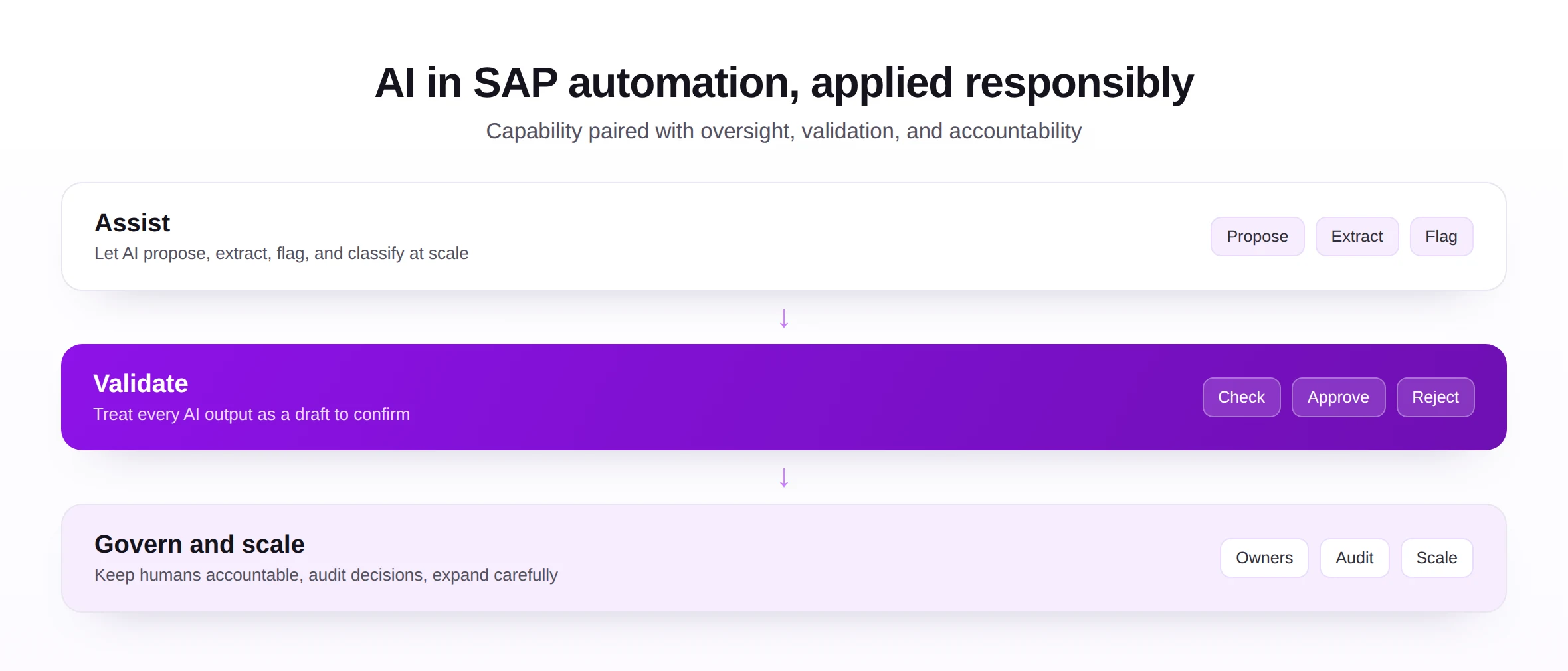
Three principles run throughout. AI proposes, accelerates, and flags, while people decide and own the consequential action. Every AI output is a draft to be validated, not a fact to be trusted. And AI adopted without governance scales risk as fast as it scales benefit, so guardrails come first, not last.
For leadership, the message is that AI rewards deliberate adoption. Choose contained, low-risk applications, validate their output, keep humans accountable, and expand only where value is proven. This guide deepens the realistic view set out in the AI in SAP automation article and connects to the process automation pillar.
This resource serves several readers at once. A director can take the executive summary, the adoption maturity model, and the action plan and have enough to sponsor an AI initiative responsibly. An architect will work through the application framework and the opportunities-and-limitations view. A process owner will focus on the applications that touch their area. The structure lets each reader take what they need without wading through the rest.
It is written to stay useful as the technology moves. Specific models and features will change quickly, but the principles, assistance under oversight, validation of output, accountability for action, describe how to use AI responsibly regardless of which model is in front of you. Those principles should outlast any particular release.
The central stance is deliberate adoption. The opposite of reckless AI is not avoidance but discipline, and an organization that engages thoughtfully captures the benefits while sidestepping the failures that befall those who either rush in or refuse to start.
Why this topic matters
AI is entering SAP work whether or not an organization plans for it. The choice is not whether to engage, but whether to do so deliberately and safely.
Business impact
Applied well, AI removes tedious, pattern-heavy effort from skilled people, letting them concentrate on judgement and exceptions. The business gains speed and capacity without losing control. Applied poorly, the same technology produces confident errors at scale, and the cost of unwinding them can exceed any efficiency it offered.
There is also a competitive dimension. As AI-assisted ways of working become normal, organizations that adopt them thoughtfully gain an edge, while those that either ignore AI or adopt it recklessly fall behind in different ways. A deliberate approach captures the upside while avoiding the recklessness.
Governance impact
AI raises sharp governance questions. An AI suggestion that posts to SAP unchecked is an unaccountable change; an AI whose reasoning cannot be explained is hard to audit. Deciding in advance where AI may act and where a person must approve is therefore a governance decision before it is a technical one, and it connects to master data governance.
Operational impact
Operationally, AI works best as a layer over disciplined processes, not as a substitute for them. AI applied to a clean, well-governed workflow makes a good process faster; AI applied to a chaotic one accelerates the chaos. The operational precondition for AI is therefore the same discipline that good automation always required.
SAP-specific impact
In SAP, AI meets shared, consequential data and strict controls. A misclassified material or a wrongly extracted invoice field propagates across many transactions, and authorizations constrain what any actor, human or automated, may do. These realities make validation and governance non-negotiable, and they shape every practical application described here.
These impacts tend to compound. A confident error that goes unchecked becomes a wrong posting, which becomes a flawed report, which becomes a poor decision, all at the speed AI operates. Because consequences chain together quickly, the value of validation is not merely catching one mistake but breaking the chain before it forms.
It is worth repeating that AI is a layer, not a foundation. It sits on top of processes and data, amplifying whatever it finds, so its benefit is proportional to the discipline beneath it. Organizations that strengthen their processes and data first find AI a multiplier; those that hope AI will compensate for weak foundations are usually disappointed.
The competitive angle, finally, rewards neither the earliest nor the most cautious adopter but the most disciplined one. Being first to use AI recklessly is no advantage if it produces errors that must be unwound, and being last is no virtue if rivals are working faster. Thoughtful adoption is the position that actually compounds.
It also helps to set expectations about pace. AI adoption in SAP is best measured in deliberate steps rather than dramatic leaps, and the organizations that progress furthest are usually those that resisted the urge to do everything at once. Patience here is not timidity; it is the method.
One more orientation: this guide concentrates on data-centric SAP work, the creation, validation, mapping, and posting of records, because that is where AI most directly meets the data enterprise teams manage daily. The principles extend to other AI uses, but the examples stay close to the SAP data tasks where the stakes and the guardrails are clearest.
Read end to end, it offers a complete and defensible approach to bringing AI into SAP data work without surrendering control.
Core concepts and practical use cases
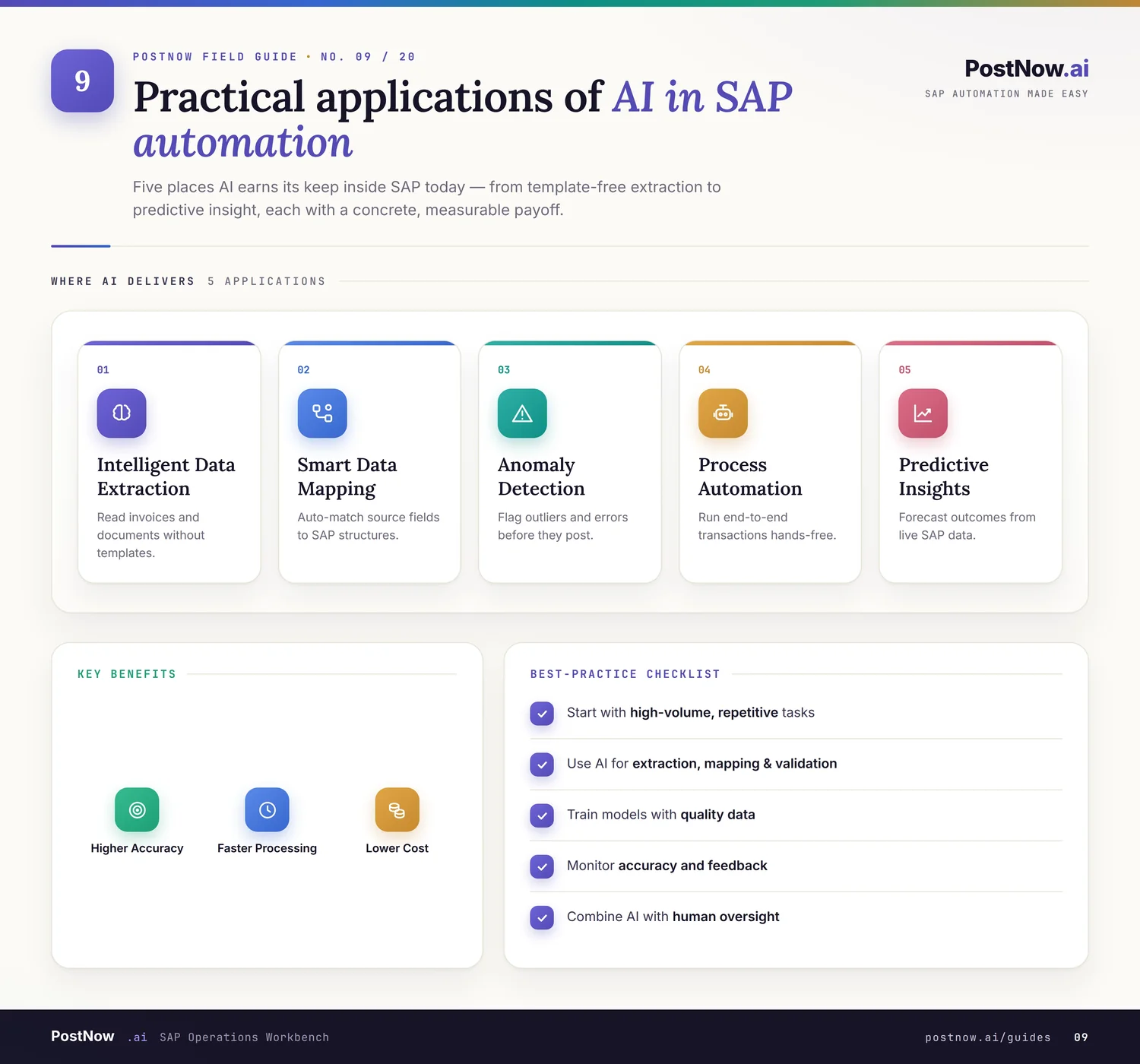
Stripped of marketing, AI in SAP appears in a set of concrete, valuable applications, each with a person still in charge.
Before the applications, two terms anchor the discussion. Assistance means AI proposes, extracts, flags, or classifies, while a person decides and owns the result. Autonomy means AI acts without that human step, which the framework reserves for only the lowest-risk, fully reversible cases. The distinction governs every application below.
Assisted validation and anomaly detection
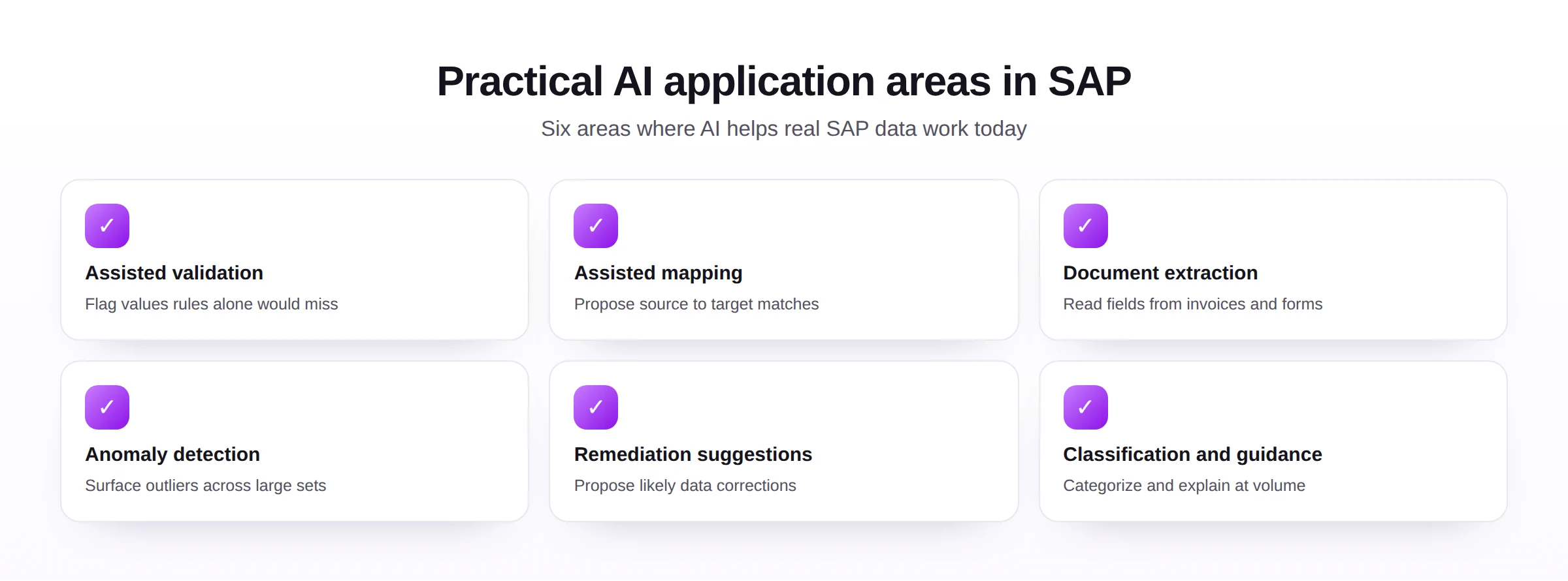
AI can flag values that look wrong in ways fixed rules would miss, and surface outliers across data sets too large to scan, such as a likely duplicate vendor or an unusual posting. It adds a layer of pattern-based judgement, but a person still defines which patterns matter and decides what to do about each flag.
Assisted mapping and document extraction
During uploads and migrations, AI can propose how source fields map to SAP fields, turning slow manual matching into a review of suggestions. It can also read fields from documents such as invoices, extracting structured data from unstructured input. In both, the output is a draft an owner approves, not a decision the tool makes.
Remediation, classification, and guidance
AI can suggest likely corrections for poor data, propose classifications for materials or accounts, and explain steps or options to users in plain language. These applications speed routine cognitive work, while accountability for any change posted to SAP remains firmly with a person.
Selecting the right first applications is a skill in itself. The best early candidates share three traits: an error would be inexpensive, the output can be checked against an objective standard, and the task is genuinely tedious for people. Applications with these traits let an organization learn how AI behaves before trusting it with anything consequential.
Reversibility deserves particular weight in that selection. An AI suggestion a person reviews before posting is fully reversible, because nothing happens without approval; an AI action that writes directly to SAP is not. Favoring reversible applications early is how an organization gains experience without risking the data it depends on.
The line between assistance and autonomy is therefore the most important design decision in any AI application. Drawn correctly, it places AI on the laborious, patternable side and people on the accountable, judgement side, which is both the safer and the more durable arrangement for consequential SAP work.
A useful habit is to describe each proposed application in a single sentence of the form: AI will do this, and a named person will own that. If that sentence cannot be written clearly, the application is not yet ready, because the division of responsibility has not been thought through.
It bears repeating that responsible adoption is not slower adoption in disguise. Well-chosen guardrails rarely add meaningful friction to a low-risk application, and they save enormous effort on the rare occasion something goes wrong. The discipline pays for itself precisely because the cost of an unguarded error is so asymmetric.
The AI application framework
Across every application, the same pattern holds: AI does the legwork, a person owns the decision. The framework makes that pattern explicit and safe.
The framework rests on a single organizing principle, the division of labor between machine and person. AI is assigned the work it does well, proposing, extracting, surfacing, and classifying at scale, and people retain the work AI does poorly, defining what matters, judging significance, approving change, and being accountable. Designing each application around this division is what makes AI both useful and safe.
Layered on that principle are three controls that apply to every application. First, a human in the loop for any consequential action, so that nothing irreversible happens without approval. Second, validation of every output, treating it as a draft to be checked against SAP rules. Third, an audit trail recording what AI proposed and who approved it, so the process is reviewable. These controls are explored further in the AI in SAP automation article.
The framework deliberately does not chase autonomy. The aim is not to remove people from SAP work but to make skilled people faster and more confident, which is both the safer and, in practice, the more valuable outcome for consequential enterprise data.
| Application | AI does | The person does |
|---|---|---|
| Validation | Flags suspect values | Defines rules, decides on flags |
| Mapping | Proposes field matches | Approves and owns the mapping |
| Document extraction | Reads fields from documents | Confirms the extracted data |
| Anomaly detection | Surfaces outliers | Judges which matter |
| Remediation | Suggests corrections | Approves the change |
The three controls are deliberately simple, because simple controls are the ones that survive daily use. A human in the loop, validation of output, and an audit trail are not exotic safeguards; they are the same precautions any organization would place around a fast but fallible new contributor. Their power lies in being applied consistently rather than in being sophisticated.
The controls also reinforce one another. Validation generates the record that the audit trail captures; the audit trail makes the human approval meaningful; the human approval is what validation exists to inform. Adopting them as a set, rather than picking one or two, is what turns an uncertain tool into a trustworthy part of the process.
It is worth being explicit that the framework does not aspire to remove people. The goal is leverage, not replacement: skilled people doing more, faster, with AI handling the drudgery around their judgement. An approach that quietly aims at autonomy for consequential actions has misunderstood both the technology's limits and the organization's need for accountability.
Locating yourself honestly on the maturity model matters more than reaching any particular level. An organization at the assisted level that believes itself governed will scale risk it cannot see, while one that knows it is experimenting will keep its trials safely contained. The model's value is the honesty it invites, not the label it assigns.
The framework is intentionally tool-agnostic. Whichever AI capability an enterprise uses, the same division of labor and the same three controls apply, which means the approach remains valid as vendors and models change. Betting on the principles rather than on a particular product is what keeps it durable.
The AI adoption maturity model
Responsible AI adoption is a journey, not a switch. The maturity model describes that journey and helps an organization locate itself honestly.
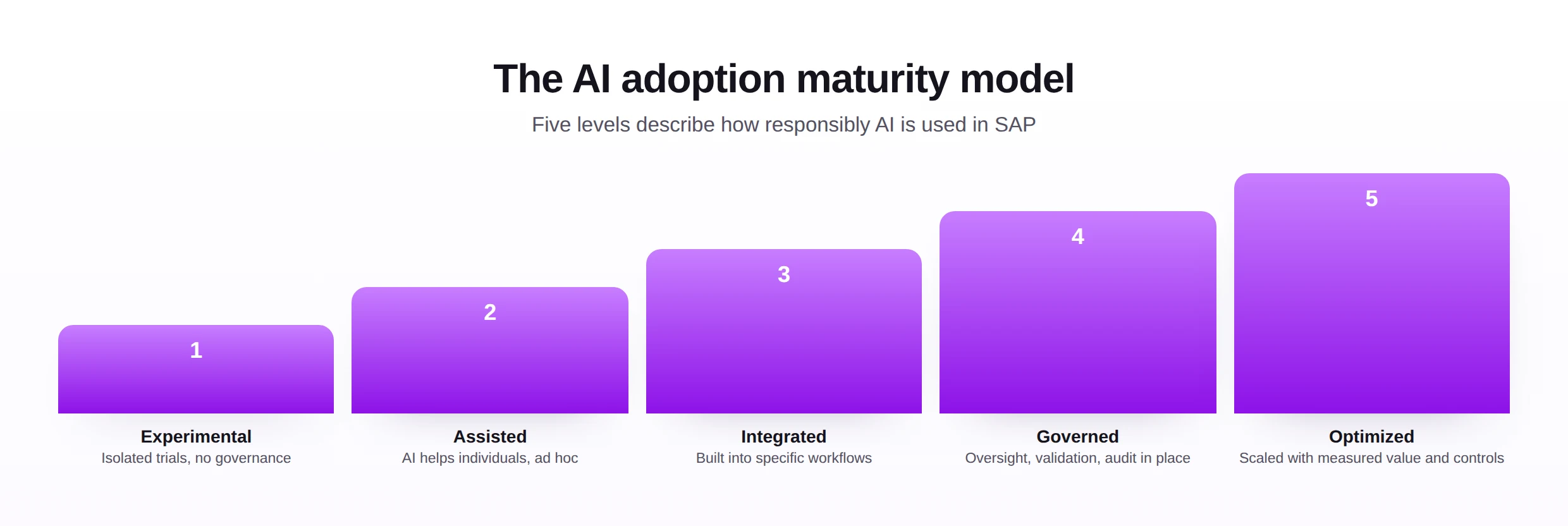
At the experimental level, AI is used in isolated trials without governance; at the optimized level, it is scaled across workflows with measured value and full controls. The intermediate levels, assisted, integrated, and governed, mark the path from individual experimentation to enterprise capability. Knowing your level prevents both timidity and over-reach.
The opportunities and limitations of AI also deserve a clear-eyed view, because adoption decisions rest on it. The infographic below contrasts what AI genuinely offers in each area with where people remain essential, giving leadership a balanced basis for deciding where to apply it.
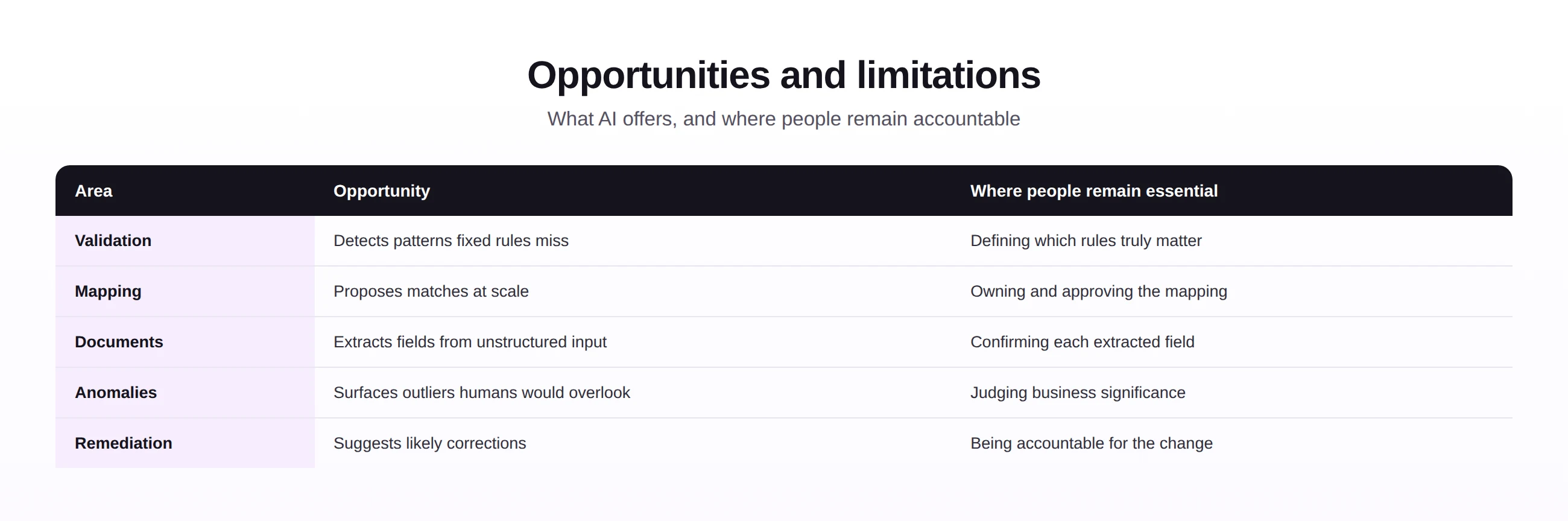
Reading the table honestly is itself a discipline. The opportunity column is encouraging and easy to dwell on; the column naming where people remain essential is what keeps adoption safe and is the one most often forgotten in a demonstration. Both are equally real, and a mature organization plans around both.
| Adoption level | What it looks like |
|---|---|
| 1 Experimental | Curiosity-driven trials with no controls. |
| 2 Assisted | Individuals use AI ad hoc to speed their work. |
| 3 Integrated | AI is built into specific, chosen workflows. |
| 4 Governed | Oversight, validation, and audit are in place. |
| 5 Optimized | AI is scaled with proven value and strong controls. |
Reading the opportunities and limitations together prevents two opposite errors. Dwelling only on opportunities produces over-reach, applying AI where it cannot yet be trusted; dwelling only on limitations produces paralysis, missing genuine value out of caution. A balanced view, holding both columns in mind, is what supports sound adoption decisions.
The adoption levels are not a race to be won quickly. Moving from experimental to governed deliberately, proving each step, builds the organizational habits, validation, ownership, audit, that make the higher levels safe. An organization that skips ahead, scaling before it has governed, tends to discover at volume the problems it would have caught in a pilot.
It is worth noting that maturity in AI adoption is closely tied to maturity in data and governance. An organization with strong data quality and clear ownership can adopt AI faster and more safely, because the foundations AI depends on are already in place. Progress in AI and progress in data discipline tend to advance together.
Adoption roadmap
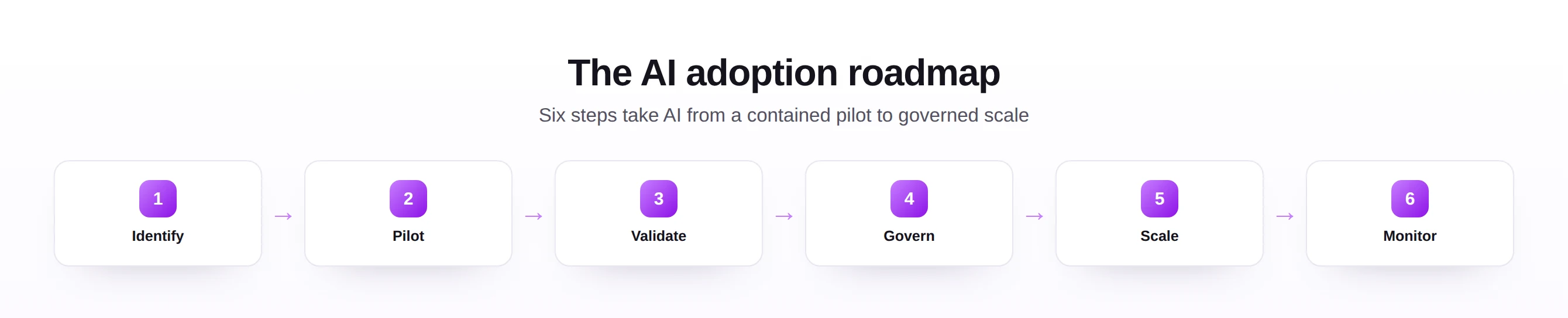
This roadmap takes AI from a contained pilot to governed scale, with planning, execution, governance, monitoring, and improvement built in.
Planning: identify and pilot
Begin by identifying applications where an AI error would be cheap and easy to catch, such as suggesting mappings a person will review anyway. Pilot these in a contained setting, with clear success criteria and an honest measure of whether AI actually helped. The output of planning is evidence, not enthusiasm.
Execution: validate and govern
For applications that prove their value, put validation and governance in place before widening use: confirm every output, keep a named owner accountable, and record what AI proposed and who approved it. This is where adoption becomes safe to scale, drawing on disciplined data entry such as Excel to SAP automation.
Scaling and monitoring
Scale gradually, extending AI to further applications only as each earns trust, and monitor outcomes against the value the pilot promised. Continuous improvement refines prompts, rules, and guardrails over time, and re-checks that the human oversight remains genuine rather than a rubber stamp.
A pilot earns its keep through honest measurement, not through enthusiasm for the technology. The question a pilot answers is narrow and practical: did AI make this task faster or better without introducing errors that cost more than it saved. Designing pilots to answer that question, with clear criteria agreed in advance, is what keeps adoption grounded in evidence.
Protecting the genuineness of oversight is a subtle but vital discipline. As AI proves reliable on a task, the temptation to wave its output through grows, and review can decay into a formality precisely when a rare error would do the most harm. Periodically checking that approvals are real, not reflexive, keeps the human in the loop actually in the loop.
Monitoring after scaling should watch two things at once: whether AI is still delivering the value the pilot promised, and whether the human oversight remains genuine. Either can erode quietly, and only deliberate monitoring catches the erosion before it becomes a problem in production.
Best practices
A set of disciplines lets an enterprise capture AI's benefits while keeping SAP safe and auditable.
- Validate every AI output, treating it as a suggestion to confirm rather than a result to accept.
- Keep a named person accountable for any action AI helps perform, so responsibility never rests with a tool.
- Audit each AI-assisted action, keeping a record of the suggestion and the person who approved it, anchored in master data governance.
- Feed AI good data, since the quality of input governs the worth of its suggestions, supported by data quality discipline.
- Start low-risk and scale on evidence, proving value on reversible tasks before widening AI's role.
- Protect the oversight, guarding against the drift where review quietly becomes a formality.
These practices place governance, validation, security, auditability, scalability, and maintainability ahead of novelty. Adopted together, they let AI strengthen an automation practice that is already disciplined, rather than papering over one that is not.
These practices interlock into a coherent posture rather than standing alone. Validation depends on good data; accountability depends on the audit trail; safe scaling depends on the evidence pilots produce; protected oversight depends on all of them being genuine. An organization that adopts them as a connected discipline gains far more than one that picks a convenient few.
They should also be applied in proportion to risk. An AI suggestion in a sandbox needs little ceremony; an AI-assisted financial posting needs the full apparatus of validation, ownership, and audit. Matching the rigor to the consequence keeps the discipline credible and prevents it from being resented where it is least needed.
Underlying all of these practices is a simple test for any AI application: if it went wrong, would the organization notice, and would someone be accountable. An application that passes both halves of that test is safe to pursue; one that fails either is not yet ready, however promising it appears.
Common challenges
Adopting AI in SAP raises real challenges that deserve honest treatment rather than either dismissal or alarm.
Confident errors
The root cause is that AI can present a wrong answer as fluently as a right one. The risk is that plausible output is accepted without scrutiny. The mitigation is mandatory validation of every output against SAP rules, so fluency never substitutes for correctness.
Over-trust and oversight drift
The root cause is that fluent, fast output invites belief, and repeated good results erode the habit of checking. The risk is that human oversight quietly becomes a rubber stamp. The mitigation is to build review into the process structurally and to monitor that it remains genuine.
Limited explainability
The root cause is that some AI suggestions are hard to justify in detail. The risk is difficulty auditing or defending an AI-influenced decision. The mitigation is to favor applications where the output can be checked against an objective standard, and to record the human approval that carries accountability.
Dependence on data quality
The root cause is that AI trained or prompted on poor data inherits its flaws. The risk is suggestions that are confidently wrong because the inputs were. The mitigation is to apply AI within a sound data quality discipline, so its raw material is trustworthy.
Unclear accountability
The root cause is uncertainty about who owns an AI-assisted action that goes wrong. The risk is a governance gap precisely where stakes are high. The mitigation is to name an accountable owner for every application, so responsibility is always assigned.
These challenges share a reassuring quality: each is manageable with process rather than requiring some breakthrough in the technology. Confident errors are caught by validation, over-trust by structural review, accountability gaps by named ownership. None of them is a reason to avoid AI; each is simply a condition to design around when adopting it.
Most of these challenges also signal themselves early to an organization that is watching. A pilot reveals how often AI errs and how fluent its mistakes are; a review process reveals whether oversight is holding. Treating the pilot as a chance to study these failure modes, rather than only to prove value, turns the challenges into knowledge before they become incidents.
It is also worth distinguishing the limitations inherent to current AI from those that are merely a matter of immature adoption. Confident error is inherent and must be managed by validation; unclear accountability is self-imposed and can be eliminated by assigning owners. Knowing which is which directs effort where it can actually change the outcome.
Common mistakes
The mistakes below come almost entirely from granting AI more authority than its reliability warrants.
Each is avoided by the same stance the framework embodies: AI assists, people decide, every output is validated, and every application has an owner and an audit trail. The mistakes are, in effect, what happens when one of those elements is dropped under the pressure to move fast.
Preventing these mistakes is largely a matter of making the framework the default. When validation, ownership, and audit are simply how AI is used in the organization, each mistake corresponds to a control someone would have to deliberately bypass. Building the discipline into the standard way of working is more reliable than trusting individuals to resist shortcuts under pressure.
The unifying principle behind every mistake is mismatched trust. The remedy is never to distrust AI entirely, nor to trust it wholesale, but to calibrate: generous trust for low-stakes, reversible suggestions, and far more reserved trust for anything that changes SAP without review. Matching the level of trust to the stakes of the task is the whole discipline in miniature.
A practical safeguard is to keep a simple inventory of where AI is used, what it does, who owns it, and how its output is validated. As AI spreads through an organization, this inventory is what prevents quiet, ungoverned uses from accumulating outside anyone's view.
Future trends
AI's role in SAP will grow, but the responsible pattern of assistance under oversight is likely to endure.
- More capable assistance, handling larger and more varied tasks with less prompting.
- Deeper integration, as AI capabilities are embedded inside SAP processes and the tools around them.
- Better explainability, as systems are expected to justify their suggestions for audit.
- Guardrails by design, with approval and audit built into AI features rather than added later.
- Formal accountability standards, as enterprises codify who owns AI-assisted actions and how.
The likeliest future is not autonomous AI running SAP unsupervised, but increasingly capable AI making skilled people faster within strong controls. The organizations that benefit most will be those that build the governance and adoption discipline now, so they can absorb new capability safely as it arrives.
These trends shift where human effort is most valuable rather than removing it. As assistance grows more capable, the scarce skill moves from doing the routine work to framing the problem, judging the output, and owning the result, which is exactly where experienced SAP people already excel. The framework is designed to keep people firmly in that higher-value role.
Enterprises should therefore treat advancing AI as an accelerator within the framework rather than a reason to relax it. More capable models make the assistance better and the validation cheaper, but they do not change who is accountable or what good output looks like. Read this way, the framework grows more useful as the technology improves, not less.
Action plan
This step-by-step plan lets an enterprise begin adopting AI in SAP deliberately and safely.
- Pick a low-risk application, such as assisted mapping or validation, where errors are cheap and easily caught.
- Define success and guardrails before piloting, including how output will be validated and who owns it.
- Run a contained pilot and measure honestly whether AI actually helped.
- Put validation in place, treating every AI output as a draft to confirm against SAP rules.
- Assign accountable owners and record what AI proposed and who approved it.
- Govern and document, connecting the application to your wider data governance.
- Scale on evidence, extending AI to further applications only as each proves its value.
- Monitor outcomes and oversight, confirming both the value and the human review remain genuine.
Followed in order, this plan yields AI adoption that is fast where it is safe, cautious where it is consequential, and accountable throughout.
A closing word on starting. The most common adoption error is to begin with the most ambitious application, where stakes are high and trust is unearned. The disciplined alternative is to begin small, on a reversible task, and let proven success expand the appetite for more. Early, safe wins build both the capability and the confidence that responsible scaling requires.
Over time, this approach leaves an organization with something more valuable than any single automation: a tested judgement about where AI helps, a set of working guardrails, and a record of what it proposed and how people decided. That accumulated experience is what lets an enterprise adopt each new AI capability quickly and safely, because it already knows how to govern it.